

Author of a new book, "The Dangerous Covenant"
Who is a Jew in the Jewish State?
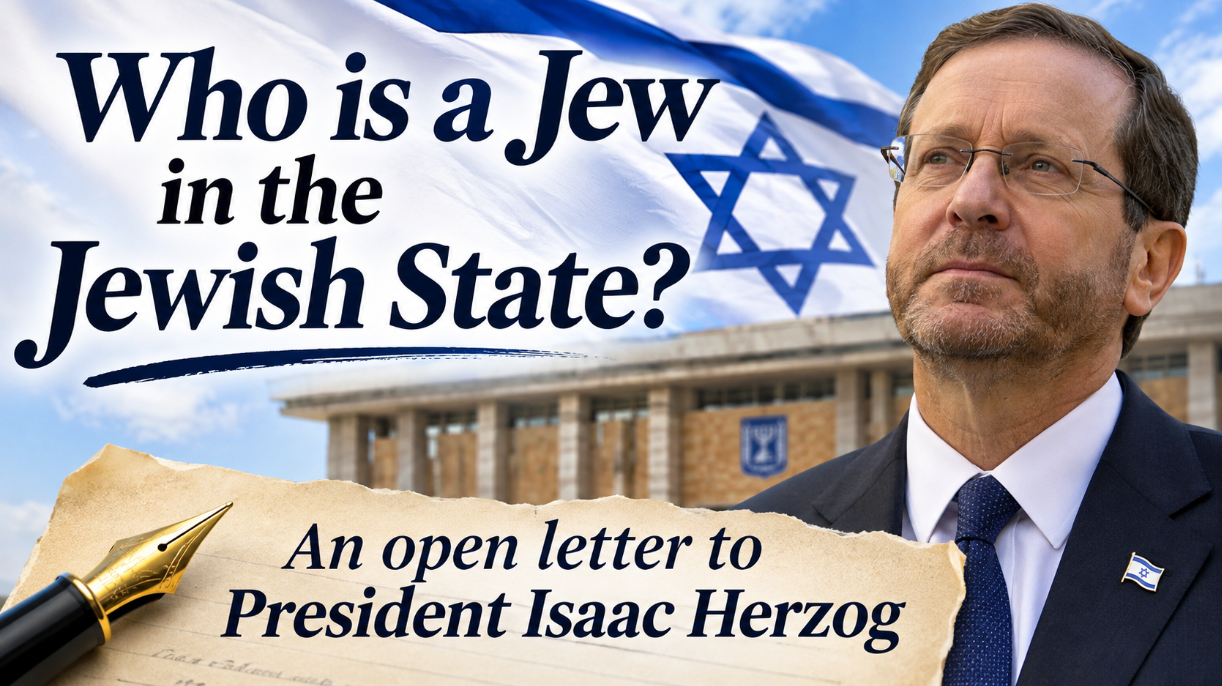
An open letter to President Isaac Herzog
Picture a Jewish man who survived the destruction of Polish Jewry. He reaches Israel, loses himself in building a country, and starts a new life with a Polish woman who shared his fate. A son is born. At the registry office, the father says: “This is my son. I am a Jew. I want my son to belong to my people.” His wife agrees.
The clerk answers: “You are a Jew. Your son is not.”
Why? Because the boy’s mother is not Jewish.
Mr. President, this scene was real in the 1950s, and it is still real today, repeated in a great many families. Nearly eighty years after the founding of the Jewish state, Israel has not given a clear answer of its own to the most basic question a Jewish state can be asked: who is a Jew?
Ben-Gurion’s question
In the fall of 1958, David Ben-Gurion faced exactly this problem. Jews were arriving from Europe, Asia, and Africa, many of them Polish Holocaust survivors who had lost nearly everyone. Some had married non-Jewish women. They wanted their children recorded as Jews.
Ben-Gurion wrote to some fifty Jewish scholars, rabbis, and public figures around the world. How, he asked, should the Jewish state register a child of a Jewish father and a non-Jewish mother when both parents want the child recorded as a Jew? He did not ask whether to abolish the Torah or forbid rabbis to keep halakha. He asked how a Jewish state should act.
Among those he addressed was the Lubavitcher Rebbe, Menachem Mendel Schneerson. In 1959 the Rebbe answered, and his answer was no. Jewish status comes from birth to a Jewish mother or from conversion according to halakha. The wish of the parents cannot change it, he wrote.
I have the deepest respect for what Chabad did, and is still doing, after the Holocaust and after decades of Soviet persecution of religion. Its emissaries went where others would not go, and they brought countless Jews back to their people. “Every Jew matters” is a beautiful principle. But I want to ask the rabbis who hold the commonly accepted definition of a Jew: are you not afraid of continuing to treat the children of such marriages as orphans, fatherless from birth?
The contradiction
By what many call the matrilineal rule, a man whose maternal line is unbroken for many generations is a Jew, even if all his forebears wore crosses, practiced Christianity, and wanted to know nothing of Judaism. But a man whose father is Jewish, who speaks Hebrew, loves Israel, knows Jewish history, and dies defending the Jewish state has been buried outside the cemetery fence, if his mother is not Jewish. That is what happened to Sgt. Lev Pesachov, killed by terrorists in 1993 and buried beyond the fence of the military cemetery in Beit She’an. Today the IDF no longer puts them beyond the fence but the situation is no less shamless. According to a 2020 report, the compromise between the Defense Ministry and the chief military rabbi places them in the same row as their comrades, but… about eight inches deeper.
Let’s recall Oswald Rufeisen, Brother Daniel. Born a Jew in Poland, he converted to Catholicism during the Holocaust and became a Carmelite monk. When he later came to Israel and demanded recognition as a Jew under the Law of Return, Israel’s Supreme Court refused him in 1962: conversion to another religion excludes a person from the law’s definition. Yet by traditional halakha, Brother Daniel remained a Jew. That he wore a cross and held Jesus to be God did not remove him from being a Jew in the eyes of Orthodoxy.
Israel’s own law half-acknowledges the absurdity. The Law of Return grants the right of immigration not only to those who meet the Orthodox definition but also to the children and grandchildren of Jews. A person can come to Israel because his or her father is Jewish, receive citizenship, and serve in the army, but cannot marry there as a Jew, because personal status is in the hands of the Rabbinate. In effect we tell such a person: you are connected enough to the Jewish people to be a citizen here, to fight for the Jewish state, and to die for it if necessary, but not connected enough for us to call you one of us.
What the Bible says
Those who most fervently defend this rule point to the Torah as supposedly seconding their position. So let us see what the Torah really says.
The Bible traces the people of Israel almost entirely through fathers. Abraham, Isaac, Jacob, and the twelve sons of Jacob. Joseph married Asenath, daughter of an Egyptian priest, and their sons, Ephraim and Manasseh, became two tribes of Israel. Moses married Zipporah, a Midianite. No one ever suggested that their sons were not Israelites. Rabbinic tradition has its own explanations for these cases, but tribal membership in Israel was passed through the father, whoever the mother was, and it is still passed that way today.
The matrilineal rule enters step by step through the Mishnah and Talmud and was finally codified in the Shulchan Arukh in the sixteenth century. Defenders of the rule normally point to Deuteronomy 7:3-4. The key text, however, is Talmud Kiddushin 68b, edited in late antiquity and which clearly states that the child of a non-Jewish mother and Jewish father is not called his father’s child, thus declaring the child a halakhic orphan.
In doing so, the authors of this rule overlooked the terrible punishment the Torah promises for afflicting orphans. “You shall not afflict any widow or orphan,” says the Torah in Exodus 22:21, and the “you” is plural. It addresses us as a people, not as individuals. And the punishment it names is death by the sword for our men, our wives made widows and our children orphans.
Current halakha, however, deliberately declares children orphans even when their Jewish fathers are alive and love them.
Why exactly the rule was made is not clear. Possibly it was meant to protect legal wives and their children from competition. Possibly, as in American South, where a child’s legal status followed the mother’s until abolition of the slavery there, it was there to allow father to sell his children. Today many of its defenders insist it was meant to protect our people against assimilation. I don’t know. I only know that the road to hell is very often paved with the greatest of intentions.
Whatever the reason, the rule overlooked not only Exodus 22 but also Deuteronomy 24:16, which says plainly that children are not to be punished for the acts of their fathers. A child does not choose his parents. He does not choose whom his father marries. He is simply born. Why should the circumstances of his parents’ marriage exclude him from his father’s people and leave him fatherless?
“This is no punishment,” the Orthodox rabbis declare. “It is simply a determination of religious status.” But when a child is told “you are not a Jew,” the second half of the answer which remains unspoken is: “because we do not recognize your father as your father.”
The half-measure
For a variety of non-halakhic reasons, American Reform and Reconstructionist Judaism took important steps in this area. In 1983 the Central Conference of American Rabbis resolved that a child of one Jewish parent is presumed to be of Jewish descent, a presumption confirmed by appropriate public acts of identification with the Jewish faith and people.
To some it may look acceptable but not to me because it hides a real inequality that favors the children of Jewish mothers. Reform rabbis don’t demand a bar mitzvah certificate, synagogue attendance, or Shabbat observance from the child of a Jewish mother as a condition of acknowledging his Jewish status. The child of a Jewish father and a non-Jewish mother, however, is told to demonstrate his Jewishness publicly. Why? Because his mother is not Jewish?
In the Soviet Union, where I grew up, such a condition would have been impossible to meet. There were no Jewish schools, and going to one of the few remaining synagogues risked the attention of the state security organs for a young man. Had Jewishness there depended on public acts of religious identification, Soviet Jewry would have been written out of the Jewish people. Our identity survived not because of public performance of Jewish rituals but in spite of a state that tried to destroy Jewish religious life. And that state knew exactly who was a Jew: it was in the fifth line of the passport, or, if the father was Jewish, in a person’s obviously Jewish family name, not in any “public acts of Jewish identification.”
A proposal for Voice of the People
Mr. President, you launched Voice of the People to invite Jews of every country, tradition, and political view to discuss our common future. I welcome it. But to unite the Jewish people, should we not determine whom we are uniting? Only those the Orthodox Rabbinate recognizes, or all the children of Israel, whether through mother or father?
I have written to you and to the initiative’s leadership proposing that it take up the question Ben-Gurion put in 1958. I am not asking you to change halakha by decree. Freedom of religion must protect the right of observant Jews to hold the traditional definition. But freedom of religion does not give any Jewish movement the exclusive right to define the boundaries of the Jewish people. The Jewish people existed before the Talmud and before the medieval codes. We do not exist by permission of the Israeli Rabbinate which has its definition of who is a Jew.
The time has come for the Jewish state to clearly state its definition.
Mr. President, ask Voice of the People to convene a working group of historians, scholars of Torah and halakha, rabbis of different streams, demographers, jurists, and members of the families directly affected. Let them examine the history of the matrilineal rule, the biblical genealogies, Israeli law, and the situation of Jewish descendants in the Diaspora. And let them answer one question: can the Jewish people recognize all its descendants without first demanding proof that they are worthy of being their parents’ children?
If Israel is to remain the state of the whole Jewish people, it has to define belonging to that people not only for the purposes of Aliyah and citizenship, but also for the purpose of the Jewish marriage, burial, national identity, and historical continuity.
In 1958, Ben-Gurion put this question to Jewish religious authorities. Today, nearly seventy years later, you have the chance to put it to the entire Jewish people, and to find the answer he never received. For in the end, the question is not only who is a Jew under religious law. It is whether the Jewish people and their state are ready to acknowledge their own children, and to stop treating the children of Jewish fathers as orphans and strangers to their fathers and to our people.
Alexander Gendler is a writer, publisher, and host of Chicago Jewish Café. He is the author of The Dangerous Covenant: The Jewish Question and the Destiny of Humanity.