

Who is Running the Show?
The fact that the Jewish people are still here, and stronger than ever, is a puzzle to most of the world. Alistair Heath, the Editor of the Daily Telegraph in London and one of the most respected voices in British journalism, recently tackled this mystery. He looked at the situation not through the lens of religion, but through cold facts, politics, and economics.
He noticed a massive contradiction: a tiny, ancient nation is simply not supposed to be this powerful. By every normal rule of history, a people scattered for 2,000 years, returning to a dry desert with no natural resources, should have struggled just to subsist. Instead, they lead the pack in medicine, farming, and high-tech defense. Heath reached a conclusion that shakes up the secular mind. He wrote:
“If the survival of Israel is not just impressive—but perhaps also Divine—everything changes… then perhaps G-d is not a myth. Perhaps He is still part of the story. Perhaps history is not accidental.”
This insight is the core of our Torah portion, Vayakhel. The portion begins with the command “Vayakhel Moshe”—and Moses gathered the people. This wasn’t just a meeting; it was a strategy. After a national crisis, the path forward wasn’t found in a few “smart” individuals working alone, but in the power of the group coming together.
In the natural world, a small group is easy to crush. But the Torah teaches that when we gather with a shared purpose, we become a single unit that is much stronger than our actual size. We don’t lead the world because of our population numbers, but because the Director [G-d] acts through a united people. When we are bound together, we have a strength that defies the “logic” of the nations of the world.
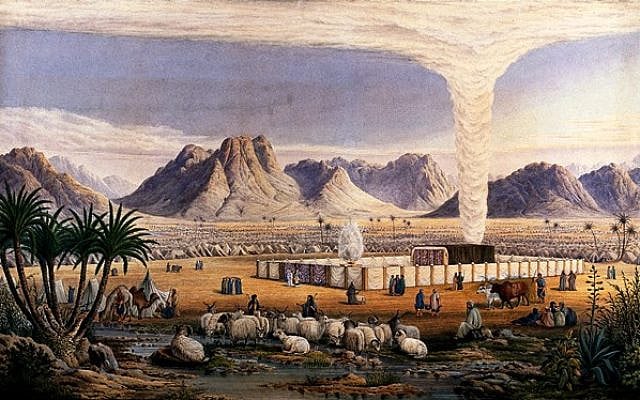
We see this clearly in how the Torah describes the builders of the Mishkan (Tabernacle). They are called Chacham Lev, “Wise of Heart.” This is a unique Jewish concept. It suggests that wisdom isn’t just a high IQ or technical training; it is a specific skill given to us by a higher source to fulfill a mission.
Most of the world uses wisdom for personal power or money, but “Wise of Heart” means using your brain to build a home for the Truth. This explains why we are the ones “producing water from the air” or turning barren deserts into green fields. It is the Director [G-d] providing the modern-day “Manna”—innovation and breakthroughs—exactly when we need it to finish our job. We lead in technology because our wisdom is tied to our heart—our duty to protect life and show the world that there is a Master in charge of the house.
The most striking evidence, however, is what Heath calls our “Monday morning” strength—the sheer resilience to get up and build a world-class economy from the ashes of tragedy. But the Torah adds a vital detail: before a single gold ring was made for the Mishkan, Moses stopped the work for Shabbos.
This is the ultimate proof. By stopping our work one day a week, we show the world that we are not the ones actually running the show. The world is often “rattled” by us because it wants to believe in a world of random accidents and human power alone. A thriving, Sabbath-keeping Jewish people makes that belief impossible. Our existence is the proof that the Director [G-d] is keeping His promises “in the quiet,” behind the scenes of every news cycle.
We survive because we are following a set path marked out for us since the beginning of time. Our success isn’t an accident, and it isn’t just because we are “smart.” Our only job is to stay united, use our skills to help the community, and—most importantly—remember Who is running the world and go in His way.