Founder of The Abraham Peace Gate
Who Is The Traitor, The Government or The Extremists Who Accuse It In Morocco?
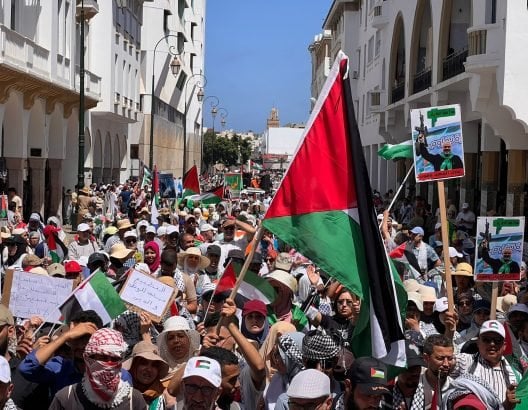
Pro-Palestinian demonstrations in Morocco. Photo: social media
Almost every weekend, Morocco’s major cities become the scene of massive demonstrations in support of the Palestinian cause. Among the slogans, some directly target the state, branding it a traitor. I have been observing this dynamic for years with a feeling combining perplexity and deep concern, and it seems crucial to analyse its underlying mechanics.
Thirty-five or 40 years ago, during my youth in Tangier, wearing the veil in public spaces remained marginal, mostly the custom of elderly women, and sparked no debate. Today, the situation has completely reversed in many neighbourhoods. Far be it from me to judge individual clothing choices; I mention this fact because it constitutes the most visible marker of a profound societal mutation observed over three decades.
During this period, Morocco’s population growth has been meteoric, while the reduction of poverty and illiteracy has not followed the same trajectory. In absolute terms, the country now has more individuals in precarious situations and deprived of basic education than 30 years ago, despite more flattering official statistics. This shift has fostered increased conservatism within society, moving the centre of gravity of public concerns toward issues disconnected from local realities.
The roots of this evolution are structural. In the early 1970s, after surviving two coup attempts, King Hassan II reoriented the country’s trajectory. While Morocco was engaging in modernisation and a gradual opening to the West, the government made a traditional turn, perceived as a lever for control and social cohesion. The aggressive Arabization of education in the 1980s, combined with Europe’s rejection of Morocco’s candidacy to the European Community in 1987, anchored this direction, leaving the field open to foreign ideological influences.
This cultural penetration accelerated in the 1990s with the advent of satellite television, conveying a dogmatic worldview from the Gulf and the Middle East. This soft power was accompanied by funding and rigid religious proselytism. Concurrently, the national education system weakened, foreign language teaching declined, and Amazigh history, a fundamental component of Moroccan identity, was erased from school curricula. As I noted back in 2017 in Mundiario and more extensively last year, an uprooted generation found a ready-made identity on its screens: that of a global ummah united by permanent grievances.
An additional, more recent migratory phenomenon has grafted itself onto this foundation. For the past 15 years, Morocco has welcomed populations fleeing conflicts in the Levant. While this humanitarian or entrepreneurial drive is legitimate, it is clear that certain profiles, settled within the local economic fabric, exploit digital spaces to transpose foreign political agendas and conflicts onto Moroccan soil. Although these are small circles, these networks constitute effective vectors for ideological diffusion. Morocco must pair hospitality with rigorous vigilance at its borders regarding the profile and motives of new residents.
Furthermore, academic research, notably a study from the Third World Quarterly, has highlighted the emergence of an organised Shia presence in Tangier, structured around figures such as Kamal al-Ghazali and Isam Hmaidan. The fact that Rabat broke diplomatic relations with Tehran in 2009, and again in 2018 over allegations of proselytism and interference in the Western Sahara issue, proves that the Kingdom’s vulnerability to foreign religious and political interference is not an illusion.
On the domestic front, we are witnessing the emergence of digital opportunism. Moroccan content creators exploit the Palestinian theme for audience reach, without regard for the strategic interests of the nation. On a larger scale, the Justice and Development Party (PJD), along with structures like the Moroccan Front for Supporting Palestine and Against Normalisation or the National Working Group for Palestine, instrumentalise this cause to regain political legitimacy and mobilise popular masses that they could not otherwise gather around internal socio-economic issues.
The urgency is heightened by the deterioration of the international context. In Europe, key partners such as France, Italy, and Spain face major political crises and the rise of radical movements. Morocco cannot assume it is immune to these destabilising dynamics.
On October 15, Rabat was the stage for a show of force orchestrated by the anti-normalisation Front and the PJD, gathering a massive crowd in the capital for electoral positioning purposes. Beyond the displayed message of solidarity, this mobilisation serves as a warning sign for the authorities: it demonstrates a coalition’s capacity to channel a critical mass around an external watchword. Historically, tolerance toward such movements has proven perilous. Egypt saw the Muslim Brotherhood escape its control up to the assassination of Sadat in 1981, while the Shah of Iran, focused on the secular opposition, was swept away in 1979 by the clerical network he had neglected. Without mechanically copying these scenarios onto Morocco, passivity toward a radical force in full organisation represents a major risk that decision-makers cannot ignore.
This subversive dynamic is already visible. Forums and video content now openly challenge the institutions of the state, and even the monarchy itself. This is no longer about international support demonstrations, but an internal political contestation advancing under a mask.
Faced with this, let us recall the reality of the state’s strategic choices. In December 2020, the resumption of relations with Israel was part of a historic agreement securing American recognition of Moroccan sovereignty over the Sahara. Faced with a permanent regional threat, this choice is a strict defence of the national cause. Accusing the state of treason while acting as a spokesperson for foreign interests constitutes an untenable contradiction. Major nations like Turkey or Indonesia perfectly separate their religious or cultural solidarity from their unwavering national loyalty.
Admittedly, a large portion of the demonstrators comes from precarious backgrounds. Their distress is linked to purchasing power, employment, and social dignity. However, their frustration is cleverly diverted from those responsible for local public policies to be projected against the major foreign policy choices of the Kingdom.
The government also shares responsibility. The fragmented management of successive social crises, from the Rif movement in 2016 to the recent student protests, has favoured short-term responses over a comprehensive vision. This approach atomises demands without extinguishing the anger, which eventually invests itself in dematerialised global causes, exempt from any local accountability.
The right to protest is a constitutional principle that I defend. However, its distortion for purposes of sedition and denigration of state institutions is unacceptable. Morocco’s economic and tourist attractiveness relies on its stability and its image of tolerance. The media exposure of these disruptions weakens this asset and alters national cohesion. Following the example of Western democracies that strictly frame identity-based drift and foreign interference in domestic politics, Morocco must set clear limits to protect its sovereignty.
The apparent passivity toward the multiplication of provocative content published in defiance of the law weakens the authority of the state. To restore this trust, a multidimensional response is essential:
- Prioritise addressing social emergencies and improve institutional communication regarding foreign policy choices.
- Reform school curricula to reintegrate all historical components of the country, notably the Amazigh identity.
- Tighten border controls and the monitoring of residents coming from tension zones.
- Legislate precisely to distinguish freedom of expression from attacks on state security, while requiring total transparency on foreign funding of associations and religious entities.
- Deploy deradicalisation and reintegration mechanisms for exploited profiles before considering punitive measures.
A fracture of this nature settles in insidiously before manifesting brutally. The state apparatus must imperatively address this drift today, within the framework of the law, so as not to have to manage its security consequences tomorrow.
Related Topics
Related Posts