
Who Pays for the Next Generation of Jews?
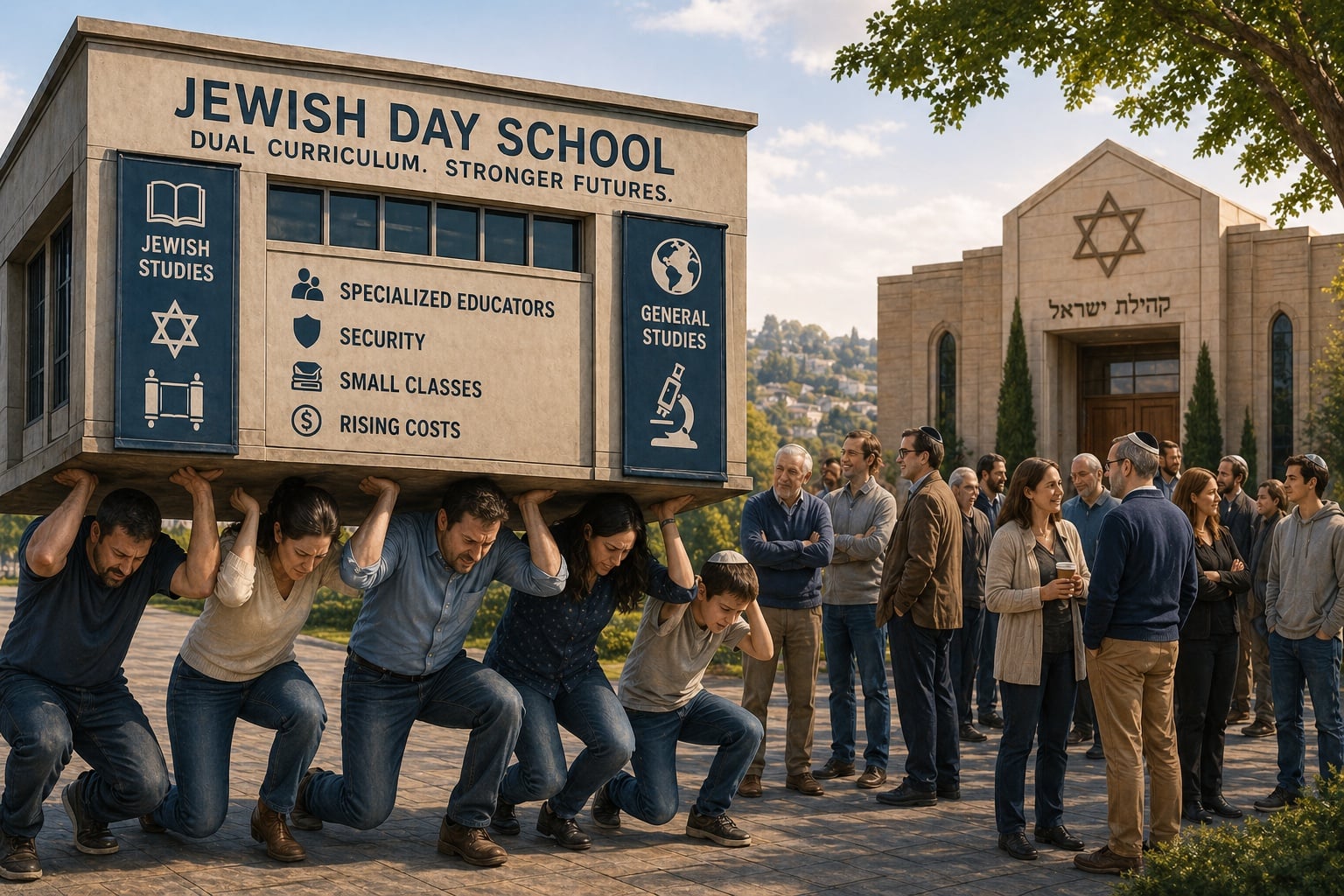
The Samis Foundation has been a thoughtful leader in the heroic effort to make Jewish day school more affordable. For decades, the Foundation has put their money where their mouth is in support of several day schools in Washington State, and they have freely shared their expertise and experiences nationally. They recently published a study called “Day School Affordability and the Catholic School Model,” the findings of which are helpful in addressing that subject, and are also a prompt to expand on other lessons that may be drawn from it.
A central premise of the study was a diligently researched response to a challenge to price day schools along the lines of Catholic schools; i.e. to make them more affordable for middle class families. While the two school systems may present as a basis for comparison from a distance, the study clarified that the components of religious education in each of the systems are incomparable.
Whereas Catholic religious instruction is only offered for a brief amount of time each day, the day school’s dual curriculum of Jewish and general studies is far more intensive. That framework requires more time, additional educators with specialized skill-sets who are specifically prepared to instruct in these areas, and other tangential components which make the cost to educate each Jewish student significantly greater than a Catholic one.
Beyond saying that the systems are unequal, not comparable and therefore it is unrealistic to expect that the cost of Jewish education would ever approach the far less cumbersome cost of Catholic school education, there is more to say. Although this was a feasibility study regarding cost and not a document to make the case for Jewish day school, what should be stated explicitly, and what I believe the Foundation would say as well, is that the dual curriculum is not a budget burden, it is the pair of wings that enables graduates to attain Jewish literacy, to feel organically connected to the Jewish people and the Jewish State, and to thrive as citizen activists in the broader community.
Antisemitism as a Cost-Driver
The study noted the intrinsic and inescapable responsibility of day schools to bear the financial load of increased security at this time of increased risk; another differentiating factor with the Catholic system. This conclusion, too, calls for expansion and amplification. The reason that Jewish day schools must bear this cost is because governments have failed to do so. Local, state, and national government charters are all based upon the foundational assurance of safety and security for their citizens. The right to life, liberty and the pursuit of happiness.
The pressure upon Congress to approve dramatically increased security funding must be unrelenting. The status quo is untenable, it is unfair, and it is unjust for us to bear the cost of protecting ourselves. We will not shrink from our responsibility to do our part as best as we can, and our elected representatives should not feel sanguine about that. We can shovel the snow off of our sidewalks; but we need government to plow the streets. The crushing security costs borne by day schools and the burden passed on to tuition paying parents needs to be eased.
Antisemitism as a Demand-Driver
At the same time, a bizarre window of opportunity is open in light of ongoing and persistently rising antisemitism. That is the prospect to attract parents who may feel unease or unsafe about their Jewish children being in public schools. Prizmah, the Center for North American Jewish Day Schools, provides a comprehensive tool kit for school leadership and parental ambassadors to attract, engage and persuade neighbors to consider Jewish day school for their public-school children. Indeed, increases in enrollment are reported. These efforts should be enhanced with targeted public campaigns expressing the advantages of a Jewish day school education (“We Can’t Teach People Not to Hate Jews. But We Can Teach Jews How to Love Themselves.”) Those advantages include the unfortunate yet indisputable reality that after years of conducting a relentless number of lockdown and active shooter drills, the Jewish day school environment is a healthier place for Jewish children today and undoubtedly will be for years to come.
From a financial standpoint, the dual curriculum is the primary cost driver. From the perspective of a parent who is unfamiliar with day schools, it may be perceived very differently as an academic hurdle too high to overcome. The enrollment campaign should tout it as a feature uniquely available only in a Jewish day school. The message to non-Orthodox audiences would be that not only does a dual curriculum offer immediate benefit in terms of educational content, spiritual development, and pride of peoplehood, it provides a long-term advantage to day school graduates who will be better prepared for the academic rigors of the university, and for the nimbleness of mind necessary to navigate an evolving career environment. What appears to unfamiliar parents as an obstacle is, in fact, one of the system’s greatest assets.
And yet, for all its educational value, the dual curriculum remains the central driver of cost. That brings us back to an essential question: how do we pay for it?
The Catholic Community Pays for Catholic Schools. The Jewish Community Underinvests.
The study provides a thorough analysis of the institutionally shared responsibility between parents and the community in paying for Catholic education, calling the formula “User Fee Plus Parish Subsidy.” This means that in addition to the tuition paid by each family, the local parish provides somewhat substantial support that has increased over time due to numerous factors. The underlying principle is that Catholic education is not a consumer good to be paid for only by the family that uses it, but is a community asset that everybody pays into whether they use it or not. In the case of Catholic schools, every member of every parish involuntarily supports the schools. In the Jewish paradigm, it is only the families that use the schools that pay for them. In other words, a Catholic family that has children going to the local Catholic school is surrounded every Sunday by a supportive congregation that helps to pay for their children’s education. Whereas a Jewish family that is sending their children to a local day school is surrounded every Shabbat by a congregation of people who at best are thinking, “Been there, done that,” or worse, “Not my problem.”
Every synagogue in any stream with a significant number of Jewish children should realize that their institutional foundation is a nearby day school acting as a magnet to attract families with children to their community. Families who will buy homes and join the synagogue; educational leaders who will join the synagogue; even grandparents who are moving to the community in their retirement to be near their children and grandchildren who attend the day school. The day school is the pillar supporting the synagogue infrastructure and therefore there is an obligation for every synagogue to be Catholic about supporting every Jewish day school. Actually, it’s not Catholic; make that just plain Jewish. It’s always been the responsibility of the entire Jewish community to educate every child. The fact that we need and heed the contemporary voices of columnists and pundits who are taking up and popularizing the case for Jewish education is an indication of how alienated we have become from our own tradition. The principle of communal responsibility has slipped away and needs to be reimagined, reignited, and reinstated. Jewish education will become affordable when the Jewish community treats it as a shared obligation rather than a private expense.
“User Fee Plus Philanthropy”
That is how the Samis Foundation study sees the long-term solution to keep day schools viable and affordable. It is terribly sad that by barely referencing the potential support of Jewish federations for ongoing and deepening commitments to secure Jewish education, the Foundation is sharing their estimation that such support is not forthcoming in significant ways. Sad but, for the most part, true. Even in the communities cited by the report where federations offer programs such as middle-income tuition assistance, the major drivers are usually family foundations. The cost is not borne by the community. And so, the report concludes that in addition to increased government support, and ESAs (Education Savings Accounts), it will be the family of Jewish family foundations that will secure the future of accessible Jewish day school education.
In doing the math to determine the amount of money to be raised in endowments that would allow even one school to be accessible for some period of time, the sum comes to staggering hundreds of millions of dollars, an amount of money that is “comparable to the endowment of a small American college.” The study calls for foundations to consider making these extraordinary investments in day school education by thinking about the future, thinking “generationally,” which after all, is the unique power of endowments.
Not every foundation has the inclination to support Jewish education, and even those that do may not have the capacity to do so at these levels. That’s why even in proposing foundation funding as one of the most stable sources of future income, a cautionary note should be observed as well: While thinking generationally, foundation leaders should also think about supporting Jewish day schools regionally, perhaps even nationally, rather than locally. Endowments are nearly forever; day schools are not. Populations shift. Day schools also have lifespans. And sometime, somewhere, the place where the need will be may be very different than the place where the money is. Wayne Gretzky famously said, “I skate to where the puck is going to be, not where it has been.” Foundation funders would do well to adopt that foresight and flexibility, to nourish a Tree of Life that can move to where the Garden will be; a source of life that endows Jewish wisdom to children we do not know in Jewish communities that we have not yet imagined.