


"Violence can be justifiable, but it will never be legitimate." — Hannah Arendt
Who Won the Iraq War?
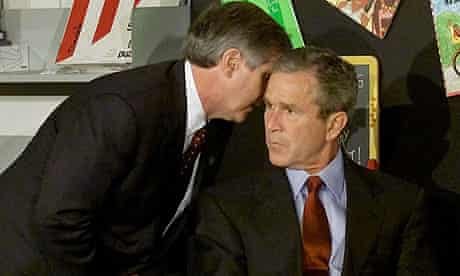
George Bush receives the news that a second plane has crashed into the Twin Towers in New York on September 11 2001. Photograph: Win McNamee/Reuters
I would like to know what went through George W. Bush’s mind on the last day of September, when the final American troops left Erbil Air Base, in northern Iraq, twenty-three and a half years after the invasion he ordered in March 2003. The former president has been painting since 2012, the year he read Winston Churchill’s essay on painting as a pastime and concluded that if that Englishman could paint, so could he. He began with pets, models that have the advantage of not complaining about their portraits, and in 2017 he published the faces of ninety-eight veterans of the wars that followed September 11th, many of whom he had met at golf tournaments and on a hundred-kilometer bike ride hosted by his presidential center. The book’s subtitle presents it as a commander in chief’s tribute to America’s warriors, and all of the proceeds went to the veterans’ initiative of the institute that bears his name, so that those soldiers received from the same pen their orders to deploy and, once home, his charity.
In the memoir he published in 2010, Bush wrote that he had a sickening feeling every time he thought about the weapons of mass destruction that had not turned up in Iraq, and that same week he told American television that Iraqis were better off without Saddam and that he would not apologize, because he did not believe he had made the wrong decision. On the morning of September 11, 2001, when someone whispered in his ear that the country was under attack, the president stayed in his seat for seven more minutes in a classroom in Sarasota, Florida, in front of second graders who were reading aloud a story about a goat, and in 2011 he explained that he had wanted to project calm. I don’t credit the sickening feeling, any more than I credited the calm on that catatonic face, and the only confession I take seriously slipped out of him on May 18, 2022, in a speech in Dallas about Vladimir Putin’s Russia. Decrying the absence of checks on power in Moscow, he condemned the decision of one man to launch a wholly unjustified and brutal invasion of Iraq, corrected the country’s name to Ukraine, muttered that it applied to Iraq, too, and reminded the laughing audience that he was seventy-five. Nor am I persuaded by the care with which he painted each of those ninety-eight faces, because all ninety-eight wore an American uniform, while the violence unleashed by the invasion killed between 187,000 and 211,000 Iraqi civilians, according to the tally kept by the Iraq Body Count project, which concedes that it has missed many of the dead.
On the American side, some 4,500 troops died in Iraq, and a Brown University study published in 2021 estimated that more than 30,000 service members and veterans of the wars that followed September 11th had taken their own lives, four times the number killed in combat. In 2004, the photographs from Abu Ghraib prison completed the gallery that Bush did not paint, with Iraqi prisoners naked, piled up, and humiliated by jailers in American uniforms.
The reasons Bush gave for the war did not survive the investigations that followed, beginning with the supposed link between Saddam Hussein and Al Qaeda, a link the 9/11 Commission dismissed in 2004 after finding no collaboration between them. Two years later, the Senate Intelligence Committee concluded that the dictator had distrusted Osama bin Laden’s network, seen Islamic extremists as a threat to his regime, and refused every request for support from the organization. The weapons-of-mass-destruction thesis met the same end, because U.N. inspectors had dismantled Saddam’s clandestine nuclear project after the 1991 Gulf War, and Iraq’s chemical arsenal had been eliminated early in that decade. In 2002, the Brazilian diplomat José Maurício Bustani headed the Organisation for the Prohibition of Chemical Weapons and was negotiating Iraq’s accession to the treaty on those weapons, a step that would have opened the country to Bustani’s inspectors and shown, according to the experts who advised him, that there was nothing left to destroy. Washington engineered the Brazilian’s ouster in April 2002, on charges of mismanagement, eleven months before the first American tanks crossed the border from Kuwait.
As for the democracy the war was supposed to bring to Iraq, the White House announced in April 2005 that the president would discuss his efforts to promote democratic reform with Crown Prince Abdullah, of Saudi Arabia’s absolute monarchy, and on the twenty-fifth the two men strolled hand in hand around the ranch in Crawford.
By toppling Saddam Hussein, a secular Sunni dictator who had spent eight years at war with Iran, Bush opened Baghdad to the influence of Tehran and of the Shiite militias that the Iranian regime arms to this day, and the chaos of the occupation spawned the Islamic State, which in 2014 seized vast stretches of Iraq and Syria. The troops who left Erbil at the end of September belonged to the contingent that Baghdad called in that same year to fight the jihadists, three years after the invasion force had departed, so that the last American soldiers in Iraq were there to contain a creature of Bush’s war. Since 1991, Iraq has been bombed under six American presidents, from the elder Bush to Trump, and seventy years earlier the British air force was already attacking villages suspected of sheltering rebels, under the plan for controlling Mesopotamia from the air that the author of the essay on painting as a pastime championed as a cabinet minister.
Tehran celebrated the withdrawal as the triumph of years of effort to extend its influence over its neighbor, and Iraq now offers Iran territory from which Tehran’s allies can fire without the Iranians having to put their name to the attack. On September 10th, drones launched from the Iraqi province of Maysan, on the Iranian border, struck the pipeline that carries Saudi oil to the port of Yanbu, on the Red Sea, the route Riyadh has used to get around the Strait of Hormuz since shipping there was disrupted in March. Accused of the attack, the Iraqi militias aligned with Iran denied any involvement, and the government in Baghdad dismissed the province’s military commander. Announcing the withdrawal, Trump wrote that very bad decisions had dragged the United States into that quagmire, and, as far as I have been able to determine, Bush has not said a word. I would have liked to be a fly on the wall of his studio that Wednesday, to see whether the catatonic face from Sarasota looked the same when the news from Erbil arrived.
Saddam was indeed our enemy, as we are reminded by the thirty-nine Scud missiles he fired at us in 1991 and by the twenty-five thousand dollars that, in 2002, he was paying the family of each Palestinian suicide bomber. On September 12th of that year, when he was out of government, Benjamin Netanyahu assured a House committee in Washington that removing the dictator would have enormous positive reverberations in the region. Twenty-four years later, he leads us through the war against Iran that he began with Trump on February 28th, and the missiles that have sent us into the mamad so many times since then came from the country that won the Iraq war.