
CFO | Empower Society for Good I Author
Who Writes Israel’s Future?
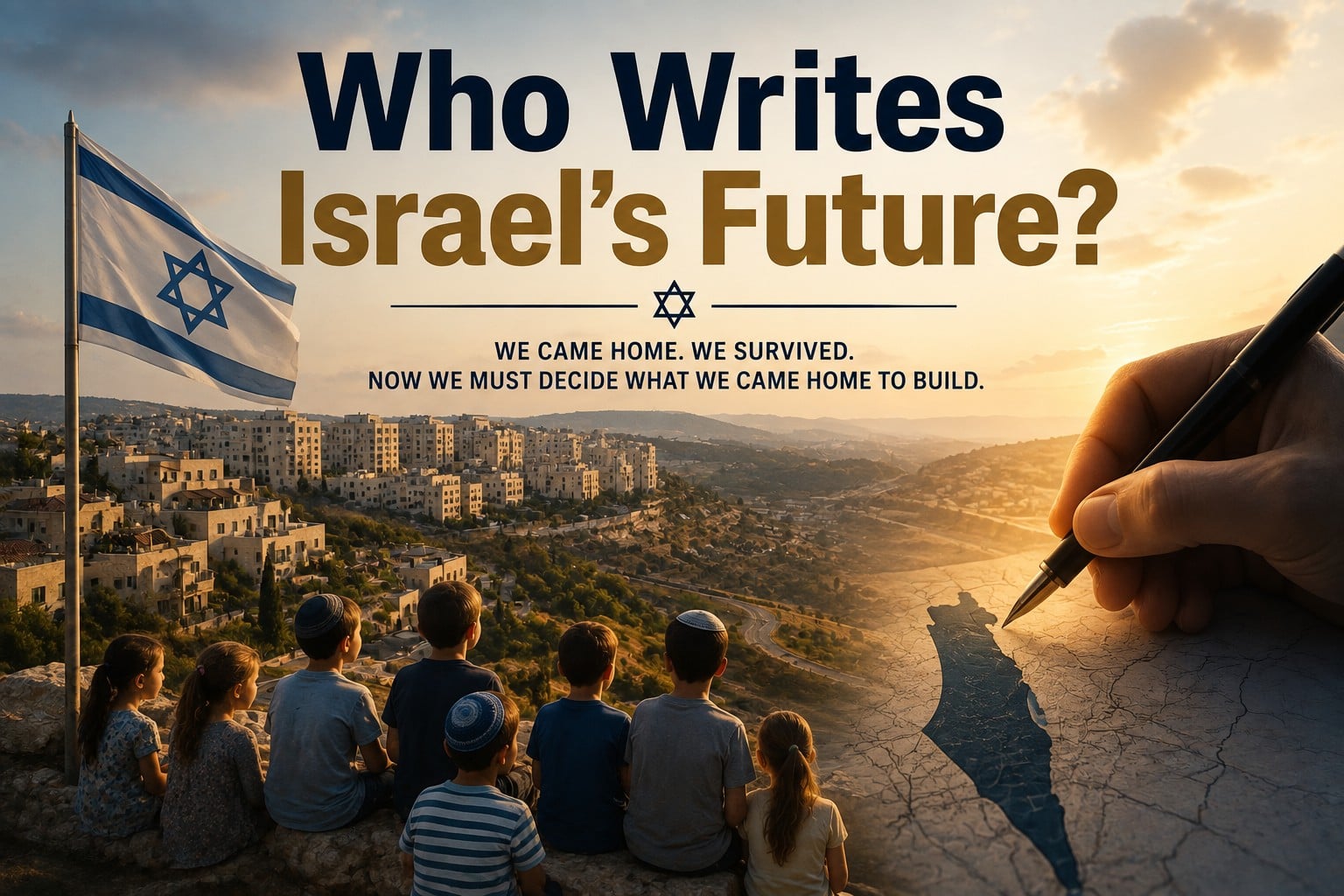
We came home. We survived. Now we must decide what we came home to build.
Something important is changing in Europe’s relationship with Israel. For decades, European governments have criticized Israeli communities in Judea and Samaria and what they define as settlements in East Jerusalem—a definition that extends even to Jewish residence in parts of Jerusalem’s Old City. They have insisted that the Israeli-Palestinian conflict must ultimately be resolved through two states and territorial separation. Israel argued back, Europe issued statements, negotiations came and went.
Now the disagreement is moving beyond diplomacy. Norway has proposed legislation restricting trade and economic activity connected to Israeli settlements, while Britain has strengthened its warnings to businesses about settlement-related economic activity. Economic power is increasingly being used to influence the political geography of Israel’s future.
I thought about this while listening to a fascinating debate between British barrister Natasha Hausdorff and Norway’s deputy foreign minister, Andreas Kravik. I expected a serious clash of legal arguments. Instead, I came away troubled by how hollow some of Kravik’s responses sounded.
Hausdorff kept returning to the underlying history: the status of Judea and Samaria before 1967, the League of Nations Mandate, Jordanian rule between 1948 and 1967, Resolution 242 and the Oslo Accords. Kravik’s position was essentially that the International Court of Justice has reached its conclusions, the international consensus overwhelmingly supports them and states therefore have obligations arising from them.
Yet I kept waiting for the underlying questions to be answered. “The ICJ has spoken” cannot end the conversation. Its 2024 opinion was advisory rather than a binding judgment in a contentious case, and its judges themselves disagreed over important aspects of the reasoning. That does not prove Hausdorff right or make the majority opinion irrelevant. It establishes something more basic: There is an argument.
There is also a human consequence largely missing from the discussion. Palestinians work for Israeli businesses beyond the Green Line, supply them and participate in economic relationships that cross the very lines Europe seeks to reinforce. A boycott aimed at an Israeli employer can therefore also cost a Palestinian worker his livelihood. This does not settle the legal argument, nor should Palestinians depend permanently on Israeli employers for prosperity. But policies promoted in the name of Palestinians should surely consider their consequences for Palestinians. They are people trying to build lives, not abstractions in somebody else’s political theory.
This is where the Norway debate becomes about something much larger. This series is not really about Norway, settlements, the ICJ or even Israel’s next election. It is about who gets to write the story of Israel’s future.
For much of the past generation, the international community—and to a significant extent Israel itself—has operated within an established narrative: The conflict is territorial; the solution is separation; draw the correct border, establish two states, separate Israelis from Palestinians and eventually peace will follow.
Perhaps that remains the best answer. But October 7 should at least give us permission to question the assumptions.
October 7 destroyed one Israeli conceptzia. We believed Hamas could be contained, economic incentives might moderate ideology, and deterrence, intelligence, technology and a sophisticated border fence could separate us from an enemy committed to our destruction. Those assumptions collapsed within hours. Yet another assumption has survived remarkably intact: that geographical separation must remain the organizing principle of our political future.
After Oslo, the Second Intifada, the Gaza withdrawal, Hamas and October 7, surely we are entitled to think again.
I do not begin with another grand solution. I begin with reality. Jews are not leaving. Palestinians are not leaving. Our geography, infrastructure and economies are intertwined. Perhaps Palestinian political agency does not necessarily require complete geographical separation. Perhaps local government, federal or confederal arrangements, different layers of sovereignty or ideas such as Dr. Mordechai Kedar’s Palestinian Emirates deserve examination. Some may prove unworkable, but political theory should fit the people and geography rather than forcing reality to fit the theory.
October 7 reminded us of the importance of knowing our adversary. But building a future also requires us to know our neighbor. A Palestinian worker, entrepreneur or family seeking a better life is not Hamas, just as a Jewish family living in Judea and Samaria is not merely a “settlement unit” obstructing somebody else’s map. Perhaps Europe, in its determination to preserve the map, is sometimes missing the people who live on it.
This feels particularly relevant as Rosh Hashanah approaches. Teshuvah, return, requires us not merely to judge others but to examine ourselves: Where have we failed, and what should we become? A sovereign Jewish nation should be capable of asking the same question. Defending our right to be here is essential, but “we have the right to be here” is not a vision for what we should build here.
For me, this is personal. I made aliyah many years ago, one of the most consequential decisions of my life. Aliyah means ascent—the same word used when a Jew is called to the Torah. Over the years, I have learned that making aliyah may happen on a particular day, but becoming settled in Israel is a much longer process. I built my family and life here; my children grew up here; today I live in Jerusalem. In that older, constructive Zionist meaning of the word, I too am a settler.
I came home to build.
Recently, I spent Shabbat in Keren Reim a beautiful modern settlement, where around 30 children, including my grandson Eitan, received a communal aliyah as they prepared to enter first grade. Watching them, I found myself thinking about 2048. When Israel celebrates its centenary, these children will be adults. They will inherit whatever we build today.
My compass is straightforward. I want a strong Israel, confident in its Jewish identity and historical legitimacy, secure in its sovereignty and capable of defending itself. But strength cannot be the destination. Ultimately, we should strive for peace. Palestinians do not have to become Zionists, but any sustainable future must recognize that Israel and Jewish sovereignty are permanent. Israel, in turn, must demonstrate that Jewish sovereignty can create security, infrastructure, economic opportunity, religious freedom and human dignity for everyone who shares this land.
That is the Good Society question I want to explore in this series: our history and legal claims, what it means to be a settler, the actual geography, Palestinian political agency, alternative forms of government, economic cooperation, Hebron 2040 and the possibilities opened by a wider Abrahamic region. I do not expect to find one magical solution. I want us to give ourselves permission to think again.
For generations, Zionism had to answer whether the Jewish people could come home. Then Israel had to answer whether we could survive here. We answered both.
Now comes the next question:
What did we come home to build?
Related Topics
Related Posts