
A Gen Z lens on Israel’s digital frontline.
Why a Brazilian Beach Town Turned on Jews

Anti-Israel activists harassing Israeli tourists in Itacaré, Brazil (Photo via Agência Brasil).
“The Imperialism of Israel.” That was the subtitle of the 1936 Brazilian edition of The Protocols of the Elders of Zion, translated and annotated by Gustavo Barroso—a leader of Brazil’s fascist Integralist movement and a former president of the Brazilian Academy of Letters. He published it 90 years ago, 12 years before the modern State of Israel existed.
A year later, in 1937, Brazil’s Foreign Ministry issued a secret circular ordered by President Getúlio Vargas instructing consulates to deny visas to anyone of known “Semitic ethnic origin”—barring Jewish refugees, entrepreneurs, and even tourists.
Yes—tourists.
Long before 1937, however, a strikingly similar script had played out on Germany’s North Sea coast. In the 1890s, a guidebook for the resort island of Borkum boasted that it was judenfrei (“free of Jews”), while the municipal band played an anthem declaring no Jew should set foot on its beaches. By 1929, Germany’s main Jewish organization was publishing a multi-page directory of resorts where Jews were unwelcome.
Nearby sat Norderney, an island that drew Jewish vacationers from across Europe—not because its beaches were finer, but because Jews could holiday openly with kosher bakeries, Jewish hotels, and a summer synagogue. To nationalists, peaceful Jewish tourism looked like an invasion. They dubbed Norderney Judeninsel (“Jew Island”), and once the Nazis took power in 1933, local officials issued stamps celebrating that it had been purged of Jews.
Those years of portraying Jews as a rootless, foreign clique conditioning societies to accept persecution culminated on November 9, 1938, during Kristallnacht—when Joseph Goebbels seized on a single teenager’s shooting of a German diplomat in Paris to torch over 1,000 synagogues, loot 7,000 businesses, murder dozens, deport 30,000 Jewish men to concentration camps, and fine the entire Jewish community one billion Reichsmarks. One person’s act became every Jew’s debt.
On November 9, 2026, precisely 88 years later, that exact mechanism unfolded on the beaches of Brazil.
Bahia’s Coast and the “Ethical Tourism” Campaign
Brazil has long drawn distinct international crowds: Argentines flock to Santa Catarina in the south, Americans gravitate toward Rio de Janeiro, and Israelis have for decades favored southern Bahia—particularly Itacaré and Morro de São Paulo.
In Santa Catarina, Spanish menus, Argentine restaurants, and Argentine flags are everywhere, yet nobody accuses Buenos Aires of colonizing Brazil—even though Argentines accounted for over three million of Brazil’s nine million foreign visitors in 2025. Even in Morro de São Paulo, official data cited by the Bahia daily A Tarde shows Argentines outnumber all other foreign tourists, while Itacaré’s city hall notes that Europeans form its largest foreign cohort.
Only Israelis are accused of an invasion.
For decades, post-army Israeli backpackers—immortalized in the Israeli comedy series Malabi Express, filmed in Morro de São Paulo—brought ordinary tourism infrastructure with them: Hebrew menus, Hebrew-speaking staff, and modest spaces for Shabbat prayer. Just like Norderney a century ago, a peaceful tourist presence was recast as an occupation.
In February 2026, an activist trailed Israeli visitors in Morro de São Paulo waving a Palestinian flag before accusing them of hostility. The following month, a tour billed as “Ethical Tourism in Bahia” moved through Morro de São Paulo, Boipeba, Itacaré, and Serra Grande. Videos circulated online celebrating physical assaults on Israeli tourists, including a flying kick captioned “A hero in Itacaré.”

Headlining the tour was Thiago Ávila, an anti-Israel militant previously detained in Israel for his involvement in the Global Sumud Flotilla and deported back to Brazil. Thiago told crowds in Itacaré that Zionists were an armed minority trying to colonize the region and declared that Brazil was “not a resort for war criminals.” Yet when an Itacaré community representative met with Bahia Governor Jerônimo Rodrigues of the Workers’ Party (PT) on November 10 and asked locals point-blank whether Israelis were roaming armed, terrorizing families, or erasing local culture, the answer to every question was an unequivocal no.
Ávila’s own allegiances reveal what drives the campaign. In February 2025, he traveled to Beirut to attend the funeral of Hezbollah leader Hassan Nasrallah, cheering alongside chants of “Death to America! Death to Israel! Victory to Islam!” and praising Nasrallah in interviews as a “father figure” and guiding strategist—the same Nasrallah who publicly called Jews globally cowardly and despicable (explicitly specifying “the Jew, not the Israeli”) and remarked in 2002 that if all Jews gathered in Israel, it would spare Hezbollah the trouble of hunting them worldwide.

By March 2026, state legislator Hilton Coelho of the Socialism and Liberty Party (PSOL) formally petitioned President Luiz Inácio Lula da Silva to bar entry to any Israeli who had participated in military operations. While Israel’s conscript army investigates and prosecutes misconduct under Supreme Court oversight—and most young Israelis serve in logistics, intelligence, medicine, or tech—Coelho’s proposal revived the logic of Vargas’s 1937 circular: judging an entire nationality by a hostile stereotype.
The Shifting Line
Historically, antisemitism rarely announces itself as an attack on all Jews at once. Instead, it targets a “problematic subgroup” to which nearly all Jews belong.
In 1492, Spanish inquisitors of Jewish ancestry such as Tomás de Torquemada claimed the problem was merely Jews who refused baptism—until converts were hunted by the Inquisition under limpieza de sangre (“purity of blood”) laws targeting Jewish ancestry across generations. In the Soviet Union, the Jewish communist Yevsektsiya dismantled Jewish religious life in the name of revolution before Stalin’s purges devoured its own members. In 1968 Poland, a state-backed “anti-Zionist” purge drove out half the country’s remaining Jews.
Today, the line is: “The problem isn’t Jews; it’s Zionists.” Yet Gallup polling shows roughly 95% of American Jews view Israel favorably, and nearly half the world’s Jews live there. Treating Zionism—the basic belief in Jewish self-determination in our ancestral homeland—as a crime effectively criminalizes mainstream Jewish identity.

As in past eras, a few ideological figures from Jewish backgrounds lend cover. Brazilian commentator Breno Altman has built an online brand attacking Israel while using his Jewish heritage to claim he cannot be antisemitic, and urging leftist lawmakers to criminalize Zionism under the revoked 1975 UN General Assembly Resolution 3379—a resolution backed by Brazil’s former military dictatorship before democratic Brazil co-sponsored its repeal in 1991. Altman has also stated that he personally “does not condemn” hatred toward the Jewish people, and went so far as to say that if he had been in Berlin in April 1945, he would have wanted to meet with Adolf Hitler for an interview.
The Blue Mansion in Itacaré

In late October 2026, hostility in Itacaré crystallized around the Casarão Azul (“Blue Mansion”) on the town’s main square. A rabbi had leased the building to operate a Chabad house for Israeli and Brazilian Jews. After the landlord declined to renew the lease and the congregation vacated, militants descended on October 30, tore down the hanukkiah from the balcony, and covered the facade in graffiti reading “Bahia belongs to Brazilians,” “Defend our culture,” and “From the river to the sea.”

When a group of Israelis tried to scrub the slogan off that night, a mob surrounded them in the square and drove them out shouting “Get out, this is Bahia.” Several media outlets inverted the story, reporting that Israeli tourists had tried to vandalize a “pro-Palestine mural.”
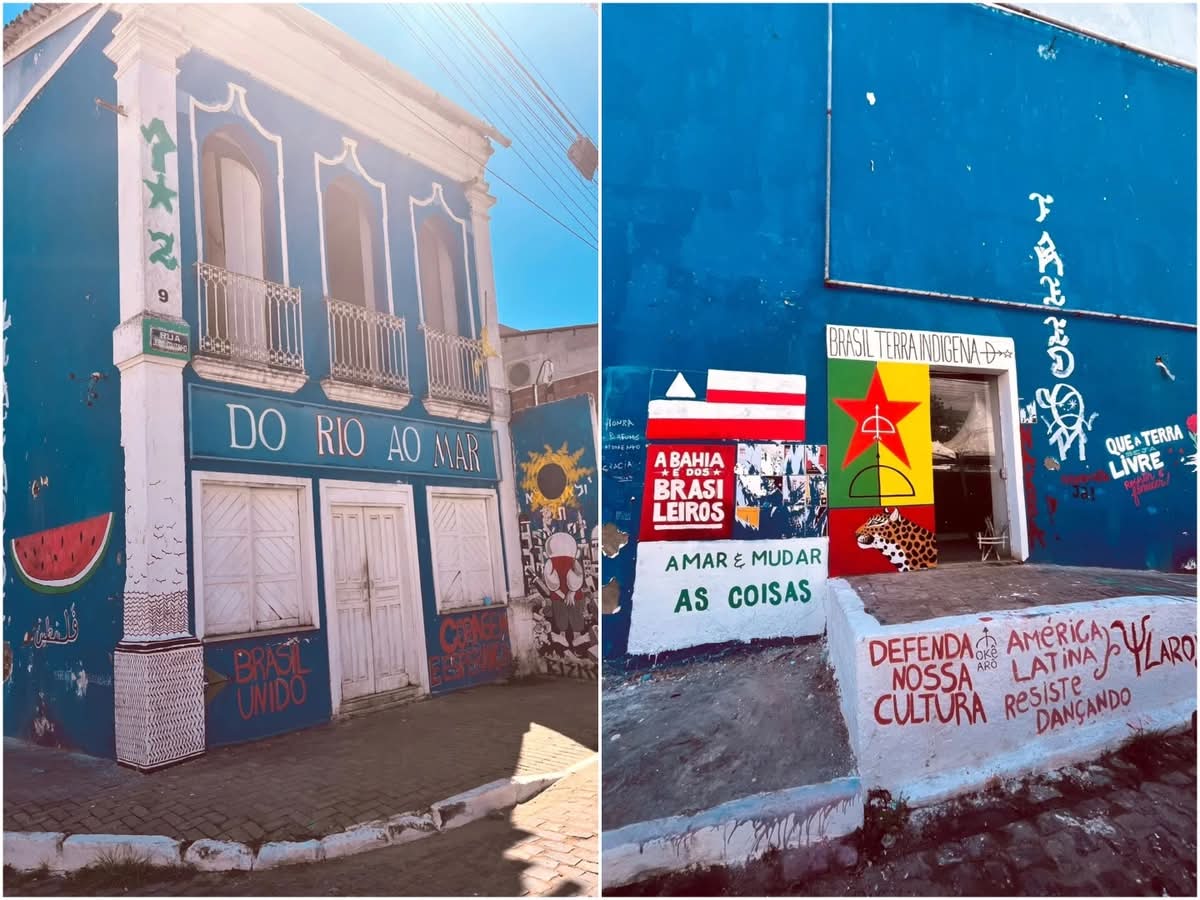
The landlord publicly clarified that the graffiti violated his agreement—noting the building had never displayed Israeli state symbols, only Jewish religious ones—and asked activists to remove it. They refused, claiming a Bahia flag was far less offensive than “Israeli imperialist symbols.” When local residents organized a City Council rally to reject hate and welcome visitors, activists mocked them on X, calling Israelis dangerous people beyond dialogue.
Painting “Bahia belongs to Brazilians” across a former synagogue wall is not a critique of government policy. It is a warning aimed at a people.
Collective Guilt and Double Standards
Earlier this year, the Arab-Palestinian Federation of Brazil (FEPAL) circulated headlines claiming an Israeli website promoted sex tourism in Bahia. The source was Muchiler, a Hebrew backpacker forum where investigators dug up a 20-year-old entry containing a racial slur—omitting that Israel’s largest news sites had exposed and condemned those very forum posts back in 2016, forcing their removal.
Using a two-decade-old forum post to tar a nation is pure collective guilt. By that standard, past blackface sketches on Brazilian television would make every Brazilian tourist in Tel Aviv a racist. When a journalist reported sexual harassment by an Israeli tourist in Salvador in November, the principle was simple: prosecute the individual perpetrator, not his nationality. Similarly, when an Argentine lawyer was arrested in Rio in January 2026 for directing racist gestures at a bartender, Brazilians demanded justice against her personally; nobody painted “Rio belongs to Brazilians” on an Argentine church or demanded border bans on Argentine tourists.
On November 10, Bahia’s legislative majority leader, Rosemberg Pinto of the Workers’ Party (PT), confirmed in a radio interview that local police had registered zero reports of assaults by Israelis, calling the uproar politically driven fake news. Yet on X and Instagram, comments targeting Itacaré’s Chabad page erupted into explicit threats—urging mobs to beat Israelis with clubs, calling them “filthy pigs” and a “cursed race,” and telling the synagogue’s caretakers to “go back to ashes.” Those messages were sent on November 9, 2026—88 years to the day after Kristallnacht.
An Imported Playbook
Ironically, the rhetoric claiming to defend “Brazilian sovereignty” is itself an imported script.

In July 2026, a 20-minute English-language video titled “How Israelis Are Colonizing the World” appeared on the YouTube channel Uncivilized. While the channel’s previous videos averaged 5,000 to 15,000 views, this one surged past 800,000, flooded with copy-paste comments: “Finally someone is talking about Israelis in India,” “in Brazil,” “in Thailand,” “in Cyprus”—a classic bot-seeded echo chamber designed to manufacture consensus before real users amplify it.
The video claims that whether Israelis are post-army backpackers or liberals fleeing their government, violence lives in “settler DNA”—citing the Yiddish-derived slang word freier (“sucker”) as proof of cultural deceit. As writer Hen Mazzig noted, legitimate criticism targets behavior, which can change; attacking a people’s essence leaves no exit and echoes the 1940 Nazi propaganda film The Eternal Jew. Weeks before the video’s release, the mayor of Varallo in northern Italy—where several Israelis had settled—received a bullet in the mail warning against allowing “Nazi-Zionists” into the valley.
The pattern spans continents:
-
Patagonia: Wildfires in 2026 revived the antisemitic “Andinia Plan” conspiracy theory across more than 469,000 social media posts accusing Israeli backpackers of arson.
-
Cyprus: In 2025, an opposition leader claimed Israelis were taking over the island via schools and synagogues, even though official Cypriot data ranked British and Russian buyers ahead of Israelis in property purchases between 2021 and 2024.
-
Asia and Europe: Anti-Israeli signs appeared in Thailand; an Israeli woman was denied service in Athens; tourists were beaten with chairs in Montenegro; and six campers were assaulted in Mongolia simply for speaking Hebrew.
-
Brazil: In April 2026, Rio’s Partisan bar posted a sign barring Israeli and American citizens, briefly losing its license before a court reinstated it on free-expression grounds. Meanwhile, the Belgium-based Hind Rajab Foundation—headed by a reported former Hezbollah operative—tracked down an Israeli survivor of the October 7 Nova festival vacationing in Brazil in January 2025, forcing him to flee under threat of lawfare.
Between July 2025 and July 2026 alone, Israel’s Foreign Ministry had to assist 45 citizens targeted in antisemitic incidents abroad.
Who funds the media infrastructure behind these narratives? Uncivilized LLC is registered in Doha inside Qatar’s state-backed Media City—home to Al Jazeera—and was co-founded by veterans of Al Jazeera and the Palestinian Institute for Public Diplomacy. Combined with Qatar’s documented multi-billion-dollar footprint in Western academia and influence operations, the pipeline is clear: algorithms distribute outrage for free, while well-funded studios package the script for local activists to copy and paste.
Choosing Peace—and Brazil’s Two Traditions
Critiquing Israeli policies is legitimate. Supporting Palestinian rights is legitimate. Prosecuting any tourist who breaks the law is basic justice. What crosses into antisemitism is collective punishment, national exclusion, and blood-and-soil conspiracy theories. As the Brazilian Israelite Confederation (CONIB) has stated, advocating for Palestinian dignity is fully compatible with respecting Israelis and Jews.
I write this as both a Brazilian and an Israeli, born in Kfar Saba to a Brazilian mother and an Israeli father. Having worked in theater and film in both countries alongside Palestinian artists, I know neither people is going anywhere. During the 2025 Iranian missile attacks on Israel, I sheltered in Kfar Saba alongside Palestinian and Arab-Israeli neighbors—citizens who share our daily lives and many of whom serve in the IDF to defend both communities. According to the Ramallah-based Palestinian Center for Policy and Survey Research (PCPSR), support for Hamas among Palestinians dropped from 35% in August 2025 to 19%, while 53% back a two-state solution.
My given name is Paz—Portuguese and Spanish for “peace.” History shows that those willing to seek compromise are always the first targets of those invested in endless war. Whether it is Yitzhak Rabin assassinated over peace talks, Fatah rivals purged by Hamas in Gaza, or October 7 activists like Vivian Silver and Oded Lifshitz, extremists always eliminate voices for coexistence first—much like Martin Luther King Jr. and John Lennon on the world stage. When I publicly debated the attorney representing Thiago Ávila and Rio’s Partisan bar, he went online and dismissed my call for coexistence as a calculated “moderation strategy.” To people addicted to war, peace is inconceivable except as a trick.
Brazil itself holds two competing legacies. In 1937, while Getúlio Vargas’s secret circular barred Jews from entering the country, Brazilian diplomat Aracy de Carvalho—known as the “Angel of Hamburg”—quietly issued visas saving Jews from Nazi Germany, while Ambassador Luiz Martins de Souza Dantas issued hundreds more in Vichy France. Both were honored by Yad Vashem as Righteous Among the Nations.
Brazil carries both traditions: Gustavo Barroso’s hatred and Aracy de Carvalho’s humanity.
On the beaches of Itacaré, ordinary residents have already made their choice. In local interviews, boat operators, merchants, and lifelong natives describe the thousands of young Israelis who visit each year as respectful, orderly customers who support the local economy—dismissing the online rumors of armed thugs as fabrication.

The people who actually live alongside them chose welcome over hate. The rest of us should do the same.
Related Topics
Related Posts