
Middle East Analyst
Why AI Is Quietly Undermining Its Own Future
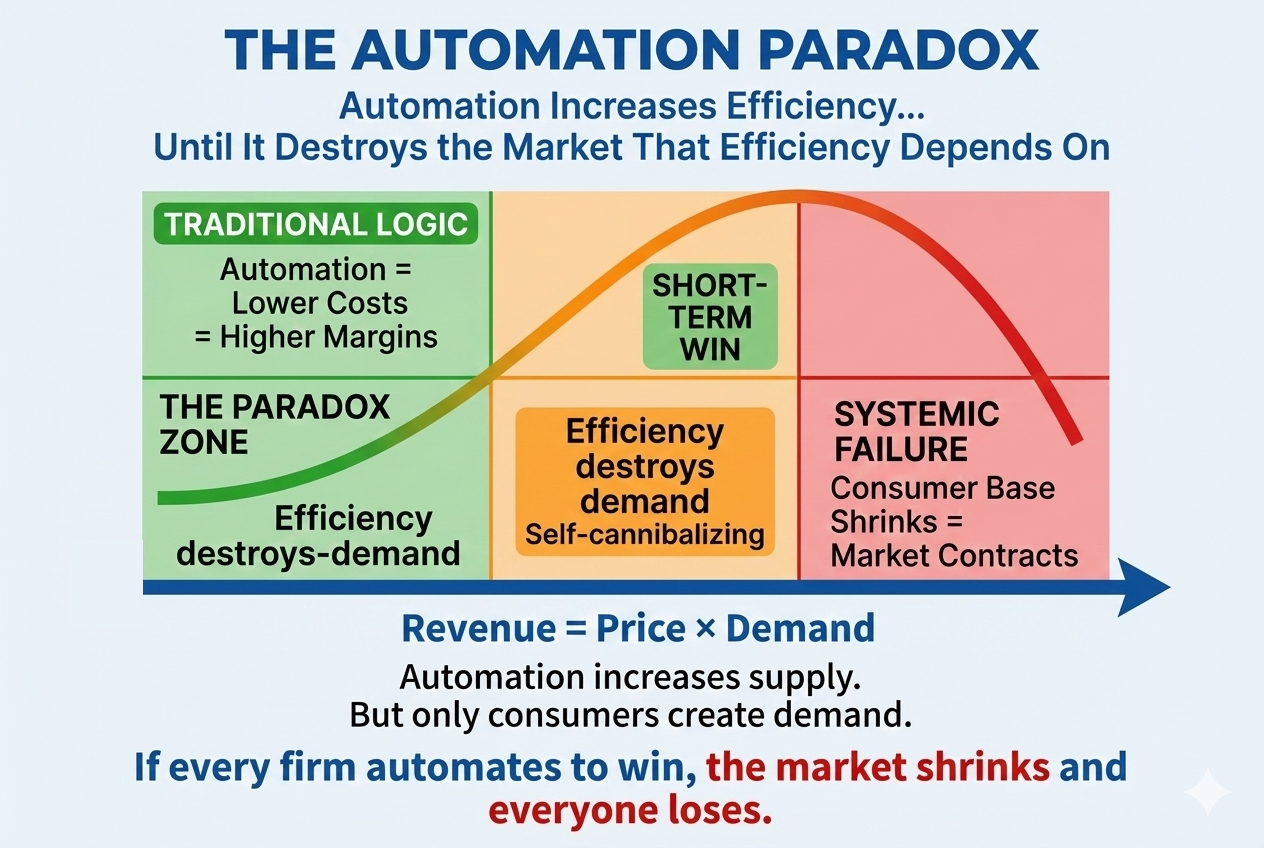
graphic by author/Nano Banana
The global race to develop artificial intelligence is accelerating, and no serious strategist believes it can be slowed. Not when geopolitical competitors are moving at full speed. Not when technological advantage translates directly into economic and national power. The companies building these systems understand that hesitation is not an option. They are right. But the industry’s focus on speed, scale, and dominance has obscured a structural risk that threatens its own long‑term viability: the erosion of the economic foundations that make the AI market possible in the first place. This is not a moral argument. It is not a political argument. It is a strategic economic argument—and one that industry leaders, investors, and policymakers can no longer afford to ignore.
For more than a century, technological disruption has followed a familiar pattern. When one sector shed workers, another absorbed them. Labor moved from agriculture to manufacturing, then from manufacturing to services. Each transition created a new “safe harbor” for human work. The assumption that this pattern will continue is now so deeply embedded in economic thinking that it is rarely questioned. But AI is eliminating the safe harbors. In earlier eras, displaced workers could move into the next sector in the chain. Today, AI is targeting the very cognitive and creative roles that once served as the next landing zone. There is no fourth sector waiting to catch the fallout.
Unlike past general‑purpose technologies, AI is not disrupting one domain at a time. It is compressing the labor market across multiple sectors simultaneously, transforming the jobs that once absorbed displaced workers at the same moment it transforms the jobs they were meant to replace. This is not a cyclical shift. It is a compression event: a simultaneous disruption of multiple labor‑absorbing sectors, leaving no clear transition path.
The consequences of this compression extend far beyond the labor market. When millions of workers lose income, the result is not just social strain. It is a collapse in aggregate demand. And when demand collapses, even the most efficient companies face shrinking markets. The paradox is stark: the very efficiency gains that AI promises can undermine the consumer base that sustains the industry’s long‑term growth. The standard rebuttal is that new jobs will emerge, as they always have. But that argument assumes AI behaves like past technologies. It assumes that the economy will generate new sectors capable of absorbing displaced workers. Yet the sectors that once played that role are being disrupted at the same time as the sectors they replaced. The old pattern of labor migration cannot repeat when the destination is collapsing alongside the origin.
This is the blind spot at the center of the AI boom: the belief that the market will remain stable even as the foundations of consumer demand erode. It is a comforting assumption, but it is not supported by the dynamics of the current transformation. Complicating matters further is the geopolitical reality. No Western company can voluntarily slow down without ceding the field to China or other competitors. This is not a debate about ethics. It is a debate about strategic survival. Acceleration is inevitable. Competition is unavoidable. The race cannot be paused.
Which means the only viable path forward is not deceleration—it is coordination. But coordination itself is not simple. It cannot be imposed by regulation alone, nor can it emerge from market forces alone. It requires something far more difficult: a society‑wide negotiation over how to maintain economic stability, social cohesion, and technological leadership in a world where traditional labor markets are being reshaped faster than institutions can adapt. This is the essence of what I call the Hybrid Paradox Imperative.
A hybrid paradox is a situation in which no single ideology, institution, or sector can solve the problem alone—and any attempt to impose a unilateral solution makes the system less stable, not more. The only viable path is a negotiated hybrid that satisfies nobody’s maximal preferences but meets everybody’s minimum requirements. It is the same structural challenge that underlies many of the world’s most intractable conflicts: multiple actors with incompatible goals, overlapping vital interests, and no stable equilibrium without shared constraints. The AI‑economy dilemma is a hybrid paradox. It cannot be solved by laissez‑faire capitalism, socialism, protectionism, welfare maximalism, deregulation, or technological determinism. Each of these models solves one dimension while breaking another. The problem is not ideological. It is structural.
The United States has navigated hybrid paradoxes before. The American experiment has never been a pure ideological project. It has been a negotiated hybrid—dynamic, adaptive, and often contentious. Its success has come not from choosing a single model, but from blending competing principles into a system that maintained social cohesion, economic growth, and innovation. The country’s greatest achievements emerged from this ability to negotiate contradictions rather than deny them. The AI era demands the next iteration of that tradition.
Executives often respond to concerns about labor displacement by saying, “If we don’t automate, our competitors will.” They are right. This is not an individual failure of corporate ethics. It is a systemic coordination failure. Every firm is acting rationally in isolation and collectively producing an outcome that threatens the entire market. The solution is not to slow down automation. That is neither realistic nor strategically viable. The solution is to redesign business models, economic stabilizers, and public‑private frameworks in ways that preserve the system while innovation accelerates.
This does not mean central planning. It does not mean freezing technology. And it does not mean building expansive welfare systems that undermine competitiveness. It means acknowledging that the industry is creating a macroeconomic externality—and participating in the design of buffers that keep the system intact. That could mean new forms of hybrid human‑AI work, transitional income mechanisms that maintain demand without distorting markets, or public‑private investment in sectors that can still absorb labor at scale. It could mean new pricing models, new revenue structures, or new forms of value creation that do not depend on a large consumer class with rising disposable income. None of these are ideological concessions. They are strategic adaptations.
If the industry fails to act, the political system will. And political intervention born from crisis is rarely subtle. When social stability erodes, regulation does not arrive as a scalpel. It arrives as a hammer—robot taxes, forced slowdowns, aggressive antitrust actions, or outright bans on certain forms of automation. None of these outcomes are conducive to innovation. All of them become more likely if the industry continues to treat labor displacement as someone else’s problem.
There is a deeper risk still—one that technologists rarely acknowledge. Economic destabilization does not remain economic. It becomes political. As workers lose stability, public consent for technological progress erodes. This fuels populist backlash, nationalism, and fragmentation of global AI markets. In other words, economic destabilization becomes political destabilization, and political destabilization becomes market fragmentation. This is the risk the industry is not modeling.
AI cannot thrive in a society whose economic foundations are eroding. A shrinking consumer base is not a market. A destabilized society is not a stable environment for innovation. A hollowed‑out economy does not buy cloud services, enterprise software, or AI subscriptions. If the AI sector continues to treat labor displacement as an externality, it will eventually discover that it has undermined its own business model. Acceleration will continue. The race will continue. But without a negotiated hybrid that preserves the economic base on which innovation depends, the industry may win the race and lose the world it needs to operate in.
Related Topics
Related Posts