


Why are 100,000 Gathering in Paris on June 20th?
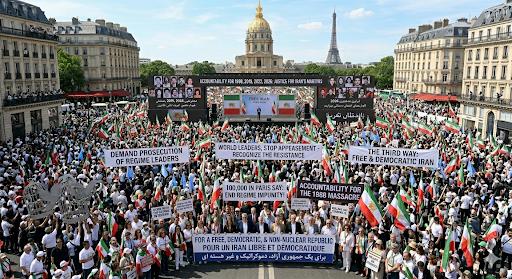
A few years ago, if you had told me that one day I would be writing about 100,000 Iranians and their supporters gathering in Paris to protest the regime in Tehran, I probably wouldn’t have paid much attention.
Like many Americans, I viewed Iran mostly through the lens of foreign policy, nuclear negotiations, sanctions, Israel, terrorism, and the usual headlines.
What I didn’t fully appreciate was the human cost.
The stories of ordinary Iranians. The families who lost loved ones. The political prisoners. The activists. The people who simply wanted the freedom to speak their minds and paid the ultimate price for it. The regime has executed at least 32 dissidents under the shadow of the recent war, two dozen of them for participating in the January 2026 protests. Thousands more remain incarcerated and under torture.
On June 20, close to 100,000 expats from both sides of the Atlantic are expected to converge on Place Vauban in Paris for one reason: to remind the world that the Iranian regime’s victims are not statistics. They are real people whose stories deserve to be heard. They will also tell the world that the solution to the Iranian crisis is not foreign military intervention, nor the decades-long policy of appeasement, which Europe has pursued shamelessly. To them, there is third way. Change from within by the people of Iran and the organized opposition.
For decades, political executions have been one of the defining features of the Islamic Republic.
Human rights organizations, former prisoners, and victims’ families have documented years of imprisonment, torture, and executions directed at political dissidents. The most notorious example remains the 1988 prison massacres, when thousands of political prisoners were executed.
Opposition groups argue that the true number of victims over the past four decades is far higher. The National Council of Resistance of Iran (NCRI) and the People’s Mojahedin Organization of Iran (MEK) maintain that more than 100,000 opposition supporters have been executed since 1981, including several thousand during the massacre of political prisoners in 1988, according to a July 2024 report by the then United Nations Special Rapporteur on Iran. While the exact number remains debated, what is beyond dispute is that countless Iranians have suffered for opposing the regime.
That is why people continue to march. Not because they agree on every political question—they do not. Their differences are real and, at times, profound. Yet they are united by a common aspiration: the establishment of a truly free and democratic republic, not the mullahs’ so-called Islamic Republic. They march because they believe their struggle transcends their disagreements. And they march because many feel that, while their sacrifices continue, the world has largely forgotten them.
What makes this rally especially important is that it comes at a time when the conversation about Iran’s future is becoming impossible to ignore.
For years, the world focused on how to contain the regime. Now more people are asking a different question: What comes after it? The answer is not simple.
Iran’s opposition remains divided. There are republicans, secular democrats, ethnic minority organizations, labor activists, monarchists, and others that all have different visions for the country’s future.
But one thing is becoming increasingly clear: the debate is no longer about whether change is needed as it is about who will lead it.
That question matters not only to Iranians but to the entire world. It matters to Americans whose sons and daughters have faced Iranian-backed terrorism. It matters to Europeans who have witnessed Iranian plots and intimidation campaigns on their own soil. And it matters to Israelis who have lived for decades under threats from a regime whose leaders openly call for their destruction.
As a Jewish American, I have spent much of the last few years writing about antisemitism and speaking out when others were afraid to do so. One lesson I have learned is that evil flourishes when good people convince themselves that someone else’s suffering is not their concern.
The Iranian people have endured nearly half a century under one of the world’s most repressive regimes. Regardless of whether one supports the PMOI/MEK, the NCRI, another opposition movement, or none at all, one reality is difficult to ignore: the PMOI/MEK and the NCRI remain the only opposition force with an organized, battle-tested network operating inside Iran through their Resistance Units. Since mid-March alone, at least eight of their members—most of them in their thirties—have been executed, while another twelve, including a 68-year-old woman, remain on death row. The NCRI has also presented a Ten-Point Plan for Iran’s future, described by many supporters as reflecting Jeffersonian democratic principles. It calls for free elections, freedom of expression and assembly, gender equality, the abolition of the death penalty, autonomy for Iran’s ethnic minorities within a unified Iran, a non-nuclear state, and peaceful relations with its neighbors.
The Iranian people deserve the same freedoms that we enjoy in democratic societies. They deserve free speech. They deserve free elections. They deserve the right to criticize their government without fearing prison, torture, or death. And they deserve a future that is determined by the people of Iran, not imposed upon them by those in power.
That is why tens of thousands are gathering in Paris. Not simply to protest the past. But to fight for a different future.