


Why Australia Must Recommit to America
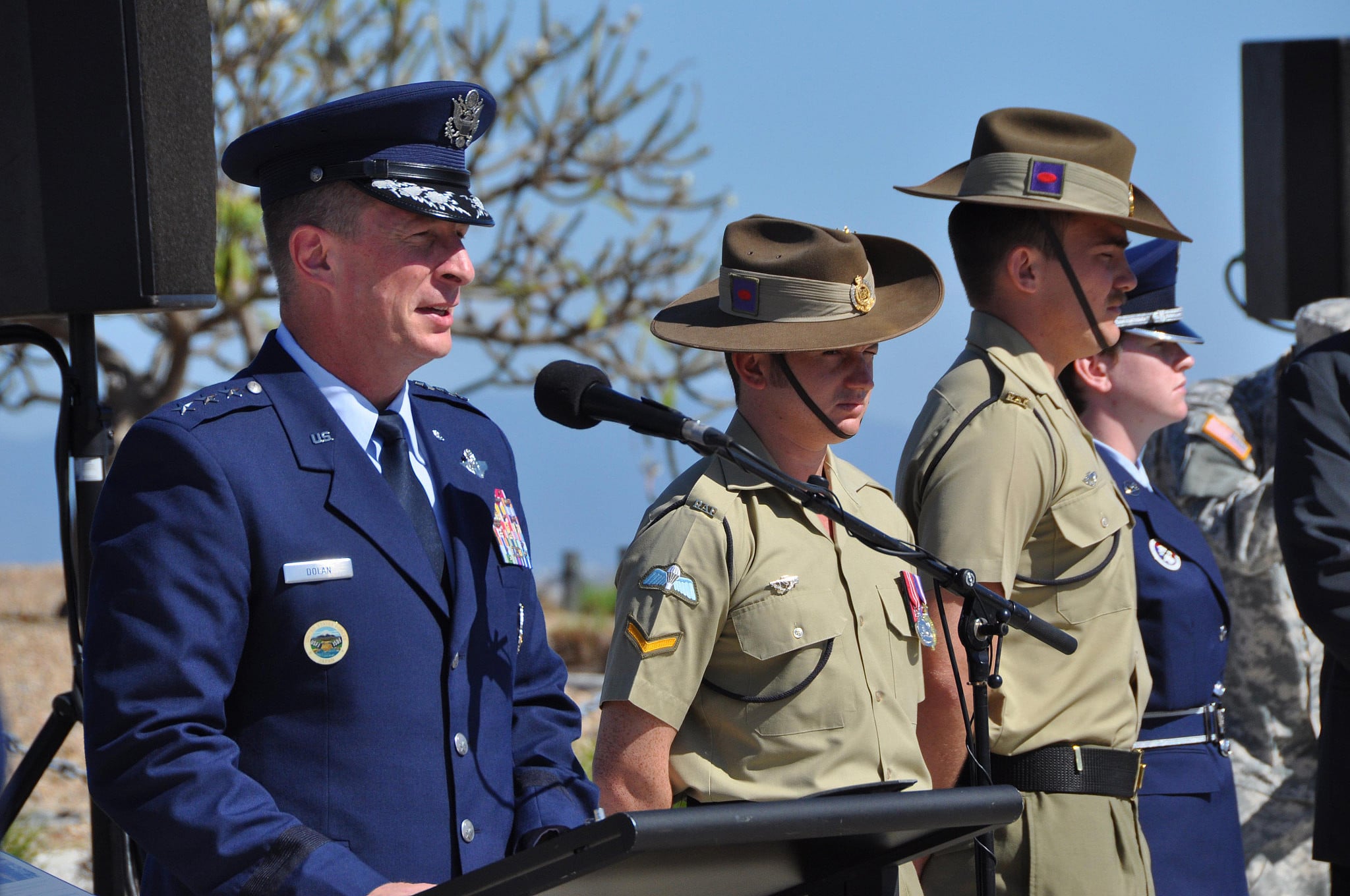
There are times when candor requires a nation to acknowledge a debt. So let it be said plainly: Americans died on Pacific beaches to keep Australia free. That is arithmetic, not metaphor—etched into cemeteries from Arlington to Manila. And let it also be said, with the bluntness Australia’s present leaders so carefully avoid: in recent years, Australia has failed to be the ally America deserves.
This is no apology in the therapeutic sense—words alone cannot offer catharsis. It is a recognition of drift, of eclipse, and of the need to recommit ourselves to the civilizational partnership that has sustained democracy for more than a century.
The failure of Australia’s current leadership is not captured by clichés about “wokeness” or “softness.” The problem is deeper: the importation of therapeutic politics into the domain of strategy. In the classroom, euphemism can defuse conflict. In the boardroom, tact may win trust. But in the realm of missiles, alliances, and deterrence, such habits are misplaced—and dangerous.
Australia’s defense and intelligence professionals, to their credit, present the world as it is: China building artificial islands bristling with missile batteries, Hamas tunneling under Gaza with military purpose, Russia feeding proxies in Ukraine and beyond. Yet when these realities reach the Cabinet table, they are reframed through the vocabulary of counseling. Missiles become “confidence-building measures in a multipolar security environment.” Terror tunnels are redescribed as “community resilience infrastructure.” Proxy warfare is softened into “regional solidarity initiatives.”
This is not sophistication. It is moral blindness dressed in the robes of nuance. The Albanese government mistakes moral equivalence for balance, as if the Chinese Communist Party, Hamas, or Putin were participants in a faculty seminar awaiting their turn to speak. Threats are treated as discursive opportunities, to be managed with language rather than force. The result is paralysis disguised as empathy.
That paralysis is a present danger and a betrayal of memory. The Anglo-American strategic tradition was never sentiment—it was survival. When Churchill spoke of the “English-speaking peoples,” he was not indulging nostalgia but pointing to a concrete inheritance: constitutional government, parliamentary liberty, the rule of law, and the habit of distinguishing between friends and foes. This tradition carried the democracies through two world wars and the Cold War. It produced NATO and the recognition that deterrence required honesty rather than euphemism.
The charge against the Albanese government, then, is not that it is insufficiently pugnacious but that it is fatally misaligned. Strategic language must map onto strategic reality. A missile that can sink an aircraft carrier is not a “confidence-building measure.” To describe it so signals to Beijing that Canberra is more concerned with framing than with facts. Deterrence depends on credibility; credibility depends on clarity. Every euphemism is read in Beijing, Moscow, and Tehran as a concession.
Nor is this merely a matter of rhetoric. Once ministers signal that they mistrust the raw briefings of their intelligence agencies, those agencies adapt. Assessments are softened. Warnings are hedged. A feedback loop emerges: the more resistance briefers encounter, the more they dilute; the more they dilute, the less ministers trust. The end result is corrosion of confidence within the state itself.
Here lies the deepest irony. Australia’s leaders present themselves as cosmopolitans, yet their error is to estrange themselves from their own strategic inheritance. For a century, Australian survival has depended on alliance with the United States, anchored in the shared institutions of liberal democracy. The current government, in seeking to appear balanced, treats this inheritance as a liability. They prefer to signal moral refinement by portraying adversaries as misunderstood actors rather than enemies with agency.
This is not cosmopolitanism. It is provincialism of the most dangerous kind—the conceit that one’s own intellectual fashions are universal. The Chinese Communist Party does not share these frameworks. Neither does the Kremlin. Neither do the ayatollahs. To confuse empathy with strategy is national narcissism, not global sophistication.
The case for renewed alliance is pragmatic. China’s ambitions extend far beyond Asia; they aim to replace the framework of liberty with one of surveillance and control. Putin’s adventurism is nihilistic imperialism, not conservative nationalism. Islamist authoritarianism, whether in Tehran or Kabul, seeks to erase freedom itself. Against these forces, the English-speaking democracies are not relics; they remain the only coherent civilizational counterweight.
This moment presents an opportunity for both nations to move beyond the reflexive patterns of recent decades. America’s evolving political landscape suggests a growing recognition that foreign policy must serve national interests rather than abstract ideals. The populist impulse that has reshaped American politics—often dismissed by establishment voices—contains a legitimate demand for allies who contribute meaningfully rather than freeload. This reflects a maturation of American strategic thinking, a turn toward reciprocity and results rather than isolationism.
Australia can meet this moment by abandoning the comfortable fiction that sovereignty means independence from hard choices. True sovereignty requires the capacity to defend one’s interests, and for Australia, that capacity is inseparable from alliance with the United States. The alternative—strategic drift disguised as “middle power diplomacy”—is a luxury Australia cannot afford in an age when distance no longer provides protection.
The path forward requires candor on both sides. Australia must acknowledge that Chinese investment in universities and infrastructure was strategic naïveté, not economic pragmatism. It must recognize that defense spending below two percent of GDP while facing the greatest military buildup in the Indo-Pacific since 1941 is abdication, not fiscal prudence. And it must understand that criticism of American foreign policy while depending on American protection is moral hazard, not sophisticated analysis.
In return, a more mature American approach to alliance management would recognize that genuine partnership requires shared understanding, not mere compliance. The strongest alliances are built on mutual respect between sovereign nations that choose to stand together—not on dependency. This is the foundation upon which American conservatives have historically built their most enduring foreign-policy achievements.
The deeper truth remains that Australia is populated by citizens who remember the American dead of the Pacific, who know that freedom is neither free nor inevitable, and who understand that solidarity with America is survival, not dependency. The Albanese government’s therapeutic politics represent an aberration, not the essence of the nation.
Eclipse is not extinction. What matters now is recommitment—visible in defense spending, in clarity of language, and in the recognition that euphemism is no substitute for policy. Above all, it must be visible in standing squarely with America and other democracies against those who would see liberty extinguished. Australia’s flirtation with recognizing a Palestinian state epitomizes the strategic blindness now crippling its role in the American alliance.
When the reckoning comes—and it always does—Australians must be ready with resolve, not therapeutic bromides. The Anglo-American inheritance is not a sentimental relic. It is the most successful political tradition in history, and it survives only if those who inherit it are willing to speak plainly, act decisively, and stand together.