


Courtyards and Characters: Wandering Through Jerusalem’s Living Stories
Why did this guy cry in Hebron?
Yesterday I was guiding a couple on their very first trip through Israel. Nice people. Smart and successful people. But not especially religious or ideological. As we started driving out of Jerusalem together, the husband leaned over to me and said:
“Rabbi, I don’t like history, I’m not religious, I’m not spiritual, and I don’t like long explanations.”
I chuckled. But inside I was thinking: Oy vey, I’m in trouble.
Because where was I taking him that day? To the Tomb of the Patriarchs in Hebron. This is possibly the worst possible place for a person who just announced that he dislikes history, spirituality, religion, and long explanations.
Maybe I should have taken him to float in the Dead Sea. Or to spend the afternoon on a beach in Tel Aviv. Or to wander through Mahane Yehuda Market in Jerusalem to eat knafeh and drink microbrewed local beer.
But Hebron?
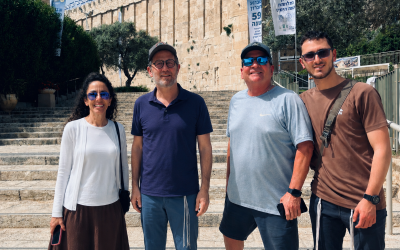
Hebron is intense and ancient, a place where almost every stone comes with layers of history and religion attached to it. To explain Hebron properly, you have to start at the beginning of everything: Abraham buying the cave in Genesis, King David ruling there before Jerusalem, centuries of Jewish communities, massacres, exile, return, religion, politics, and competing narratives.
Hebron is not a “walk around and vibe” kind of place. And yet that was exactly where we were headed.
Driving South
As we drove south from Jerusalem into the hills of Judea along Route 60, past the checkpoint and into the area that we call Judea and Samaria, and what the West calls the West Bank, I kept wondering how this day was going to go. The husband was perfectly pleasant, but clearly not someone looking for a deep spiritual experience. Throughout the morning he asked practical questions about security, geography, and daily life. Nothing suggested he was about to have an emotional breakthrough in Hebron.
Honestly, he had no idea what he was about to encounter.
Hebron itself does not exactly ease people into spirituality. It’s not Judaism for Dummies. My wife told me that I was crazy for taking “first-timers” there and even suggested that I was imposing my interests and ideology on these poor folks.
Hebron is complicated. Soldiers are posted at multiple checkpoints. Narrow roads wind through one of the most disputed cities on earth. Even people who love Hebron usually speak about it with a certain heaviness.
Inside the Tomb of the Patriarchs
Then we entered the Tomb of the Patriarchs, that ancient structure built over the traditional burial site of Abraham and Sarah, Isaac and Rebecca, Jacob and Leah.
The massive Herodian stones are foreboding. The strange mixture of mosque and synagogue vibes is confusing. Hebrew prayer books mix with Mamluk Arabic calligraphy. The minyans of “daveners” shuckle back and forth as the sound of their prayers echoes off walls that have absorbed thousands of years of longing.
Let’s just say, I was wondering why I didn’t listen to my wife. They would have loved that beach in Tel Aviv or the local cuisine in Jerusalem’s main marketplace.
And then, slowly, almost against his own will, this husband started crying. And before long, he was sobbing.
Tears of Belonging
At first he tried to hold it together. He apologized and turned his head away. He managed, momentarily, to regain composure, but every few moments the emotions came flooding back.
“I don’t even know why I’m crying,” he finally said.
Bingo. Now I understood what was going on. Because at first, I wondered if maybe something really difficult was happening in his life. Maybe a loved one was suffering from an illness, or he had recently experienced a deep loss. Now I understood that this was something else entirely.
This wasn’t about something going on in his life. These weren’t tears induced by grief or sorrow. These were tears of feeling a new and unusual, deep sense of belonging.
We know that people do not usually react this way to history alone.
Millions of tourists stand inside the Colosseum every year, impressed and moved by the scale of it all. The age. The engineering. But very few people walk into the Colosseum and suddenly break down crying because they feel existentially connected to ancient Rome.
Visitors stand inside Westminster Abbey surrounded by centuries of monarchs and empires. They can admire the history, even feel moved by it. But for most people, it still feels like someone else’s story.
Most historical sites are experienced this way: you visit them, admire them, learn from them, and move on.
Hebron feels less like visiting a historical site and more like opening an old family photo album, one that has been passed down for generations, and suddenly realizing that it’s your family and the people inside it are your relatives. The reaction is not an intellectual one; it’s pure raw emotion. Like meeting your great-great-grandparents for the first time.
Moments like this suggest that people long to feel connected to something larger and older than themselves.
When History Stops Feeling Distant
The husband I was guiding is not somebody who walks around talking about belonging, ancestry, or spiritual connection. If you had asked him over coffee whether he felt some deep connection to Abraham, he probably would have laughed at the question.
And yet his reaction in Hebron was deep and real. And that’s what interests me.
What exactly are people encountering in places like this?
Perhaps for a moment, Jewish history stops feeling like something in the distant past. Maybe hearing about Abraham and Sarah no longer seems just like Bible stories that we spaced out on as they were being told by boring Sunday school teachers, but instead like close family members whom we are meeting for the first time. Standing before these tombs, Sarah somehow feels less like a Biblical figure and more like a bubbie.
I’m not sure.
And maybe that experience is especially powerful in Israel because history here feels like it’s still going on. In most countries, history seems far in the past, preserved behind glass in the museum you visit.
In Israel, it weirdly feels like history is still happening now, in the present.
Here, ancient history and modern life constantly collide with each other. Biblical names appear on highway signs. Ancient Hebrew returns as the language people use to argue with the person who leaves his cart in line as he goes to seek more items in the supermarket. Archaeological sites sit underneath apartment buildings and coffee shops. Soldiers are fighting wars in the same cities they conquered on biblical pages.
The Story Feels Personal
Maybe that is why some people react here in ways they themselves do not fully understand.
This man who I was guiding that day clearly did not arrive in Hebron searching for meaning. He was not trying to have a spiritual breakthrough. In fact, he would probably hate me describing it that way.
But something undeniable happened to him there anyway.
And honestly, I think what moved him was not religion or G-d connection. I think it was belonging. The feeling, however briefly, that he was part of a story much older and much larger than himself. And that it was his story.
I think something very human happens in moments like that. Most people move through life feeling disconnected from the past, as if history belongs to other people.
And then suddenly, in a place like Hebron, the distance disappears.
The story no longer feels external to them.
It feels like their own.
Driving Back to Jerusalem
Driving back toward Jerusalem later that afternoon, he was mostly quiet.
At one point he shook his head and laughed a little, still embarrassed by the whole thing.
“I really don’t know what that was,” he said.
I think I do, I thought to myself.
And I couldn’t wait to get home and tell my wife: “I told you so!”