Peacemaker, Motivational Speaker
Why didn’t you call me after October 7th?
On October 7th, not just the security of Israel but the soul of Jewish Muslim relations in Los Angeles was dealt a severe blow. Many anti-Zionist activists, influencers, and social media users across platforms responded to the October 7th massacre of Jewish citizens with a mix of outright celebration, glee, and justification for the killings, murder and rape. Some even called for additional violence and praised Hamas terrorists and the Palestinians involved as heroes of the anti-Zionist movement.
But what hurts most is not the outright celebrations of those out there, but the silence of the friends of Jews, who once stood in solidarity and support, but today stand in silence and separation. Los Angeles, a city renowned for its diversity, is unfortunately becoming plagued by antisemitic activities that cannot be ignored. As a resident, I fear for the safety of my Jewish friends and neighbors, and the moral decay that has set in my Muslim world.
At an interfaith Ifthar (Ramadan break-fast) organized by my colleague Anila Ali, of the American Muslim Multifaith Women’s Empowerment Council, along with members of a leading synagogue, we invited an Imam (Muslim religious leader) to lead the Ramadan prayer. The memory of the beautiful evening was marred by the retraction posted by the Imam on social media the following day. He wrote – “I regret participating in the Zionist Ifthar.” Such is the level of hate and ignorance even in the month of Ramadan.
The once vibrant relationships between the two peoples is today, a desolate graveyard of indifference and mistrust.
As a significant segment of the American Muslim community refrains from engaging with or openly condemning acts of violence against Jewish individuals and institutions, the silence raises concerns regarding social responsibility and community relations. This reticence may stem from historical grievances and ongoing conflicts that have shaped Muslim perspectives, but failing to acknowledge and respect Jewish experiences undermines the principles of empathy and solidarity essential in diverse societies.
Today, the air is toxic and mingles heavily in our very divided city. The deeply ingrained Jewish presence and Interfaith solidarity has become a large wound, a sore – cracked open with politics and pain.
Protests across the country, ostensibly demonstrations for various causes, under the umbrella of “Palestine” have today devolved into violence. These incidents are emblematic of the dangerous intersection between protest and hatred, particularly hatred for the Jews and Israel.
Paul Kessler’s life was taken for the simple act of carrying an Israeli flag during a protest march. The protest, which unfolded near the Adas Torah synagogue in Los Angeles turned violent, marking a point of concern that many of us could have never anticipated in our own backyard. This was followed by the vandalism of the Canter Deli with antisemitic graffiti, an act which illustrated the disturbing reality of rising antisemitism in Los Angeles.
These three incidents and a myriad of others, had one common response – the silence of the Muslims. What compounds my worry is this deafening silence from local Muslim leaders regarding these heinous acts against the Jewish people who were once our friends and partners. In times of crisis, community condemnation can serve as a powerful unifier, yet the absence of such statements creates a chasm that undermines interfaith solidarity in our vibrant city- Los Angeles.
October 7, 2023, has forever changed the way Jews will see Muslim solidarity. Jewish-Muslim solidarity has transformed into the pre-10/7 era and the post-10/7 reality.
Many Jews expected that after the world witnessed Hamas’s heinous crimes, responses to the crimes committed by Hamas would be one of shock and unequivocal condemnation.
Instead, in many Muslim circles, responses were silent, they denied Hamas’s wrongdoing and even justified and supported the perpetrators.
At an interfaith lab held at Columbia University, we encountered a profound moment of tension as we encountered three Arab American women in a contentious dialogue concerning the events of October 7th.
Their assertive denial of this date’s significance, coupled with allegations that Israel was propagating misinformation, opened a complex discourse around narratives shaped by conflict.
This exchange underscores the critical need for dialogue in interfaith settings, enabling a space for open and respectful dialogue, as Jews around the world – on campuses, online, and on the streets – are being attacked verbally and physically.
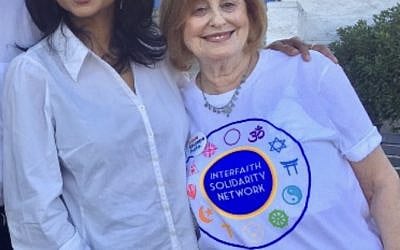
Since October 7th, myself and a group of Muslim women, forming a coalition of women’s organizations led by Anila Ali (CEO AMMWEC), came together to address antisemitism and anti americanism in the United States.
For months we traveled across the United States, held Zoom discussions, spoke at Harvard University, MIT, and Jewish organizations.
From Jewish federations to interfaith organizations from synagogues to one Mosque, we worked hard to bring.Jews and Muslims together, to reconcile with each other. A unifying lament from the Jewish community was that, “They don’t talk to us anymore!”
I was once told that the decision to abstain from Jewish events, expressing concern for rising antisemitism and the refusal to collaborate, do not stem from an intrinsic animosity toward Jewish individuals. Rather, it is often a political statement aimed at advocating for Palestinian rights and drawing attention to perceived injustices by the government of Israel.
Our concerns mount and we assert, we can’t afford to continue to count our offenses against one another. We must focus on repairing the ruptured relationships to improve Jewish-Muslim relationships in our city. Engaging in boycotts can perpetuate divisions, stifling opportunities for reconciliation and shared humanity. In fostering interfaith dialogue and collaboration, communities can work towards a more inclusive and harmonious future, transcending historical grievances and focusing on shared values and aspirations.
In recent months, I have personally engaged in extensive efforts to foster dialogue and collaboration across various communities. From conducting workshops and panel discussions to delivering keynote presentations, my outreach initiatives have spanned diverse venues, including institutions as prestigious as Harvard and organizations ranging from the Jewish Federation to women’s groups and youth organizations. Despite these endeavors, there remains a noticeable absence of participation from the Muslim community.
I recall on one occasion, speaking at Harvard, the room was full of Jewish students and when we inquired as to why there were no Muslim students, we were told that the Muslim Students resist every effort to dialogue and participate. Some even went as far as to declare – “There can be no conversation with Zionists.” This is the state of communication at our institutions of learning.
Unresolved grievances and heightened emotions have led to indifference and hate, increased tensions and Conflict- contributing to social and societal polarization.
Discontent and alienation on our college campuses is aggressively creating an environment conducive to radicalization, as individuals seek out extreme ideologies as responses to perceived injustices.
We must wake up to acknowledge the impact on our youth. Young people may internalize divisions, leading to a cycle of hatred and distrust that could affect future generations. This has begun to hinder cooperative and collaborative initiatives that are essential for building a common future.
I must assert that most attempts to reignite Jewish-Muslim relations stand hollow and empty. The hallways to reconciliation seem empty and desolate. The work we did post October 7th, and the collaborations we were so proud of, where love once thrived, is no more.
Personally for me, the erosion of Interfaith Dialogue has been appalling. We are burning a vital source which is essential for building bridges, fostering empathy, and resolving conflicts.
These incidents raise important questions as to why we have not seen greater engagement from Muslims since October 7? My outreach efforts have been characterized by a commitment to inclusivity and understanding, yet the lack of response from the Muslims suggests a disconnect that warrants exploration. It is essential for us to examine the barriers that may be preventing meaningful participation.
I encourage individuals from within the Muslim community and the Jewish communities to reflect on this situation, engage with those in their networks, to rekindle old friendships and foster new connections. Together, we can cultivate a more inclusive and collaborative environment, preserving the vital dialogue that strengthens our shared commitment to community-building and mutual respect.
The wounds are bleeding, not just in my home city, Los Angeles, but in every Muslim and Jewish heart mired by pain and separation. Indeed the journey toward reconciliation will be a winding road, mixed with challenges and obstacles.
For Jews and Muslims, the People of The Book – One of the great peacemaking stories in scripture relates the remarkable resolution of the mortal conflict between the first born twin Esau and his younger brother Jacob. Jacob places his trust in God and decides to reconcile with his brother.
Jacob sends peace offerings to Esau and they are reunited, demonstrating the potential for forgiveness and restoration even after deep conflict. This sacred story shows just how difficult reconciliation is. It involves risk; it comes with sacrifice, even injury; and takes faith and trust in one’s God. When we do this; and are finally able to see “the face of God” in the face of our enemy and reconcile with our brother; we will be blessed.
We must remember that we share our neighborhoods, schools, and aspirations. By fostering relationships rooted in understanding, we can cultivate resilience against the forces that seek to divide us. It is through these connections that we can enhance safety, promote solidarity, and embody the essence of our shared humanity. The hostilities we experience today, is largely a consequence of geopolitical strife. What we must remember is that left to infest, it threatens the bonds of neighborliness that are vital for our collective safety and understanding.
Let us take the proactive step towards friendship and understanding, reminding ourselves that compassion must prevail over fear.
Today, more than ever, the reconciliation we seek between Muslims and Jews is not merely acknowledging the past, but it must be about building a future. A future with respect, reciprocity and responsibility. A wise rabbi once told me, “Even in the face of adversity, our shared humanity binds us more than our differences divide us.” This ethos serves as a reminder that we are all part of a larger tapestry—a community woven together regardless of the many threads we each represent.
Who will make that first call, reach out, to ask – “Why didn’t you call me after October 7th?”
Soraya M. Deen is a lawyer and Co-chair of the Women’s working group of the International Religious Freedom Roundtable in DC and Sri Lanka. She is a fierce advocate for Israel and the Jewish people. Her work prioritizes addressing Islamic Antisemitism, anti Americanism, hate and religious freedom.
CONTACT Soraya M. Deen to speak at your next event.
E-mail: soraya@muslimwomenspeakers.com
Phone: (818) 395-2032