
CFO | Empower Society for Good I Author
Why Do Jews Fast for Jerusalem?
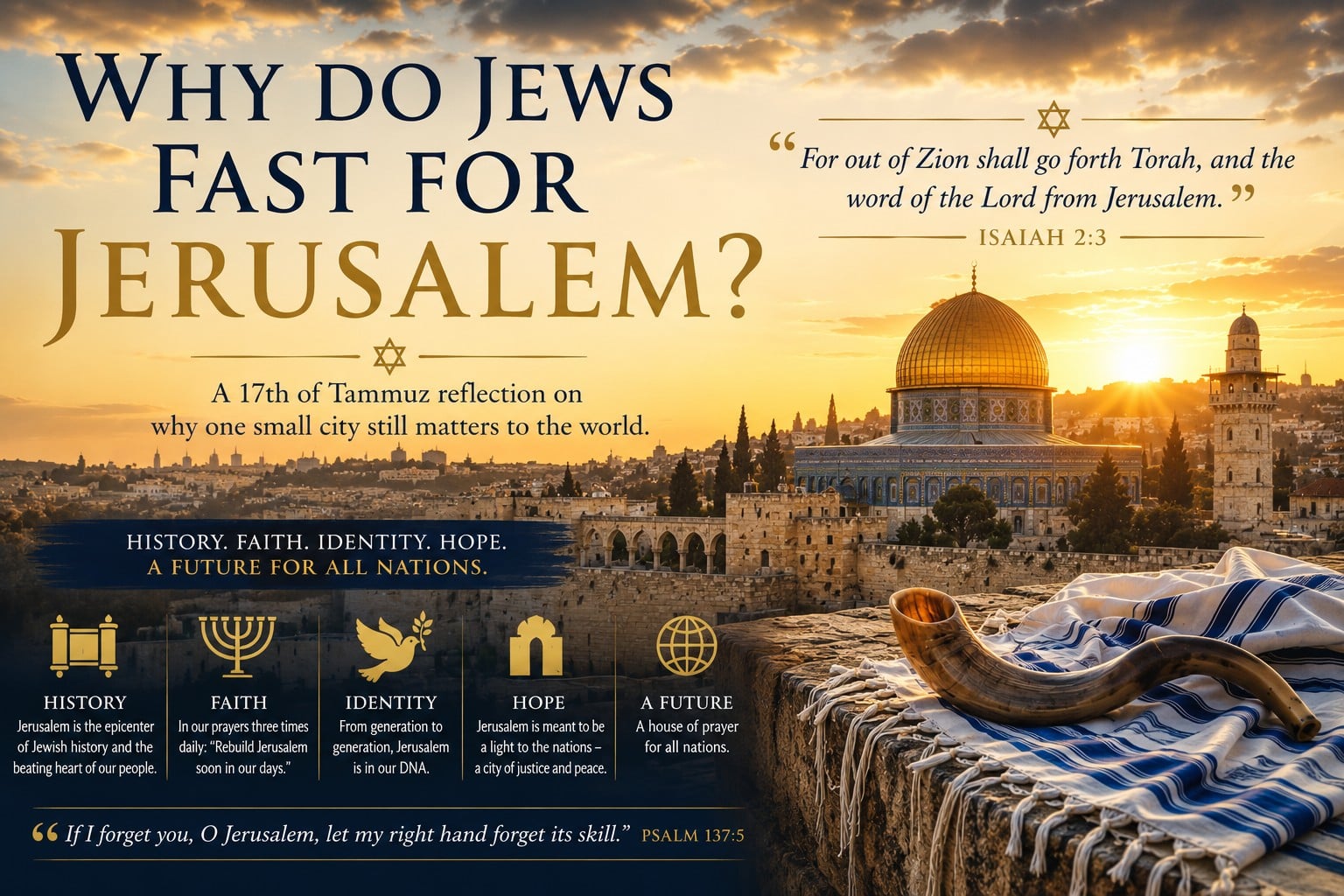
A 17th of Tammuz reflection on why one small city still matters to the world.
I write these words as the sun rises over Jerusalem.
The first light breaks across the hills of this extraordinary city, just as it has for thousands of years. Long before today’s headlines, before kingdoms rose and fell, before empires came and went, the sun rose over Jerusalem.
Today is the 17th of Tammuz, the day that marks the breaching of Jerusalem’s walls before the destruction of the Second Temple in 70 CE. It begins the Three Weeks of national mourning that culminate in Tisha B’Av.
As I fast, I find myself asking a simple question.
Why do Jews still fast for Jerusalem?
Why does the destruction of a city nearly two thousand years ago still shape Jewish life today?
History is full of cities that have been conquered and destroyed. Most have become little more than chapters in history books.
Yet Jerusalem is different.
It is one of the smallest and least geographically significant cities in the world. It has no great river, no oil, no natural harbour. Yet it has become the spiritual heart of Judaism, Christianity and Islam and remains the most contested city on earth.
Why?
Because Jerusalem is about far more than territory.
It represents identity.
It represents truth.
It represents legitimacy.
It represents the question of what kind of society humanity wishes to build.
Jerusalem Is in Our DNA
To understand why Jews still fast for Jerusalem, one must first understand that Jerusalem has never left the Jewish people.
For almost two thousand years, Jews did not simply remember Jerusalem during times of crisis.
We remembered Jerusalem every single day.
At the end of every Passover Seder, after retelling the story of freedom from Egypt, Jews conclude:
“Next year in Jerusalem.”
Not next year in London.
Not next year in New York.
Not next year in safety or prosperity.
Next year in Jerusalem.
After every meal, in the Birkat Hamazon (Grace After Meals), Jews pray for God’s mercy on Israel and for the rebuilding of Jerusalem.
Three times every day, in the Amidah, Jews pray:
“Return in mercy to Jerusalem Your city… Rebuild it soon in our days.”
Even at Jewish weddings, at the height of our joy, we break a glass and remember Jerusalem.
Psalm 137 reminds us:
“If I forget you, O Jerusalem, let my right hand forget its skill.”
Generation after generation.
Century after century.
Whether in Babylon, Spain, Morocco, Yemen, Iraq, Ethiopia, Poland, South Africa or America, Jews faced Jerusalem in prayer.
Jerusalem is not simply part of Jewish history.
It is part of Jewish identity.
It is woven into our prayers.
Our festivals.
Our homes.
Our celebrations.
Our mourning.
It is, in many ways, in our DNA.
This is why attempts to erase or deny the Jewish connection to Jerusalem are experienced by Jews not merely as historical inaccuracies, but as a denial of who we are.
One cannot understand the Jewish people without understanding Jerusalem.
Nor can one understand Jerusalem without understanding the Jewish people.
The Competing Visions of Jerusalem
For Jews, Jerusalem is not simply a capital.
It is the city from which the prophets envisioned a better world.
Isaiah proclaimed:
“My house shall be called a house of prayer for all nations.”
And:
“For out of Zion shall go forth Torah, and the word of the Lord from Jerusalem.”
The Jewish vision is remarkable.
The purpose of Jerusalem was never simply Jewish sovereignty.
It was to become a source of justice, wisdom, truth and moral responsibility for all humanity.
For Christians, Jerusalem is where Jesus lived, died and, according to Christian belief, rose again.
For Muslims, Jerusalem is home to Islam’s third holiest site.
Yet for radical Islamist movements, Jerusalem has become something very different.
Hamas deliberately named its October 7 massacre “Al-Aqsa Flood.” The name itself reveals that this conflict is not merely about borders or settlements. It is about Jerusalem and competing claims to its future. For these movements, Jewish sovereignty over Jerusalem is viewed as religiously unacceptable.
Many Muslims reject extremism and seek peaceful coexistence.
But neither should we whitewash the reality that Jerusalem has become the centre of a profound theological struggle. Lasting peace requires honestly confronting that reality, not pretending it does not exist.
Why We Still Fast
The Hebrew prophets taught that Jerusalem’s holiness never depended merely upon its stones.
It depended upon justice.
Compassion.
Responsibility.
Truth.
When those values disappeared, the walls eventually fell.
Perhaps that is why Jews still fast.
Not because we cannot let go of history.
But because history warns us that societies collapse from within before they are conquered from without.
Division.
Hatred.
Corruption.
The loss of shared purpose.
The walls are first breached in the human heart before they are breached in stone.
As I watch another sunrise over Jerusalem, I realise that my fast is not about mourning the past.
It is about accepting responsibility for the future.
Jerusalem is not meant to be a trophy of conquest.
It is meant to be a responsibility.
If Zion is truly to become “a light to the nations,” then those who love Jerusalem must be known not only for defending it, but for pursuing justice, truth, compassion and human dignity.
That is the Jerusalem I pray for.
That is the Jerusalem worth fasting for.
Final Thoughts
Perhaps that is why the world struggles to understand Jerusalem.
For many, it is simply another disputed city.
For Jews, it is the thread that has connected every generation for more than three thousand years.
We prayed for Jerusalem while living in Babylon, Spain, Poland, Yemen, Morocco, Ethiopia, South Africa and America.
We face Jerusalem in prayer.
We end the Passover Seder with “Next year in Jerusalem.”
We pray after every meal for the rebuilding of Jerusalem.
Three times every day we pray for Jerusalem.
Even at our weddings, our greatest moments of joy, we remember Jerusalem.
This is not politics.
This is Jewish memory.
This is Jewish identity.
The prophets did not envision Jerusalem as a city that excluded the nations.
They envisioned it as the place from which God’s truth and moral law would radiate to the world.
That vision cannot be fulfilled by denying Jewish history, erasing the Jewish connection to Jerusalem, or pretending that the First and Second Temples never stood there.
Truth must come before reconciliation.
Recognition must come before peace.
I fast because I believe Jerusalem still has a future.
I believe the day will come when Jerusalem will truly become “a house of prayer for all nations.”
Perhaps that future will include a rebuilt Jewish place of worship on the Temple Mount, existing alongside the Muslim holy sites—not as an act of conquest, but as a testimony that Jerusalem can become what the prophets envisioned: a place where people of different nations come together in reverence for the One God.
Impossible?
Perhaps.
But if we cannot imagine such a future, we have already surrendered to perpetual conflict.
Questions to Ponder
- Why do Jews continue to fast for Jerusalem after nearly two thousand years?
- Why has Jerusalem remained central to Jewish prayers, festivals and identity for over three millennia?
- Can there ever be lasting peace if Jewish history, the Jewish connection to Jerusalem, and the historical location of the First and Second Temples are denied or erased?
- Why does one small city inspire such extraordinary devotion, conflict and hope?
- Is the conflict over Jerusalem fundamentally about land, or about competing religious visions?
- If Jerusalem is meant to become “a house of prayer for all nations,” what would that look like in the twenty-first century?
- Could there ever be lasting peace if any future Jewish place of worship on the Temple Mount is considered impossible?
- Is it time to begin imagining the Temple Mount as a place where Jewish and Muslim worship could coexist, reflecting Isaiah’s vision rather than humanity’s divisions?
- Finally, when I fast on the 17th of Tammuz, am I remembering only what was lost—or am I recommitting myself to helping build the kind of society Jerusalem was always meant to inspire?
“If I forget you, O Jerusalem, let my right hand forget its skill.” (Psalm 137:5)
Perhaps remembering Jerusalem is not only about remembering a city.
It is about remembering the values upon which every good society ultimately depends.
Related Topics