
Left is not a dirty word
Why do you ask?
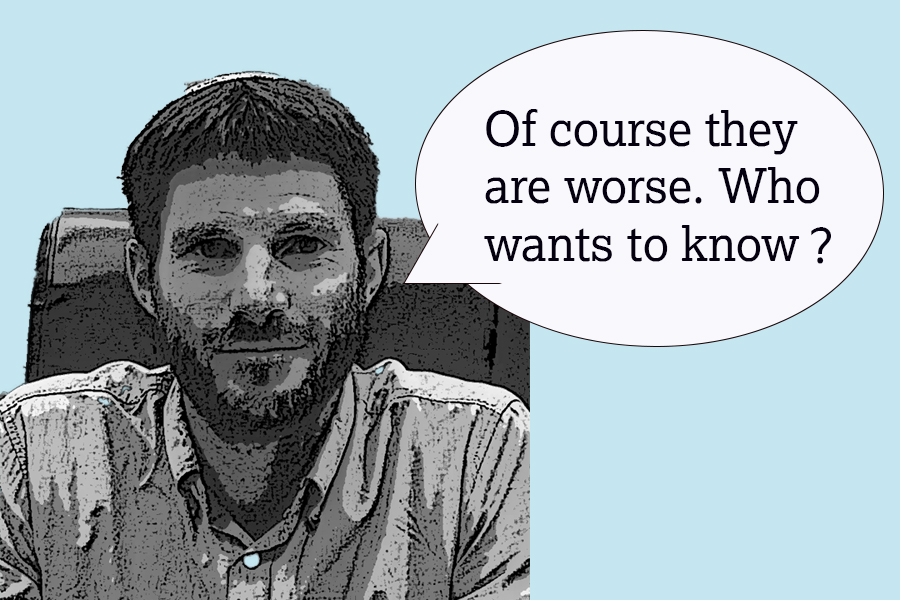
Finance Minister Betsalel Smotrich recently said, in a widely-quoted radio interview, that including an Islamicist party in the government coalition (referring to the previous coalition led by Naftali Bennett) was much, much worse than the Likud’s governmental errors that led to the Oct. 7 massacre and the onset of war with Gaza. Opposition politicians immediately jumped into the fray to denounce what was, I hope we can all agree, a horrific statement.
“One second,” I asked myself, “Why did the interviewer ask such a specific, leading question – one in which Smotrich was bound to belittle the mistakes made by Bibi and his minions, while heaping scorn on decisions made by Bennett and his party (which governed for a little over a year until the Likud’s underhanded tactics forced them out)? On the other hand, did he really ask Smotrich to compare, on air, the faulty decisions that led to the bloody Oct. 7 invasion with the inclusion of a legitimate political party in the government?”
Obviously, Smotrich’s answer had little to do with facts, truth or the future of the State of Israel, and everything to do with politics. Because, for all of his current power, Smotrich heads a small sliver of a party, on a political wing that was willing to let the hostages rot underground while IDF troops rolled heavy tanks from Gaza City to Rafah. It includes those who had hoped to raze Gaza and retake it for Jewish settlement. It includes those busy terrorizing Muslim residents of the West bank. And when it comes to the “alleged” errors Bibi and his advisers committed, admitting there were probably egregious cabinet-level mistakes might hint at the desirability of an independent commission – the kind most of the country wants, according to polls – to investigate, rather than a “national commission” in which the commissioners are appointed by those suspected of those deadly errors.
When it comes to demonstrating loyalty, Smotrich knows which side his bread is buttered on, and it’s not slathered with the fresh butter that comes from kibbutzim and moshavim – farms he wants to shut down. Oily margarine is fine with him, if it lets him control the money.
The statement itself was awful enough, but its consequences may be worse. Let’s start with the fact that, in the year Bennett ran things with the Ra’am party led by Mansour Abbas in his coalition, we did not engage in any wars. Inequality started to shrink. The Ministry of Internal Security had started making inroads into the problem of crime in the Arab sector. And for the first time, we could say aloud that most of our collective biases and prejudgments were wrong. That “all Arabs” do not think one way, hate Jews or want to kill us all. The country, during that period, was pretty much ok. So where, Mr. Smotrich, was the mistake?
To win back that power, the rest are jumping on the racist bandwagon – the one built by Bibi with his unscrupulous manipulation of public opinion.
Smotrich is voicing what appears to be, if not a terribly popular opinion, one that has some clout in election politics. These days, leaders of every party from the so-called center to the right – about 7/8 of the “Zionist” parties – have to proclaim they will only sit in a government with Jews. They are proudly Zionist. They will never, ever (read their lips) sit with an Arab party. That includes Bennett, who is busy declaring, in his staunchest voice with a solemn squint, that he will not repeat his previous action.
And that, right there is the problem. Bibi and the Likud managed to topple Bennett’s government and retake power on the racism platform. And to win back that power, the rest are jumping on the racist bandwagon – the one built by Bibi with his unscrupulous manipulation of public opinion. Every one of them declares, assertively, that only Jews are worthy of sitting in the government coalition. They would rather have the likes of Ben-Gvir – far-right trouble-makers who leave chaos in their wake, push endless war on our army and population, and turn the world against us. They would rather have the ultra-orthodox parties who extort billions in taxpayer money to support schools that do not teach their kids math or science, while refusing to contribute, in any way. They would rather pander to extremists, turning a blind eye to crime in the West bank in Lebanon and Gaza – as long as it is perpetrated by Jews.
Most politicians are not generally asked questions that are quite so leading as the one Smotrich answered, but they are all asked, in interviews, some version of the question as to whether they would sit with an Arab party, should they be asked to form a coalition. Predictably, only Yair Golan, head of the Democracy party, has come out in favor of sitting with Ra’am. Alas, Golan’s chances of being asked to form a coalition are slim.
I get it. “Israel after Oct. 7” has become a kind of slogan – one that suggests that up to Oct. 6, we were naïve, believing the status quo was working, while after that date, we realized we need to trust no one, fight enemies on every front. That includes, according to many, the “enemies within.” The entire Arab population of the country is, by the new definition, one with Hamas, Hezbollah and other Jihadist groups.
This is the kind of racist thinking that creates situations in which our army is overextended, still fighting on two or three fronts. It is the thinking that has brought us to a standstill in Gaza and Lebanon, holding on to territory that is not ours, fighting through ceasefires as the “next stages” refuse to magically appear. It is the thinking that tells Israelis on the northern border they must keep to their bomb shelters day after day, while listening to empty promises from those sitting safely in Jerusalem. Because, we are told, we are surrounded by horrible, vicious enemies and our only choice is to fight.
If a coalition made up of opposition parties wins on a platform meant to do nothing but get rid of Bibi; if they scramble to wave their right-wing credentials, jumping over their pupiks, as we say in Hebrew, to be more war-like than their predecessor, excoriating Arabs and talking to us in short, declarative sentences about security and winning – what will really have changed? Will we get a slightly more honest version of the same thing?
The thing is, not only do we have a choice, but we have a right to demand choices. We do have the right to demand parties that can form a coalition based on rational decision-making. And if the rational decision – the one that might produce the best outcome for all citizens of the country – involves sitting with an Arab party, then that should be what happens. Real choices would enable us to make rational decisions in the voting booth, rather than voting with our emotions, on whether we love or hate ___fill in the blank.
It is, of course, no secret who I sincerely dislike here. But I would prefer it if more of the politicians running for office did not just jump on Smotrich for seemingly belittling the trauma of Oct. 7, or seem to think he was offensive but don’t completely reject the sentiment. I would like politicians who point out that Arab citizens of the country have been hiding out in bomb shelters, just like Jews, over the nearly three years of war, that they were killed alongside Jews on Oct. 7. I would like politicians who don’t just offer the knee-jerk reaction, who don’t just jump on the racism train because they think it will bring them votes. I want politicians who oppose the current toxic narrative, in its entirety, who seek alternatives, and yes, who think that Arab parties do have a place in a country that is 20% Arab, and that some of those parties can play a real role in making this country a better place for all its citizens to live.
Related Topics
Related Posts