
Former journalist, now a grumpy old man
Why does a hatred of Israel become a hatred of Jews in general??
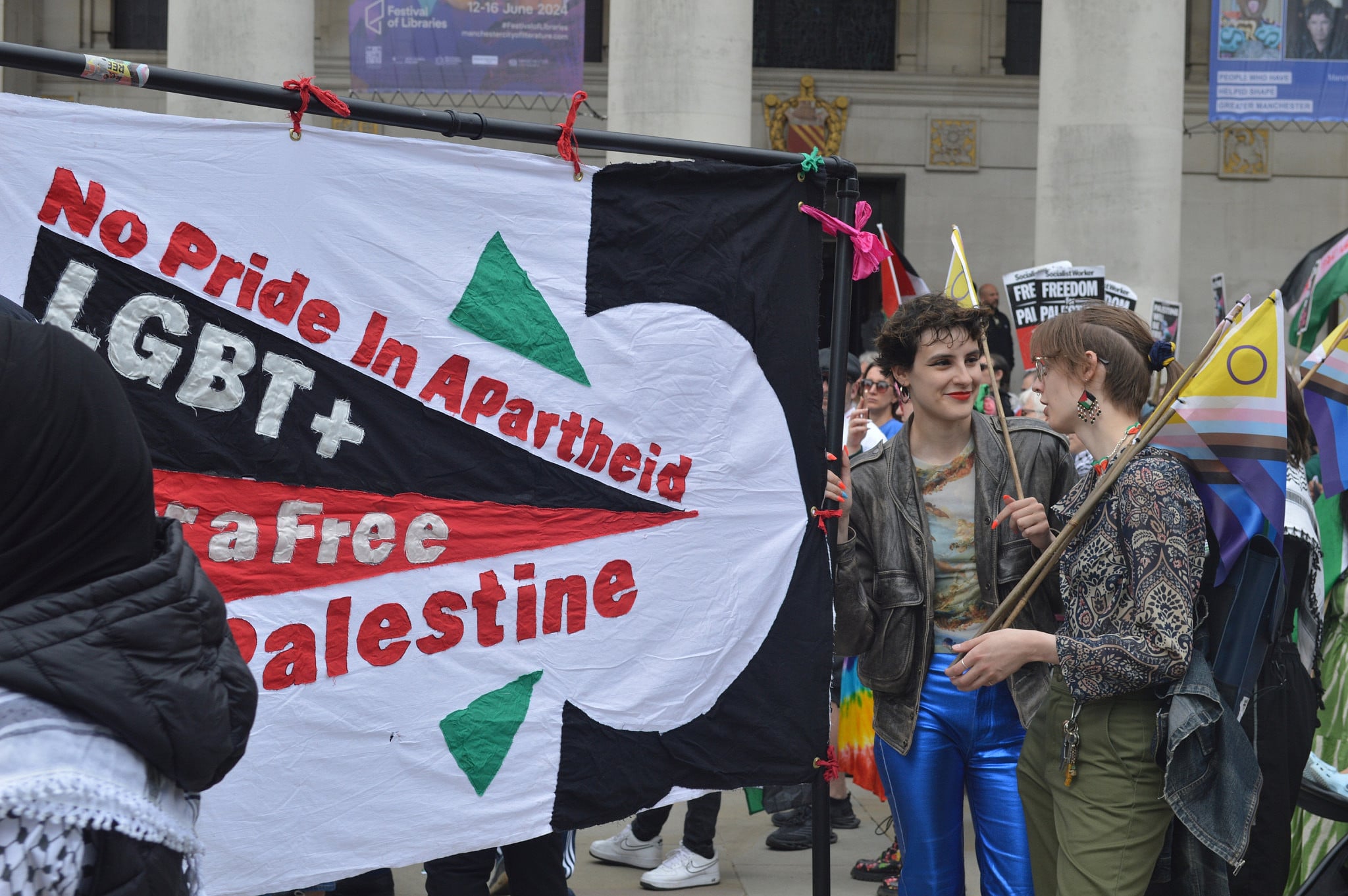
Do Green Party activists in the UK really know how the truth as to how they would be treated in Gaza? Photo: Ed Moss
Advice: this is an in-depth long-form read
There is a question that the Green Party, Your Party and the Workers Party of Great Britain need to answer honestly and directly. At what point does their relentless condemnation of Israel cease to be legitimate political criticism and begin to contribute, however indirectly, to an atmosphere in which Jews in Britain are blamed for the actions of a government over 2,000 miles away?
I ask that question not because I believe Israel should be above criticism. It most certainly should not. Support for Palestinian rights is not inherently antisemitic, although there is a fine line that certain British politicians cross at every available moment. Out of habit.
I do have considerable sympathy for ordinary Palestinians who have endured some quite appalling suffering, nearly all of their leadership’s making. I especially sympathise with Palestinians who live under the rule of Hamas, those who have no say in the decisions made in their name, and with Palestinians who dare to speak against Hamas and risk intimidation or worse. Their suffering deserves rather more than to be turned into a political slogan.
No, my concern is something different.
It is the increasingly one-dimensional political narrative in which Israel is presented as the source of virtually everything wrong in the Middle East, while Hamas’s ideology, terrorism, repression and stated objectives are either minimised, ignored or treated as inconvenient background.
That matters because political rhetoric does not exist in a vacuum.
The Green Party, Your Party and the Workers Party are not themselves primarily responsible for every person who shouts “Zionist” at a Jewish person, attacks a Jewish business, daubs graffiti on a synagogue or assaults somebody because they are Jewish. Nor should anybody pretend that they are. But neither should politicians pretend that words have no consequences. Britain’s Jewish community is not Israel.
While Your Party, led by former disgraced Labour leader Jeremy Corbyn is very much a fringe, hard-left, socialist Marxist grouping, and the Workers Party is led by the opportunistic former MP George Galloway, both are threateningly ideological when it comes to Jews. However, while the Green Party is established fairly worldwide as part of the Green movement, in the UK, they have clearly shown a deliberate shift away from climate concerns to an anti-war, not, surprisingly, fixated on Judea, Samaria and Gaza. They rarely, if ever, mention other world conflicts apart from, in essence, but not quite de facto, supporting the regime in Iran.
The Greens (in the UK) now have a very strange mixture of policies, all very much aligned with hard-left socialist, and some may say, ideals that, in the long run, were they to accede to power, would not only break the economy of the country, but the social fabric too. Their most recently elected (in a constituency in Greater Manchester) member of Parliament, Hannah Spencer, in her maiden speech to the UK Parliament, actually did not mention the traditional environmental issues or net-zero policies that were once the bedrock of Green Party Politics.
And as I was writing this, the Green Party Leader in the UK, Zack Polanski, a Jew, is making a bid for the soon-to-be vacated seat of former Prime Minister, Sir Keir Starmer. Yet some of his party members are concerned that he is not pro-Palestinian enough.
This is the awful state of British politics in certain parties in the UK. A total fixation on Gaza to the exclusion of issues that are of direct concern to constituents and their families. Their cost of living, unemployment, energy prices, transport issues, health issues. All discarded for a conflict some 2,500 miles away from their constituency.
The Community Security Trust (CST) recorded 3,700 antisemitic incidents in Britain in 2025, the second-highest annual total it has ever recorded. In 1,977 cases, or 53 per cent, the perpetrator referred to Israel, Gaza, Hamas, 7 October or the subsequent war. CST found explicitly anti-Zionist ideas alongside antisemitic abuse or targeting in 1,766 cases.
CST recorded seven antisemitic incidents associated with the Green Party in 2025, as well as one associated with Your Party and one with the Workers Party of Britain. Those numbers should not be misrepresented. CST itself warns that they cannot be used to measure the amount of antisemitism inside any party, nor to establish that the party itself was responsible.
That in itself does not prove that the Green Party, Your Party or the Workers Party caused those incidents. It does, however, demonstrate something very important. Political arguments about Israel and Palestine are demonstrably capable of becoming anti-Jewish hatred when they cross the line from criticism of a state into hostility towards Jews.
A Jewish shopkeeper in London is not Benjamin Netanyahu. A Jewish pensioner in Manchester is not the Israeli Defence Force. A Jewish student in Birmingham is not responsible for what happens in Rafah. A British Jew who has not visited Israel, who may not hold a particular opinion about Israeli governments, cannot be treated as though he or she is an extension of the Israeli state. But this becomes blurred when political language repeatedly reduces a complicated conflict to a morality play of Israelis as aggressors and Palestinians as victims. All the time. Without let-up. The figures following should render any sentient politician very uncomfortable.
But surely the correct response is neither denial nor complacency. It’s to ask whether political organisations, which devote enormous energy to demonising only Israel while ignoring other far more serious conflicts in the world, are acceptable. No, it is not. They have an equally vital responsibility to make absolutely certain that their supporters understand the distinction between Israelis, the Israeli government, Zionists and Jews. Sadly they do not stress this enough. They make the usual perfunctory gestures about “taking antisemitism very seriously”. Do they really do that? No, they don’t.
The Green Party itself does recognise this problem, but in a rather “swept under the carpet” manner. Its Jewish Greens guidance specifically warns against using “Zionists” or “Zios” as substitutes for Jews, against confusing British Jews with the Israeli government and against glorifying violence.
That is welcome. But some of the membership, including seniors in the party, seem to take no notice. For example, being repeatedly caught out on the back foot for being blatantly antisemitic on their private postings, with what they always, without fail, suggest “was an error on their part and they apologise”.
Are they really that innocent, or are they leveraging the fact that when you say something on the internet, it can’t be unsaid? I may be wrong. But I seriously doubt that I am given their fixation on Israel.
Political parties should be judged not merely by the disclaimers contained in their guidance, but by the overall political culture they help create and ultimately maintain. And yes, political parties are responsible for what their members say in private, because when you post something as a known ‛activist’, it is because your supporters know you are a member of one of the parties.
There are ‛nasty’ people and politicians in all parties. It’s just that far-left and socialist parties now have a proven track record. People don’t join these parties for the fun of it.
The place Hamas has in the debate is where I believe the three parties have a particularly serious obligation. Hamas is not simply an inconvenient irritation in the conflict.
The organisation’s 1988 founding charter contained profoundly antisemitic material, including conspiracy theories about Jews and an explicit religiously framed commitment to armed struggle and the destruction of Israel. Hamas’s 2017 political document was less explicitly antisemitic and indicated that a Palestinian state based on the 1967 borders could be acceptable as a matter of national consensus, but it still refused to recognise Israel and retained the concept of liberating all of Palestine.
Hamas is also not merely a cuddly, historical organisation. Britain proscribed Hamas in its entirety as a terrorist organisation in 2021. The Home Office describes Hamas as a single terrorist organisation rather than accepting a moral distinction between its political and military wings. But you only have to listen to the political debate in Britain. How often do we hear the Green Party, Your Party or the Workers Party discuss the Hamas ideology which preceded the present war?
How often do they discuss the consequences for Palestinians of living under Hamas, explicitly condemn Hamas’s repression of Palestinian dissent or explain to their supporters why Israel believes it cannot simply assume that Hamas will peacefully coexist with it?
Yes, there is a perfectly legitimate argument to be made about whether Israel’s military response has been proportionate, whether particular Israeli actions comply with international humanitarian law, whether settlements should continue, whether arms should be supplied and whether a different strategy could have saved lives. But those arguments become intellectually dishonest if Hamas is removed from the equation.
The part I find most troubling is what these three parties are actually encouraging. I’m not suggesting that the Green Party, Your Party or the Workers Party secretly want Jews attacked, but it’s something considerably more subtle, and potentially more dangerous.
Political parties can create a vocabulary. They can repeatedly parrot to their supporters that only one country is evil, illegitimate, responsible and deserving of punishment. Supporters should understand the distinction between opposing a government and attacking an ethnic or religious group. But sadly, so many don’t. Or don;t want to.
Some will know remarkably little about the history of the Middle East and will have never heard of the 1948 war, the Egyptian administration of Gaza, Jordan’s control of the Judea and Samaria, the Oslo process, Hamas’s 1988 charter or the reasons why Israel regards Hamas as an existential threat.
Some may know little beyond what they have encountered on TikTok, X, Instagram or at demonstrations. And some, frankly, may simply enjoy Jew-hatred. As I mentioned, that last group exists in every political movement. The big danger arises when sophisticated political organisations indoctrinate less sophisticated or even just stupid people with an apparently respectable vocabulary through which their hatred can be expressed.
“Jew” can become “Zionist”. “Kill the Jews” can become “globalise the intifada”. “Destroy Israel” can become “from the river to the sea”. That many don’t know which river or which sea they wish to chase Jews from makes it all the more worrying. Fighting for a cause they in reality have no clue about.
Then an ordinary British Jew, probably from a family with a long British lineage spanning a hundred years and possibly many more, suddenly discovers that their business, synagogue, school or community organisation is being treated as a legitimate battlefield in a conflict thousands of miles away. That is not Palestinian liberation. That is simply ignorant, imported hatred. Political parties have a duty to put the brakes on. Firmly and without hesitation.
The Green Party, Your Party and Workers Party are perfectly entitled to oppose the Israeli government. The list of what these parties can do is a long one.
They are entitled to demand a ceasefire, advocate Palestinian statehood, campaign against settlements, criticise Israeli military operations, support certain sanctions, but not selective, hypocritical BDS ones and even argue that Israel may have committed serious breaches of international law.
But with those rights comes responsibility. And from a moral standpoint alone, this following list is perhaps longer.
They should be equally emphatic that British Jews are not Israel, condemn antisemitism whenever it appears in pro-Palestinian politics, rather than treating it as an embarrassing distraction, condemn Hamas terrorism without qualification, acknowledge Hamas’s repression of Palestinians, explain the Hamas ideology which makes Israel so deeply distrustful of its intentions, acknowledge the enormous complexity of Jewish history in the region.
And they should tell their supporters, over and over, and with conviction. Do not vent your anger at Israel at a Jewish shop in Britain, at a synagogue, at a Jewish student or at a British Jew who has nothing whatsoever to do with the Israeli government.
That is the test. These parties have a responsibility to demonstrate that their rhetoric is not contributing to the vile occurrences against Jews, their institutions or their businesses. And I remain unconvinced that these three parties have yet done even near enough.
Because when hatred of Israel repeatedly spills over into hatred of Jews in Britain, it is no longer sufficient for these politicians to say, with a soporific look on their faces when questioned, “That isn’t what we meant.” They must ask themselves whether their supporters are hearing something rather different. Or pretending not to hear because they are not being told right from wrong.
They should not fan the flames and then blame somebody else for the fire.
Related Topics
Related Posts