


Why Friendship with Israel Doesn’t Match the Voting Record
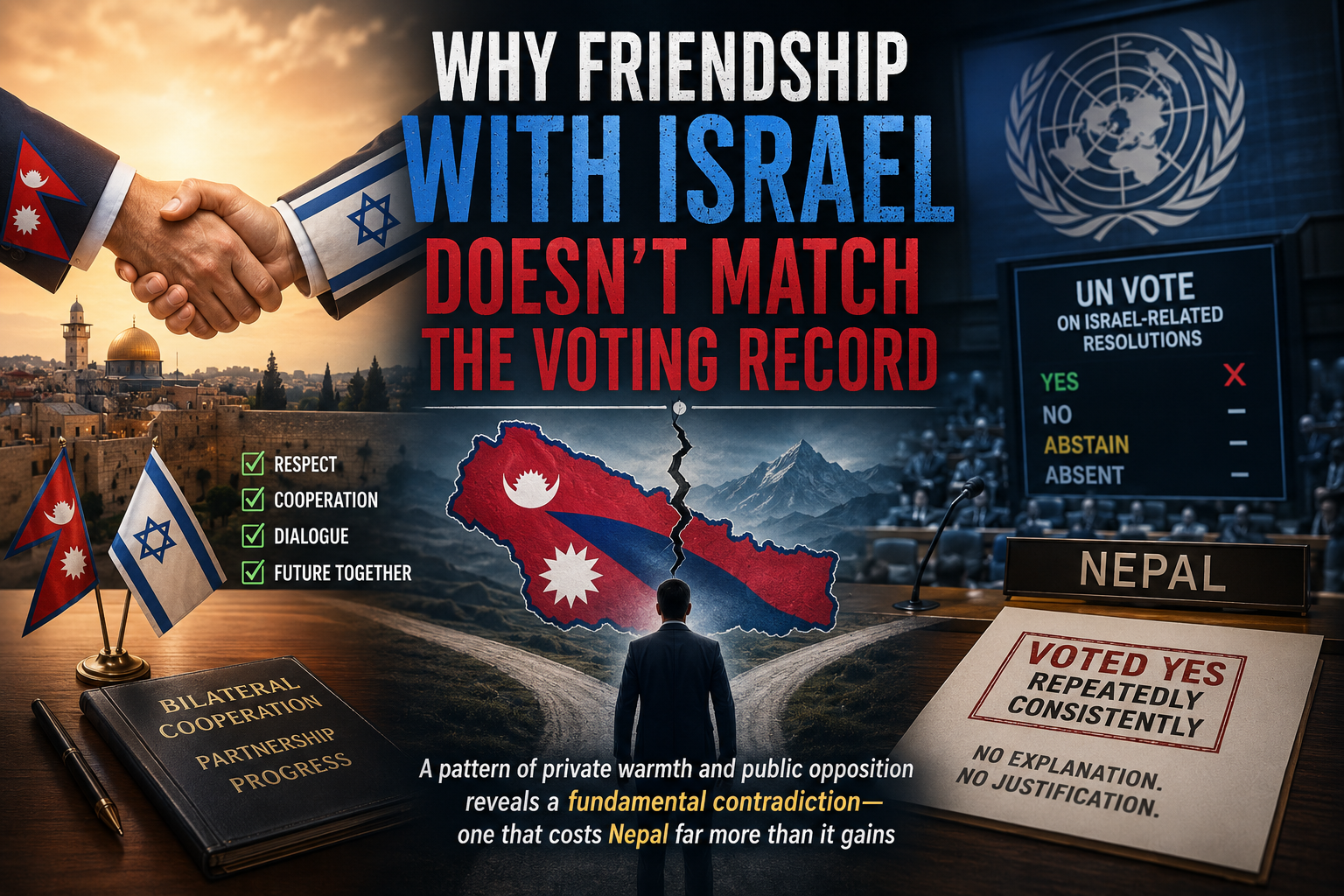
The Central Contradiction
In private meetings with Israeli diplomats, Nepal’s government officials are remarkably consistent. They offer the same message every time: “We value our bilateral relationship. We respect Israel. We want to strengthen ties. Our new government is reviewing our policies with fresh eyes.”
Then Nepal goes to the United Nations and votes against Israel.
Not once. Not occasionally. Repeatedly. Consistently. Without explanation.
This isn’t diplomatic nuance. This is a contradiction that undermines Nepal’s credibility, damages its relationship with Israel, and reveals something troubling about Nepal’s actual control over its own foreign policy.
The voting records don’t lie. And neither do the private meetings. But they can’t both be true at the same time.
The Pattern That Keeps Happening
Let me be specific. This isn’t a one-time anomaly we can excuse as a mistake or miscommunication.
In 2024-2025: Multiple UN General Assembly resolutions on Palestinian humanitarian issues resulted in Nepal voting YES. Meanwhile, when resolutions on Israeli security or defensive actions came up, Nepal was often absent or didn’t initiate counter-votes. The result: Nepal votes against Israel when voting occurs, but doesn’t show equivalent effort voting for issues Israel cares about.
In May 2026: The WHA79 World Health Assembly resolutions on health conditions in occupied Palestinian territory and Syrian Golan came up. Nepal voted YES on both. No explanatory statement. No indication this reflected a policy review or principled decision. The pattern simply continued as if nothing had changed.
The consistency is damning because it reveals something more troubling than disagreement: it reveals institutional habit masquerading as policy.
Nepal’s UN delegation votes the way it always has. Without apparent direction from elected government. Without explanation. Without regard to the contradiction with bilateral signals. In the last decade, Nepal has demonstrated diplomatic instability in various forums of the United Nations. Sometimes Nepal has stood up for the sovereignty and integrity of small nations and sometimes it has remained silent. Nepal has not been able to take the same stand in two incidents of the same nature. The main foundations of Nepal’s foreign policy are subjected to Non-alignment, UN Charter, mutual respect for each other’s territorial integrity and sovereignty, non-interference in each other’s internal affairs, respect for mutual equality, non-aggression, peaceful settlement of disputes, cooperation for mutual benefit and world peace, etc. But Nepal does not seem to be stable at the base.
Israeli Officials-The Foreign Minister’s Meeting
Foreign Minister Sishir Khanal made signals that created expectations.
He met with Israeli officials on 20 April 2026, where he discussed bilateral and multilateral issues during the meeting. A source says, “He made statements suggesting openness to policy review.” There was an expectation on Nepal’s new government policy, which would take a fresh look at longstanding positions. The subtext was clear: Nepal would “look seriously into Israel’s concerns.”
But when the WHA79 votes occurred in May 2026, nothing changed.
Nepal voted YES. The institutional pattern continued unchanged. The Foreign Minister’s signals meant… what, exactly?
This is where the problem becomes acute.
This gap between signals and actions creates three possible explanations, and none of them is good for Nepal.
Explanation One: The Foreign Minister is Genuine But Powerless
Maybe Khanal genuinely wants better Israel relations but cannot enforce this through Nepal’s bureaucratic apparatus. Maybe Nepal’s career diplomats, particularly the Secretary and Joint Secretary for International Organizations, maintain voting patterns regardless of elected leadership wishes.
If this is true, it reflects institutional failure. A democratically elected government should control its own foreign policy. If the Foreign Minister cannot implement his own stated policy, the problem isn’t with Israel policy. It’s with Nepal’s governance.
But here’s the problem: this interpretation makes Khanal’s future signals diplomatically worthless. If he cannot or will not deliver on promises, why should Israeli officials trust anything he says?
Explanation Two: The Foreign Minister Was Playing Theater
Maybe Khanal’s private statements were diplomatic courtesy. He told Israeli officials what they wanted to hear in bilateral meetings, but these words reflected no actual policy intention.
If this is true, the UN vote represents Nepal’s true position. Private meetings are courtesy; public votes are policy.
This interpretation damages Nepal’s reputation. It suggests Nepal’s government cannot be trusted. If a Foreign Minister’s private statements are meaningless, why engage with Nepal diplomatically at all?
Explanation Three: There Is No Policy
Maybe Nepal’s elected government never actually formalized a decision about Israel policy. The Foreign Minister made hopeful signals without cabinet approval or formal government directive. When voting time came, no directive reached the delegation, so career diplomats defaulted to institutional precedent.
If this is true, it reflects policy incoherence. Nepal’s government hasn’t decided what its Israel policy is. It’s hoping for good relations with Israel while allowing institutional voting patterns that contradict this hope.
The Non-Alignment Problem
Now here’s where the argument gets stronger.
Nepal claims something very specific: it practices non-aligned foreign policy. This is enshrined in Nepal’s constitution. It’s foundational to how Nepal presents itself internationally.
Non-alignment means:
- Refusing to take sides in global disputes
- Maintaining balanced relationships across ideological blocs
- Voting based on principle, not tribal loyalty
- Transparency about own position
Nepal’s voting record violates all of these principles.
A genuinely non-aligned nation facing these UN health resolutions would have four options:
Option 1: Vote YES—if you genuinely support the resolution on principle
Option 2: Vote NO—if you genuinely oppose the resolution on principle
Option 3: Vote ABSTAIN—if you acknowledge concerns on both sides but don’t want to take sides
Option 4: Remain ABSENT—if you believe the issue isn’t your concern and issue a statement explaining why
Nepal consistently chooses Option 1 (Vote YES) without any of these justifications.
Nepal doesn’t explain it voted YES because it supports robust humanitarian principles applied universally. Nepal doesn’t issue statements explaining its voting rationale. Nepal doesn’t abstain or stay absent to demonstrate non-alignment.
Nepal simply votes against Israel, maintains the pattern across multiple resolutions, and offers no principled explanation.
That’s not non-aligned. That’s bloc voting dressed up as non-alignment.
A Genuinely Non-Aligned Vote Would Have Looked Like This
Imagine if Foreign Minister Khanal had directed Nepal’s delegation to abstain with this statement:
“Nepal strongly supports healthcare access, protection of medical personnel, and adherence to international humanitarian law. These principles are universal and should apply to all parties in all conflicts. We abstain from this resolution because we believe a comprehensive approach to humanitarian issues in conflict zones should address the protection of all civilians and all medical workers, and should acknowledge the security concerns of all parties. Nepal remains committed to advancing humanitarian health goals through bilateral cooperation and comprehensive multilateral approaches.”
This statement:
- Acknowledges humanitarian concerns (genuine)
- Maintains non-aligned status (abstaining rather than voting)
- Respects international humanitarian law (applies to all)
- Avoids voting against Israel (no antagonism)
- Preserves bilateral friendship (no political opposition)
Nepal could have protected its non-aligned credential while preserving its relationship with Israel. Instead, Nepal voted YES and did nothing of the sort.
What This Costs Nepal
Here’s what confuses many observers: Why would Nepal vote this way?
The answer might be that no one actually decided Nepal should. The vote just happened the way votes have always happened, by institutional precedent, without fresh direction from elected government.
But whether it’s deliberate or habitual, the cost is the same:
Nepal’s credibility as a non-aligned nation is damaged. When you vote as if aligned with a bloc while claiming non-alignment, you lose credibility with everyone.
Nepal’s relationship with Israel deteriorates. Israel explicitly asked Nepal to reconsider its voting. Nepal didn’t. Israel will notice.
Nepal’s government appears not to control its own institutions. If elected leaders want one thing and bureaucrats do another, who’s actually running Nepal’s foreign policy?
Nepal gains nothing and loses benefits. Nepal’s votes don’t change UN outcomes. But they signal opposition to Israel, damaging a relationship that provides Nepal with Workers on Caregiver Sector, Benefits on agricultural technology, defense cooperation, and development assistance.
It’s a cost with no benefit.
A Question for Nepal’s Leadership
Nepal faces a choice that cannot be avoided much longer: Is Nepal serious about friendship with Israel, or not?
If yes: Change your voting to match your words. Reform your institutions so government actually controls UN voting. Be consistent.
If no: Stop telling Israeli diplomats you want better relations. Stop suggesting policy will change. Be honest about your actual alignment.
If uncertain: Decide now. Make a cabinet-level decision. Communicate it clearly. Implement it consistently.
What Nepal cannot continue doing is claiming all three while practicing none.
Nepal’s current approach serves no one’s interests, least of all Nepal’s.
A nation that sends mixed signals, takes no clear action, and appears either dishonest, weak, or confused undermines its own position in international relations.
Nepal’s credibility, and the long-term prospects of any genuine partnership with Israel, depend on Nepal resolving this contradiction soon.
But beyond Nepal and Israel, this matters for how we think about international relations generally.
Non-aligned foreign policy is a legitimate choice. So is strategic alignment. So is neutrality on specific issues. But you have to actually practice what you claim.
Nepal hasn’t. And that’s a problem that extends far beyond one UN vote.
What should Nepal do? Should it genuinely embrace non-alignment by abstaining on disputed issues? Should it honestly acknowledge its strategic alignment if that’s the case? Should it actually support Israel as its leaders privately claim?
The answer requires Nepal’s government to finally choose what it actually wants to be-and then have the institutional capacity to back that choice up with consistent action.
Until it does, every word its leaders speak carries the burden of being contradicted by its votes.
That’s not sustainable diplomacy. And Nepal deserves better than that.