
Bridging faith. Defending truth. Confronting hate
Why Hamas Cannot Make Peace with Israel
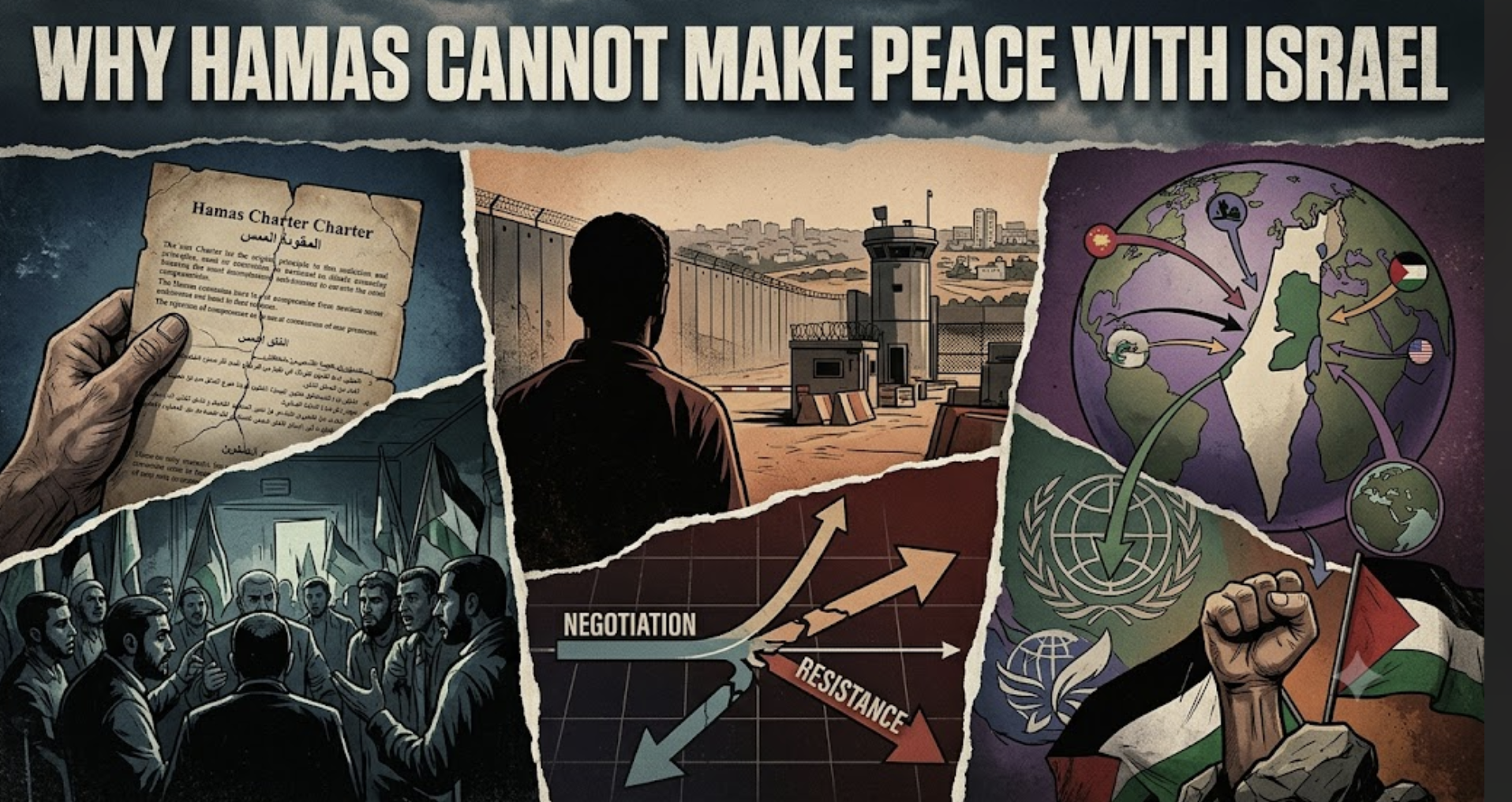
Image created from Google Gemini by Tim Orr
In Hamas’s Islamist theology, Palestine is an Islamic waqf (a religious endowment held in trust for God) that no political leader or generation possesses the authority to surrender. This conviction transforms any compromise or political concession into an act of religious betrayal. Negotiations are not judged according to whether they improve Palestinian lives or would produce a viable state. They are rejected because if they recognize Jewish sovereignty over any part of the land, it would violate the aforementioned divine command.
This is why Hamas does not approach negotiations in the same way that a conventional nationalist movement might. Hamas has at times held elections, agreed to ceasefires, and entered political talks, but none of this signals acceptance of a permanent settlement. Hamas will make tactical concessions when they serve its immediate interests. while continuing to reject the legitimacy of Jewish sovereignty over the land.
Even Hamas’s 2017 political document accepted a Palestinian state along the 1967 borders only as a temporary compromise. It did not recognize Israel or give up Hamas’s claim to the rest of the land. For Hamas, compromise is not merely a practical bargain involving land, security guarantees, and political recognition. Ending Israeli control of Gaza and the West Bank is only part of Hamas’s goal. Its vision still includes all the land between the Jordan River and the Mediterranean Sea.
This makes the destruction of Israel an organizing principle of Hamas’s ideology, which is reflected in its earlier covenant. In that covenant, reflected in leaflets, speeches, and educational materials repeatedly describe Israel’s elimination as historically necessary and religiously guaranteed. Hamas is committed to this goal publicly, and doesn’t hide its intentions behind diplomatic language. It announces that Palestine could be liberated only through jihad and that no political settlement could permanently resolve the conflict.
It is important to point out that Hamas’s enemy is not only Israel. Hamas’s defenders frequently insist that the movement is anti-Zionist rather than antisemitic. Hamas may now claim that its enemy is Zionism rather than Jews, but that does not erase the openly anti-Jewish language and conspiracy theories in its founding covenant. The distinction is important in principle, since opposition to a government or political movement is not necessarily hatred of a people. But here I return to Hamas’s own rhetoric, which should destroy that distinction. Hamas’s propaganda does not limit its accusations to Israeli policies, its military actions, or its political leaders. Instead it speaks about Jews as a collective people who posses an essentially corrupt and malevolent character.
In A Lethal Obsession, Robert Wistrich shows that Hamas draws on long traditions of antisemitism and combines them into a single strategy. For example, it adopts medieval accusations of Jewish treachery, it employs the statements in the Quran that degrades Jews by animal imagery, relegating them to apes and pigs, invokes apocalyptic traditions about the killing of Jews that are found in the Hadith literature, and incorporates modern European conspiracy theories.
They also echo the Protocols of the Elders of Zion, a fabricated text that claimed Jews secretly controlled world affairs. These conspiracy theories fit into that same broader narrative, in which Jews supposedly dominate finance, media, revolutionary movements, international institutions, and global politics. Hamas’s multifaceted propaganda campaign has blamed Jews for wars, social disorder, atheism, sexual immorality, communism, capitalism, and the erosion of religious faith.
Hamas is not simply criticizing Israeli policy, but offering a totalized conspiracy theory in which Jewish agency explains nearly every form of disorder in the modern world. Once this worldview takes hold, Jews are no longer seen as ordinary people with different beliefs and interests. They become the hidden cause of history’s corruption. Once this happens, violence against them is not portrayed as murder, but as saving the world from a supernatural enemy.
It is important to understand that Hamas is not simply a nationalist movement seeking better borders or political independence. Believing this propaganda is to make a horrible mistake. Hamas’s struggle against Israel is not merely political.
It comes from a religious and ideological worldview that rejects Jewish sovereignty. They see territorial compromise as betrayal, and present violence as a sacred obligation. This should galvanize people to stand against this hateful ideology, but right now, Hamas is winning the narrative war and normalizing the idea that their violence is justified.
–
Endnotes
- Hamas, “The Covenant of the Islamic Resistance Movement,” August 18, 1988, arts. 11 and 13. Article 11 defines Palestine as an Islamic waqf that no ruler or organization may surrender; Article 13 rejects negotiated settlements as contrary to Hamas’s principles. https://avalon.law.yale.edu/20th_century/hamas.asp
- Hamas, “A Document of General Principles and Policies,” May 1, 2017, paras. 2–3 and 18–21. The document defines Palestine as extending from the Jordan River to the Mediterranean Sea, accepts a state along the 1967 borders as a “formula of national consensus,” but refuses to recognize Israel or relinquish the rest of Palestine.
- Hamas, “The Covenant of the Islamic Resistance Movement,” preamble and arts. 6–8, 13, 15, 22, and 32. These passages address the elimination of Israel, jihad, the rejection of political settlements, alleged Jewish control of wars and institutions, and The Protocols of the Elders of Zion.
- Robert S. Wistrich, A Lethal Obsession: Anti-Semitism from Antiquity to the Global Jihad (New York: Random House, 2010), Qur’an 2:65; 5:60; 7:163–166.
Related Topics