Why I Am Not Attending My College Graduation
My peers in the Department of Urban and Regional Planning at the University of Illinois Urbana-Champaign (DURP at UIUC) will be attending our graduation ceremony on Saturday, May 16, 2026, and I will not be joining them. It isn’t because I don’t want to be there.
When I entered UIUC in Fall 2022, I believed that a university should be a place where people with fundamentally different worldviews could and should engage one another respectfully. After all, UIUC, like other great research universities, purports to prize both intellectual engagement and a commitment to diversity and inclusion.
Yet, over my three and a half years as a student, I found that my minority identity as a religiously observant Jew was not welcomed, and that my support of the existence of the State of Israel placed me outside the bounds of my department’s understanding of inclusion.
So, when I learned eight months ago that my department’s small graduation ceremony would take place on Shabbat, and I requested an accommodation to move the ceremony to another day, I was not surprised when DURP refused. I was, however, disappointed; a department that spoke regularly about inclusion should have found a way to respect my religious observance — an immutable part of who I am — without interfering with anyone else’s experience.
My Time at DURP
Throughout my time in the Department, I was the only openly Modern Orthodox and Zionist Jewish student. I have always been aware that my involvement in the greater DURP community would be different from my peers’. As a Jew who keeps kosher and is Shabbat observant, full participation in certain departmental activities inherently presented challenges. However, with proper planning and arrangements, it was possible to overcome many of these hurdles.
DURP has a written “Commitment to Inclusion” posted on its website. This commitment ensures that students have the right to speak from personal experience, that students and faculty are responsible for maintaining an inclusive environment and respecting the opinions of others, and that students and faculty alike should “assume an active role in ensuring that we maintain a positive and open department climate by working to understand and avoid invalidations, insults, or offenses.”
Sadly, that was not my experience.
In the summer of 2024, I was an intern at the Jerusalem Transportation Masterplan Team in Israel. A few weeks before the start of the fall semester, I received an email invitation titled, “Highlight your Internship Experience for Planning at Illinois social media!” This email was sent by DURP staff to students who held summer internships in the field of Urban Planning and asked us to provide related photos and blurbs for posting on the Department’s Instagram and Facebook accounts.
I was excited to share my experiences, which included technical assignments, such as proofreading maps for Jerusalem Light Rail Stations to ensure they were accurately translated into Hebrew, Arabic, and English, visiting an Arab neighborhood in East Jerusalem, and seeing the area where a light rail line is planned for construction to provide easier access from Ramallah to Jerusalem’s city center.
After already sensing negativity towards my Zionist values the previous two semesters in the wake of the October 7 attacks, I was hoping my post would lead to positive and productive discussions about urban planning in Israel.
Instead, my post became a hotbed for hateful comments and offensive language directed at me, without any condemnation from the University or DURP.
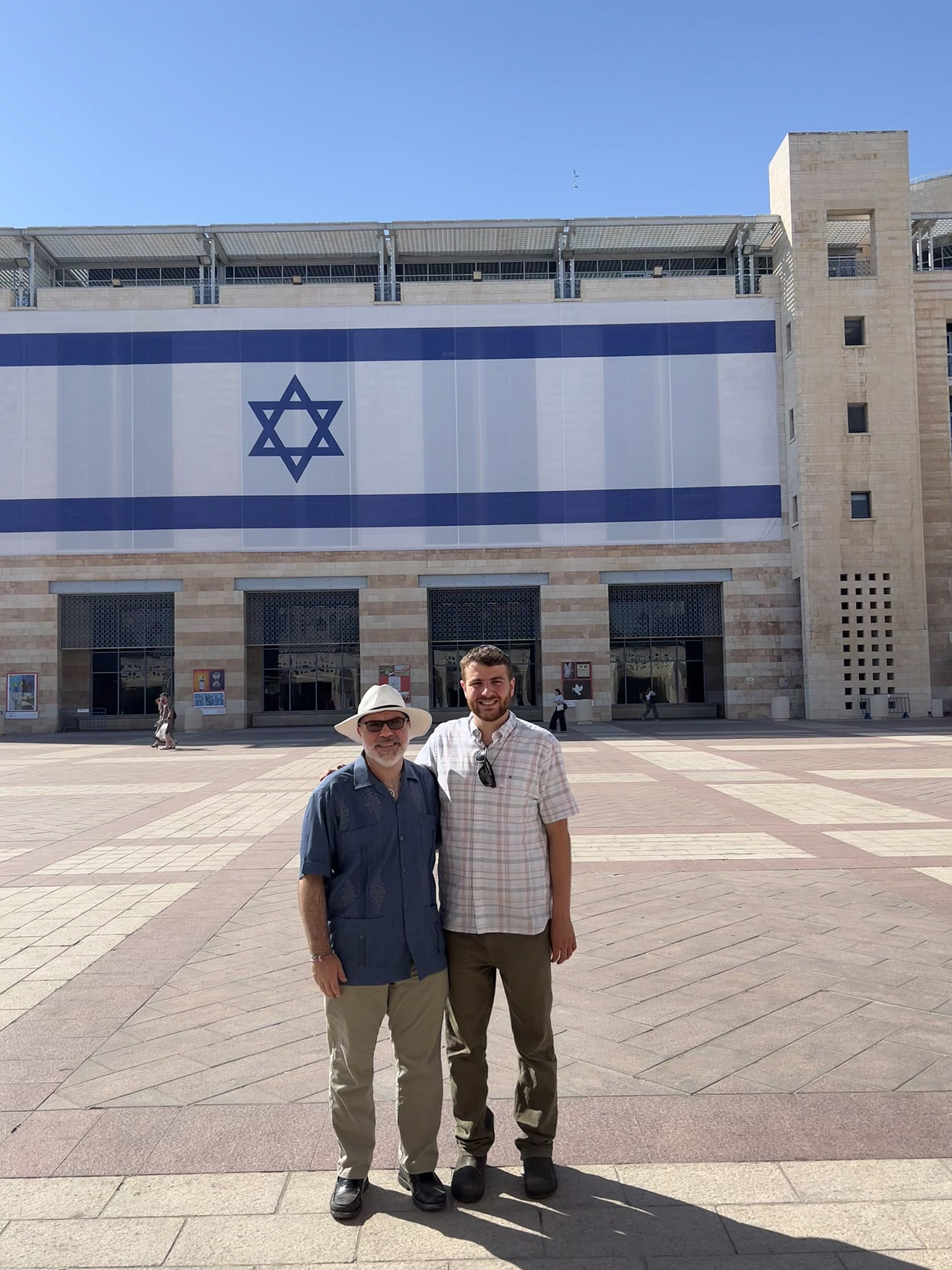
Photo credit: Ezra Landman-Feigelson.
Internal faculty email chains obtained through FOIA requests showed a veritable flood of criticism of the post, some of it outright vitriolic. DURP Professor Faranak Miraftab assured her faculty colleagues that their “collective wish” to take down the post had been communicated to the College of Fine and Applied Arts (FAA), but speculated that the “FAA communication team must be facing legal constraints”.
Students and alumni of DURP more than voiced their dissatisfaction, as well. They sent a letter to DURP criticizing its featuring of my internship on the Department accounts. They demanded that the post be removed and an apology be made for publishing it. The letter disingenuously alluded to October 7, 2023, as “the latest Israeli attack on Gaza,” making no mention of the mass murder, rapes, and kidnappings committed by Hamas that day.
This letter was signed by 52 students and alumni of DURP including the current UIUC Student Affairs Associate Director of Social Justice Leadership, a DURP alumna herself.
A few weeks after the post had been published, I entered Temple Buell Hall, the building which houses DURP, where I was greeted by a flyer which read “Holding DURP Accountable for Standing Complicit in the Occupation of Palestine.” It was posted by “DURP Students & Alumni Collective” and featured a QR code leading to a statement attacking DURP for seemingly endorsing “any internship… that panders to Zionist narratives.” While I was not specifically named, it was immediately clear that the statement was in response to the social media post highlighting my internship.
I was stunned and scared. There, in a space that was the home to the majority of my classes, where the Department supposedly supported open, respectful discussion and inclusion, my experience was not only being publicly negated but was labeled with offensive words and terminology from a one-sided narrative. I took some time to try to collect my thoughts and went to class, missing a substantial part of the lecture. Looking back, I am not sure how I attended class at all. Shortly after, a sympathetic professor from a different department gave me a key to his office so that if I ever felt I was in danger, I could have a place to hide — a gesture which, while welcome and deeply appreciated, is simultaneously troubling. No university student should ever feel like they have to hide from anyone.
A few days after the flyers were posted, a decision was made to shut down all forms of social media for DURP. Rather than use this as an opportunity to expand viewpoints and live up to the Department’s stated “Commitment of Inclusion,” it chose a path of avoidance.
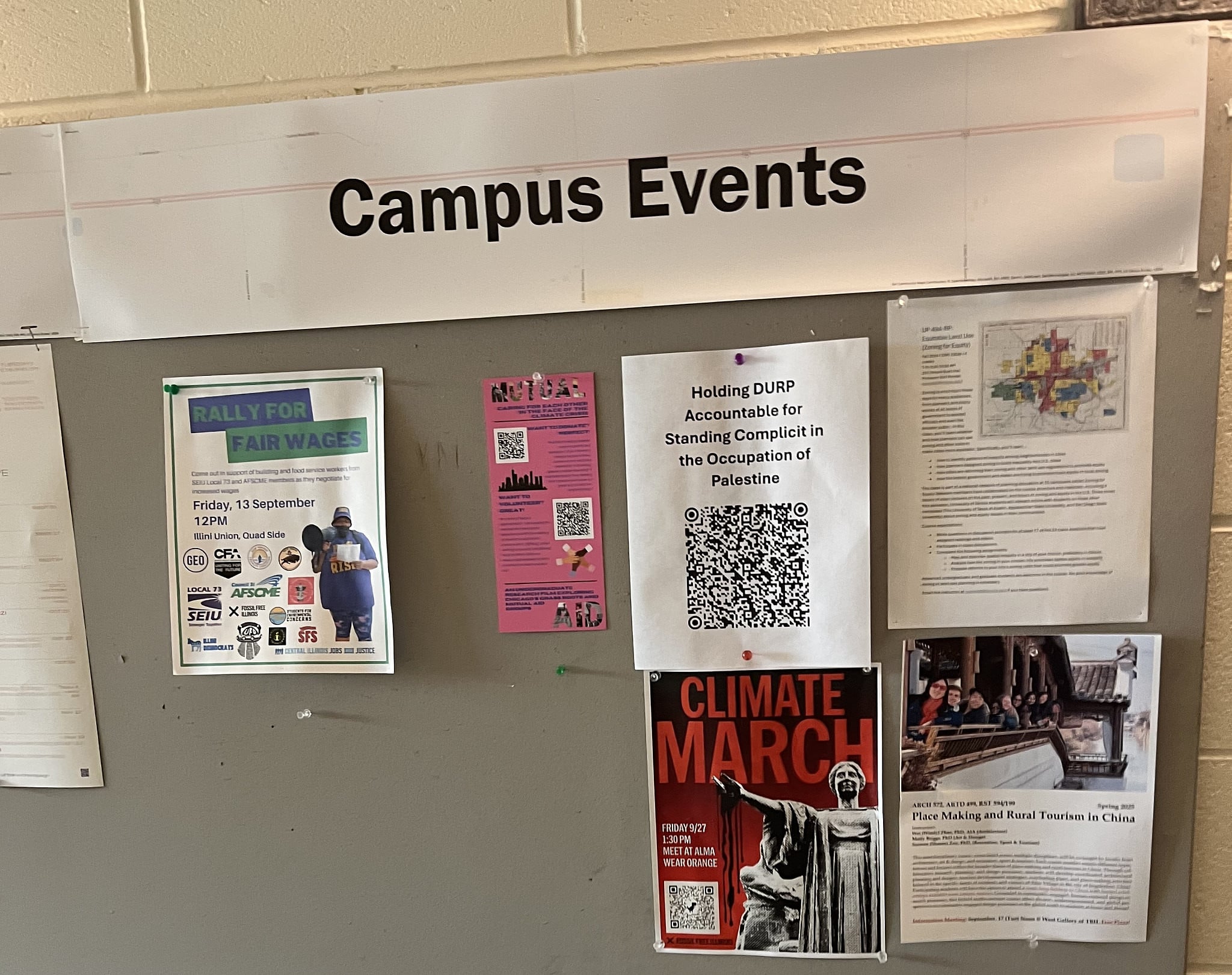
Photo credit: Ezra Landman-Feigelson.
Shaken, I felt compelled to learn more about the DURP faculty and filed additional FOIA requests. What I came to understand was that, even before my arrival as a freshman in Fall 2022, DURP faculty began to create an environment that they should have anticipated would isolate Jewish and Zionist students.
The FOIA results were disheartening. Amid eleven days of attacks by Hamas on Israeli civilians in May 2021, a petition was circulated among architects and urban planners globally, authored by “Architects and Planners Against Apartheid” titled “Architecture and Urban Planning Organizations Stand in Solidarity for Palestine.” The petition, circulated to DURP faculty by Professor Miraftab, called for organizations to pressure institutions to support Boycott, Divestment, Sanctions and to recognize the supposed “injustices of the Israeli settler colonial state.”
Prof. Miraftab urged all faculty to support the statement as a unified department rather than as individuals. Doctoral students and the Department’s Student Planning Organization were also encouraged to sign, and they complied.
I was saddened to learn that faculty members whom I had previously thought respected my identity — and with whom I had felt comfortable speaking — had supported a petition that characterized Jewish Israelis as colonizers in their ancestral homeland. While I came to UIUC expecting and even hoping for my own views to be challenged so that I might grow, this was not reasonable higher education discourse. It was reductive, tendentious, and blatantly politically motivated.
By this point, the toll of these experiences shaped decisions I never expected to make. I chose to complete my degree a semester early, in part because I wanted to leave as soon as I reasonably could. The idea of pursuing a master’s degree at UIUC — something I had genuinely considered when I arrived — was no longer viable. Another year in that environment was not something I was willing to endure.
Graduation
Soon after learning that my department’s graduation ceremony was scheduled on Shabbat — placing my religious identity and my academic identity in direct conflict — I reached out to DURP and asked for a change in the ceremony date so I could be present for a milestone I had worked toward alongside my peers. Requests for religious accommodation are not extraordinary; they have been recognized by the U.S. Supreme Court, so asking a public university to honor one seemed entirely appropriate. DURP would not entertain the one accommodation that would have allowed me to celebrate with my peers and share in the actual experience of that moment. Although they offered alternatives, none of them could give me that.
For observant Jews, Shabbat is not simply a preference or cultural tradition; it is a central religious obligation. Scheduling a graduation ceremony on Shabbat effectively excludes strictly observant Jewish students from participating. From an emotional standpoint, it is perhaps loosely analogous to how a devout Christian might feel if a major school event were planned on Easter Sunday.
I reached out to DURP staff in September 2025 — the graduation date had been announced in August. The departmental ceremony is much smaller than a university-wide event, with only about 40 students graduating, so rescheduling seemed feasible. With eight months of lead time, students and their families would have had ample opportunity to adjust any travel plans. Many other unit ceremonies, including Architecture, Business, and Engineering, take place on Fridays or Sundays; I asked DURP if they could do the same.
My request was not accommodated.
Department Head Marc Doussard instead suggested that the commencement team arrange a private stage crossing for me on a different day. Accepting this would have meant yet another experience of isolation — celebrating alone, apart from my peers, a milestone we had reached together.
I expressed my dissatisfaction to Erez Cohen, Executive Director of Illini Hillel, who agreed to meet with me and Doussard to convey the gravity of the situation. Months later, the meeting was held virtually and included the DURP advisor, the Dean of the College of Fine and Applied Arts, and a staff member from the Office of the Vice Chancellor for Access, Civil Rights & Community.
During the meeting, I once again expressed that I wanted to celebrate my graduation with my peers. The response was disappointing. Doussard indicated that rescheduling was no longer possible because families had already purchased flights and booked hotels — a logistical problem that would not have existed had this been addressed proactively in September. I also asked for an apology for every instance in which my identity and viewpoints had been dismissed or excluded. The request was met with silence. Had an apology been forthcoming, it would not have changed my inability to graduate with my peers — but it would have meant that my experiences were recognized. That validation mattered to me, and it might have been a first step in showing that the Department took its commitment to inclusion seriously.
In that moment, I proposed what felt like a last resort: that I might participate virtually from a location — Israel, Japan, Australia — where Shabbat would already have ended by the time the ceremony began in Illinois. This was an impulsive grasp at something, anything, that might let me feel connected to the moment. The Dean indicated a willingness to explore university funding for travel and lodging for me and my parents.
But sitting with it after the meeting, I realized that what I would actually be doing would be watching my graduation from a hotel room, thousands of miles away, while my peers crossed the stage together. The location might have been novel, even memorable in its own way, but it would not have solved what actually mattered — being present, with my classmates, for a milestone we had reached together.
When a frustrated student’s last-minute, impulsive idea becomes the institution’s best offer, it’s hard to believe the core problem was ever taken seriously.
I declined the funding when it was offered. Instead, I asked that whatever dollars had been set aside be redirected toward programming for DURP faculty, staff, and students — programming that fosters genuine understanding, sensitivity, and belonging for people of all backgrounds and faiths, including religiously observant Jews and people who support the basic existence of the State of Israel (i.e., Zionists). That felt like a more meaningful use of those resources. And unlike a plane ticket, it might actually prevent the next student from finding themselves in the same position.
Conclusion
None of this was happening in a vacuum. The experiences I’ve described unfolded in the aftermath of the University’s 2024 resolution with the Department of Justice’s Office for Civil Rights concerning allegations of antisemitism on campus. As part of that resolution, the University publicly committed itself to improving its response to antisemitism and discrimination against Jewish students, recognizing that “for many Jewish students, Zionism is an integral part of their identity and their ethnic and ancestral heritage.” Against that backdrop, DURP’s stated Commitment to Inclusion — a promise extended to everyone except me — increasingly rang hollow.
My three and a half years at DURP showed me that the University’s commitment does not extend to religiously observant Jews or to anyone who supports Israel’s right to exist. From faculty leveraging their positions to suppress viewpoints they find unwelcome, to the deliberate othering of students who think differently, I was shown repeatedly that I did not fit within what might more accurately be called a Commitment to Selective Inclusion. When I arrived at college, I believed universities should be places for principled disagreement — where different worldviews could meet, challenge one another, and coexist. I still want to believe that. But my experience at the University of Illinois leaves me with something I didn’t expect to carry out of here: the knowledge that, at least at DURP, disagreement was not something to engage with. It was something to extinguish.