

Why I No Longer Attend Yom HaShoah Commemorations
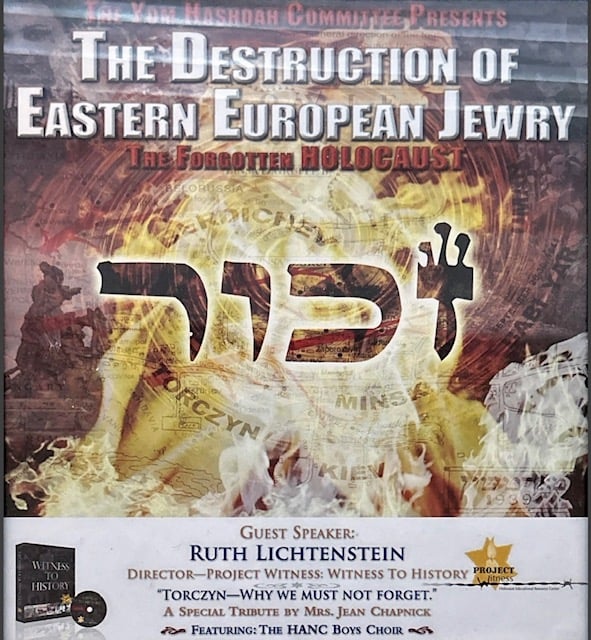
There was a time when I felt it was much more important attending Yom HaShoah (Holocaust Remembrance Day) commemorations than Yom Kippur services. Not only did I attend them religiously, but many times I was involved in the planning of them.
The first time was when I was involved in student government at the Wurzweiler School of Social Work of Yeshiva University. I invited David Szonyi the Co-Editor of “Living After the Holocaust: Reflections by Children of Survivors in America”. It was the first book at the time written by children of Holocaust survivors about their experiences. The commemoration was simple; all the students and professors were sitting in a circle with David and talking. Just talking. There was a rawness and an honesty about that afternoon. It was one of the most moving afternoons of my lifetime.
That event took place just over thirty years since the end of the Holocaust. The Jewish community was still grappling with the horrors of the Shoah and its seismic aftershocks. We were unsure how to appropriately mourn the extermination of one-third of our people. Traditional Jewish methods of mourning and prayer did not fill the void we all felt within ourselves.
Rabbi Yitz Greenberg, a major thinker at the time and today, stated that it would take years, if not decades, to figure out how to observe this period in an appropriate manner. After all, for the first time in Jewish history, the feeling was that Hashem turned His back on the Jewish people.
There was also a debate during the subsequent years after the Shoah as to which date should be designated on the Jewish Calendar for Holocaust Remembrance Day. Some wanted to combine it with Tisha B’Av, then considered the most tragic day of the Jewish year. That was not to be because Tisha B’Av ends with hope while Yom HaShoah ends with lingering doubts. Besides, combining the two holidays would dilute the unprecedented uniqueness of Yom HaShoah.
During that same time, the Conservative Movement added a section about the Shoah in its Passover Seder; A most inappropriate placement. Passover is about Hashem’s rescuing the Jewish People from bondage. No such rescue took place between the years of 1939-1945.
In the 1970s I attended a Yom HaShoah commemoration at the Young Israel of Forest Hills. The Rabbi expressed derision in that the premier Yom HaShoah event at the time took place at Temple Emanu-El – the prestigious Reform synagogue. I was aghast. Yom HaShoah should not be a day of divisiveness. Our enemies made no distinctions, why should we?
That next day at work, a colleague who saw me at the service apologized for her rabbi’s speech. She knew, at the time, I rarely attended shul and she could just imagine how I felt. I responded to her that I found it disturbing but was not angry. After all, Yom HaShoah services were in their early stages and still in a state of flux. In time, I believed, the Jewish community will attain a greater understanding and find the right tone and messaging.
During the 1980s and 1990s I lived in Teaneck, New Jersey. Teaneck held annual community-wide Yom HaShoah commemorations in the vast auditorium of Teaneck High School. Esteemed speakers such as Leon Bass, Yaffa Eliach, Emil Fackenheim, and Rabbi Yitz Greenberg were invited. Politicians in attendance were acknowledged, but never spoke, nor were they allowed to. There was a candle lighting ceremony, a survivor sharing their experiences, with the chanting of the El Moleh Rachamim, the traditional Jewish Memorial Prayer concluding the event,
What made the Teaneck event so appropriate was witnessing how it affected everyone in attendance. Before the commemoration, neighbors were hobnobbing in the aisles. Afterwards, there was a deep silence permeating the crowded room. The attendees departed as if they were just attending a funeral. Everyone was in mourning and it seemed as if each person was observing their personal Yahrzeit.
Fast forward forty years and today Yom HaShoah in America lost its essence, its élan vital. The service of today is stale and unimpactful. In some venues, attendance is sparse.
The commemorations have become unimaginative, and stagnant; The lighting of the six candles, each representing one million of the six million murdered and a survivor addressing the audience. Unlike the survivors of thirty or forty years ago, the survivors of today were mere children, or even babies, when The War broke out in 1939. Their messages are meaningful, but in very different ways. Their recollections are different than those past survivors born during the 1910’s and 1920’s who were of adult age during the outbreak of The War.
Plus, today, any politician who attends this event is often given the platform to speak, thus diluting the impact and desecrating this sacred event.
Yom HaShoah commemorations have lost their impact. In turn, at this rate, the new generation will never be able to internalize how the Shoah changed us as a people.
We must get it right in America. For the sake of humanity and future generations. Given the resurgence of antisemitism, we, the torchbearers, have fallen short in our messaging.