Why I Took a College Basketball Team to Berlin
My father passed away almost exactly one year ago.
My dad was deeply proud of the work I do in Holocaust education. But I think what mattered most to him was not simply that I was teaching history. He believed that being Jewish came with an obligation—to remember where we came from, to understand what our people had endured, and then to do something with that knowledge.
Since he died, I have thought a lot about what it means to carry that obligation forward.
We say L’dor V’dor, from generation to generation. We tell the story of the Jewish people to our children, who will someday tell it to theirs. But as the generation of Holocaust survivors disappears, I have become increasingly convinced that simply preserving these stories is not enough. We have to find new ways to tell them, and new people to tell them to.
That is why, this summer, I took the Davidson College men’s basketball team to Berlin.
On the surface, a college basketball team might seem like an unusual group for an immersive Holocaust education program. But that was precisely the point.
If we want the lessons of the Holocaust to endure, we have to transcend the boundaries of traditional Holocaust education. We need to reach people who might never choose to take a Holocaust history class or attend a lecture at a Jewish institution. And athletes have something particularly powerful: influence, visibility and a platform.
So, for four days, these young men walked through history.
And one of the most important things they learned was that the Holocaust did not begin with concentration camps.
It began with ideas.
We learned how science and medicine were manipulated to create a hierarchy of human worth—to define some people as superior and others as inferior, some lives as worthy of protection and others as lives that did not deserve to exist.
Then we saw how those ideas became part of everyday life.
At the Places of Remembrance art installation in the Bavarian Quarter, 80 signs scattered throughout an ordinary neighborhood document the gradual restrictions imposed on Jews. One tells us that Jewish sports groups could no longer use public playing fields. Years later, another says Jews could buy food only during a single designated hour.
This is something I wanted the players to understand.
People were not taken from full participation in society directly to ghettos and concentration camps. First, they were told they could not join a choir. They could not belong to a sports club. They could not use a public playing field.
Little by little, the circle of who belonged became smaller.
One of our players, Sam Brown, reflected that although we often learn about the end of the Nazi regime, it was “eye-opening to hear how the process began.”
That distinction matters.
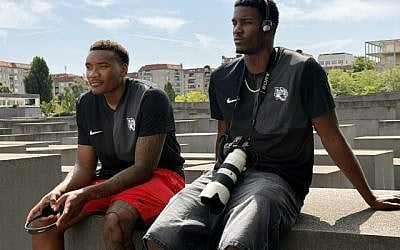
At the Memorial to the Murdered Jews of Europe, our guide offered an interpretation I have thought about ever since. The memorial begins with low concrete blocks. You can see over them. You can see where you are going. They are easy to ignore.
But as you continue walking, the blocks become taller. Eventually they tower over you. You become isolated. You lose sight of the people around you and almost lose your way out.
He described it as a metaphor for the gradual erosion of the rights of the Jewish people. At first, the violations were small enough for ordinary citizens to ignore. But they continued until the violations of human rights and human dignity had become so enormous that there was no longer any way to pretend they were not there.
Throughout the trip, one of the players, Josh Scovens, kept asking questions.
How could people do this?
How could ordinary people go along with it?
And over and over again: Where was their moral compass?
That question feels particularly appropriate today.
Yom Kippur asks us to examine our own moral compass. We account for our choices—not only the enormous ones, but the seemingly insignificant choices we make every day. Josh eventually came to a realization that I think captures one of the most important lessons of our journey: “A moral compass isn’t something we should develop only when we face an enormous decision. It is something we establish through the choices we make every day.”
Perhaps nowhere was that clearer than on one of the most difficult days of our trip.
That morning, we went to the House of the Wannsee Conference.
We stood inside the beautiful villa where, in 1942, high-ranking Nazi officials coordinated the implementation of the “Final Solution”—the systematic murder of European Jewry.
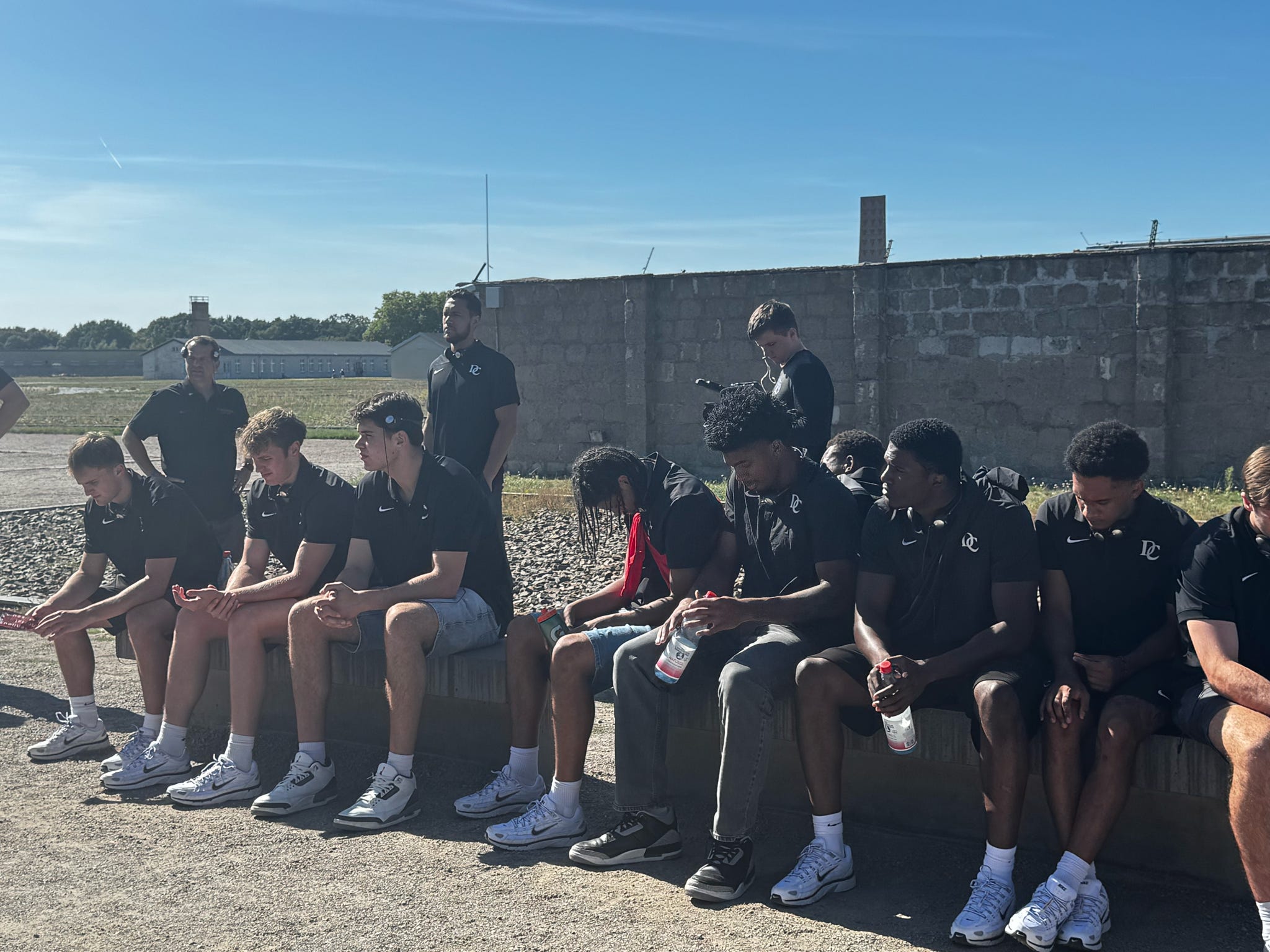
Then we left Wannsee and traveled to Sachsenhausen concentration camp.
The juxtaposition was almost unbearable.
In the morning, we stood in the place where men sat around a table and discussed how to carry out mass murder. Hours later, we stood where human beings experienced the consequences of decisions like theirs.
One of our freshmen, Eetu Heinonen, reflected afterward: “Being in these places made me realize that hatred and discrimination do not happen all at once. They can grow when people stop questioning what they are being told, look the other way, or convince themselves that something is not their responsibility.”
That is something you cannot fully understand from a textbook.
As sophomore Nick Coval said after our first day, “It’s one thing to read about something in a textbook or watch these events unfold in a documentary, but it’s completely different to stand where it actually happened.”
But this trip was never intended to be only about the past.
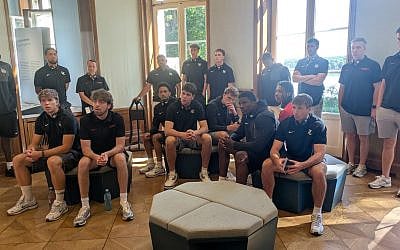
One day, the Davidson players met with Jewish athletes from Makkabi Berlin. They heard firsthand what it means to be a Jewish athlete in Germany today and about the antisemitism and discrimination these athletes continue to experience.
That conversation changed something.
Jackson Keith later reflected that listening to the Makkabi athletes reminded him that you cannot fully understand someone else’s experience without taking the time to listen. Then he connected that lesson to himself as an athlete: “People listen to us, watch us and look to us as examples.” Because of that, he said, athletes have a responsibility to use their voices to speak against discrimination and help create spaces where people feel respected and included.
Later, Jackson said something that, for me, justified every moment of this trip:
“My previous education on the Holocaust didn’t cover anything we covered here. Seeing everything here really makes me motivated to speak out.”
He said he wanted to become educated enough not to stay out of difficult conversations, but “to lead conversations and grow.”
That is why I took a basketball team to Berlin.
And that is why I will continue doing this work.
My father taught me that remembering our history is an obligation. But he also taught me that memory has to lead somewhere.
L’dor V’dor cannot simply mean that we tell our children what happened to our grandparents. It means that we entrust the next generation with the responsibility that comes with knowing.
And sometimes, the next generation we entrust with our story may not be Jewish.
Sometimes it may be a group of college basketball players from North Carolina who stand at Wannsee asking where humanity’s moral compass went, who walk through Sachsenhausen struggling to comprehend what human beings did to one another, and who sit across from Jewish athletes their own age and discover that antisemitism is not something confined to a history book.
They now carry a piece of our story too.
And because they are athletes, because people watch them and listen to them, they have the opportunity to carry that story into places I never could.
On Yom Kippur, we are asked to look inward. We ask where we have fallen short. Where we remained silent. Where we looked away. And we ask who we want to be in the year ahead.
Perhaps the lesson these young men brought home from Berlin offers us an answer.
We do not suddenly acquire a moral compass when history presents us with an enormous moral crisis. We build it every day—in the moments when we notice someone being excluded, when we question something everyone else seems willing to accept, when we decide whether to remain silent or speak.
My father understood that.
He taught me that being Jewish means more than bearing witness. It means carrying forward the stories and lessons of our people. It means educating. Speaking out. Acting. And making sure that what happened before is not allowed to happen again. That understanding of remembrance as an obligation to act is the legacy he left me.
So today, as I remember my father almost one year after losing him, I understand more clearly than ever why I do this work.
I do it for him.
I do it for those who came before us.
And I do it for the young people who will carry these stories long after we are gone.
L’dor V’dor. From generation to generation.
May we continue to tell the story.
May we have the courage to recognize when the lessons of that story are needed.
And may we raise—and educate—a generation with the moral compass to act when they are.
G’mar Chatimah Tovah.