

Writing on Jewish identity, Israel, and American politics
Why I Wrote BAD JEW
 I did not set out to write a book called BAD JEW. The title came later, after I had already spent a long time trying to understand what had changed in me after October 7 and why so many political assumptions I had carried for years suddenly felt unstable. I had been active in Democratic politics for much of my adult life. I had worked for Barack Obama, volunteered for Bernie Sanders, and spent years around people who believed, as I did, that politics was ultimately about fairness, rights, opportunity, and protecting people who were vulnerable.
Then October 7 happened, and the attack itself was followed almost immediately by something I was not prepared for. Before Israel had even mounted a major response, before the war had produced the arguments that would dominate the months that followed, I was watching people explain, minimize, qualify, and in some cases celebrate what had just happened to Israelis. The speed of that reaction mattered to me. It made it much harder to pretend that what I was seeing was simply criticism of Israeli policy.
That was the beginning of the book.
I have used the phrase “October 8 Jew” because October 7 was the attack, but October 8 was the realization. It was the day I began to understand that some of the people and institutions I had considered political allies were operating from assumptions about Jews and Israel that I had either ignored, underestimated, or never fully confronted.
That realization did not turn me into a different person overnight. I still believe in many of the same things I believed before October 7. I still believe healthcare should be treated as a basic right. I still believe in environmental protection, civil rights, a strong social safety net, and a government that should do more to make ordinary people’s lives workable. What changed was my willingness to accept political language at face value.
Words like colonialism, resistance, genocide, Zionism, occupation, and apartheid were being used constantly, often without much concern for whether they accurately described what was actually happening. I became much more interested in definitions, evidence, context, and consistency. That habit eventually became one of the central ideas of the book: define the words, then decide what you believe.
The book also became more personal than I expected. It is not only about October 7 or Israel. It is about how those events forced me to revisit my own life, my family, my politics, my relationship to Judaism, and the assumptions I had made about belonging.
Running for Congress in 2026 became part of that process.
I ran for the United States House of Representatives in California’s 32nd Congressional District. I did not win. I finished seventh out of nine candidates. That is not exactly the standard opening line for a political memoir, but losing turned out to be useful material.
Campaigns force clarity. You have to tell people what you believe in rooms where not everyone agrees with you. You have to answer questions without having several days to perfect the language. You also spend a great deal of time with people who are not professional political obsessives, and that experience reinforced something I had already begun to suspect: the country is much less ideological than the internet makes it look.
Most people are trying to raise children, make rent or mortgage payments, keep businesses open, care for aging parents, deal with schools, and figure out why everything costs more than it used to. They may have strong political opinions, but they do not necessarily organize their entire lives around ideological categories.
During the campaign, I often talked about what I called the center 80 percent. I did not mean that most Americans agree on everything. Obviously they do not. I meant that most people are still capable of disagreement without treating disagreement as moral contamination.
That distinction became increasingly important to me.
Writing BAD JEW also forced me backward into my own family history. I wrote about my parents, immigration, Israel, my political evolution, people I had misjudged, people I had trusted, and some of the ways I had changed over time. I also found myself writing much more about fatherhood than I expected.
My daughter is two years old. She does not know what Zionism is, what antisemitism is, or why adults become so consumed by arguments about history and identity. She knows her family. She knows English, Spanish, and some Hebrew. She knows where the chickens are. She knows which of my shirts she likes. Her world is still very small.
Becoming a father changed the way I think about politics because it made many abstract questions feel concrete. I now find myself asking very basic things. Does this make my family safer or less safe? Does this create a society in which my daughter can live freely as a Jew? Does this encourage her to think for herself, or teach her which conclusions she is expected to reach? Does this leave room for disagreement, or does it divide everyone into the righteous and the condemned?
Those questions matter more to me now than whether I fit neatly inside anyone else’s political category.
The title BAD JEW comes from that tension. The phrase can mean many things depending on who is using it. For some people, a bad Jew is someone who is insufficiently religious. For others, it is someone who is too religious, too Zionist, not Zionist enough, too assimilated, too tribal, too universalist, too outspoken, or not outspoken enough.
At some point I stopped worrying very much about satisfying all of those competing definitions.
I did not write the book to prove that I am a good Jew. I wrote it because I wanted to understand what I believed after many of the political and social assumptions I had relied on stopped making sense to me.
I also decided to self-publish it rather than spend years waiting for the traditional publishing process. There are good reasons to pursue agents and publishers, and I may do that with future books. But this book is about a moment that is happening now. The arguments about Israel, antisemitism, political identity, and the direction of the Democratic Party are happening now. American Jews are asking questions now that many of us were not asking three years ago.
I wanted the book to exist while those questions were still immediate.
There was also something liberating about simply finishing it and putting it into the world. Running for office taught me that it is possible to spend a great deal of time waiting for institutions, gatekeepers, donors, editors, parties, or other people to decide whether what you are doing is legitimate.
Eventually you have to decide for yourself.
So I wrote the book.
What surprised me most is that the conclusion is less angry than the title sounds. I came away from the process more comfortable with complexity, not less. Loving Israel does not require believing that Israel never makes mistakes. Caring about Jews does not require caring less about anyone else. Changing your mind does not mean abandoning your principles. Sometimes it means applying them more consistently.
That is what BAD JEW became for me: a memoir about politics, Israel, family, fatherhood, and the uncomfortable experience of realizing that some of the things you once believed no longer fit as neatly as they used to.
I do not expect every reader to agree with me. That would defeat much of the point.
I do hope they will understand how I got here.
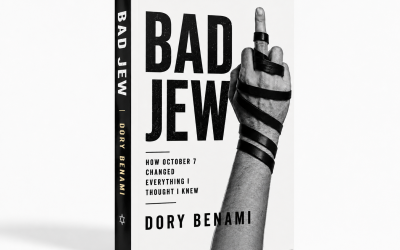
BAD JEW: How October 7 Changed Everything I Thought I Knew is available now on Amazon paperback and Kindle Unlimited.