Examining Extremism, Identity, and Influence
Why India Honors a Muslim Visionary Who Rejected Separatism and Built Schools
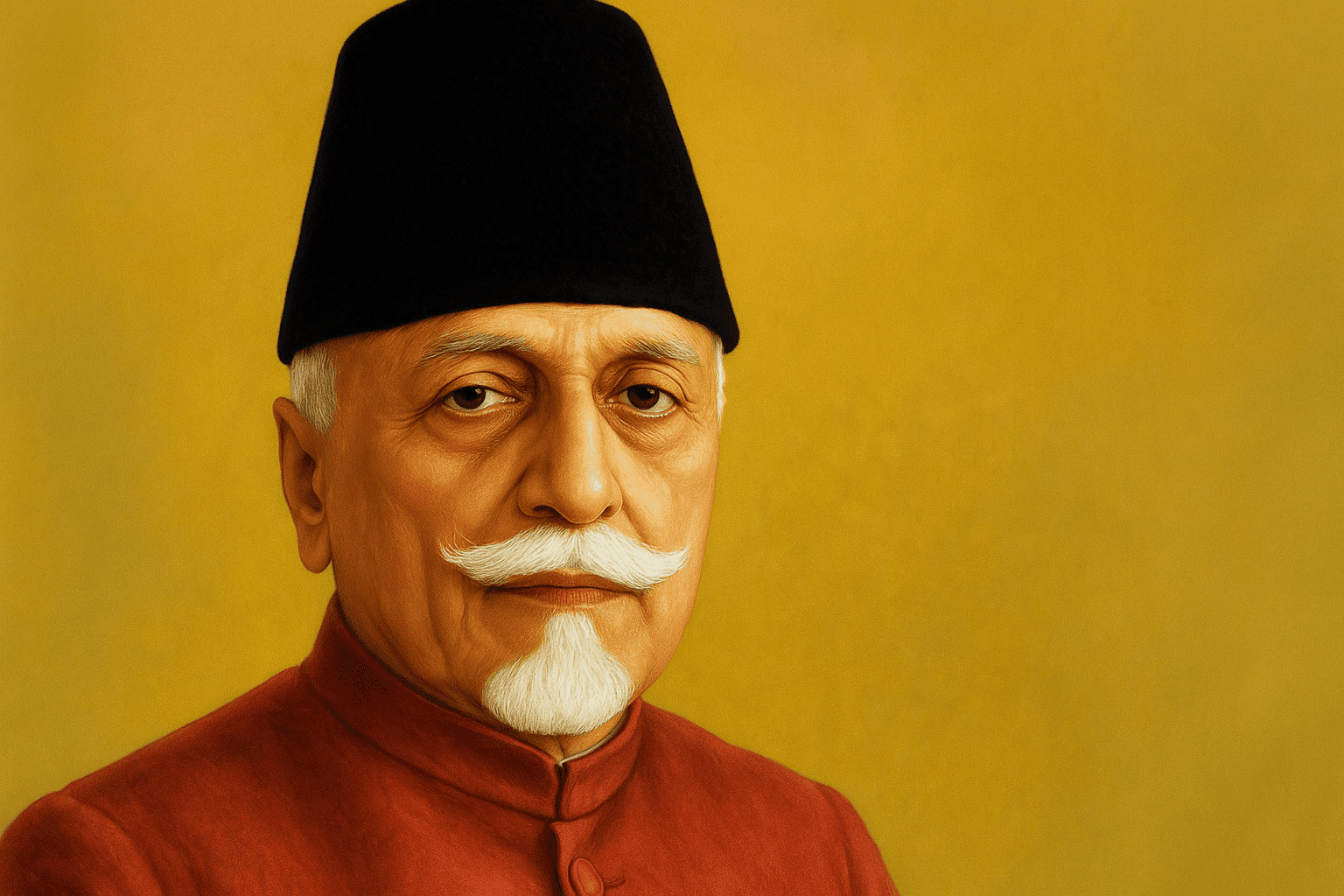
Photo: Abul Kalam Azad / Courtesy of the Author
Azad’s career embodies the conviction that religious identity need not combine with political exclusivism.
In the Middle East today, even amid deep political divisions, many intellectuals increasingly acknowledge that the future of stability lies in coexistence — in pluralism over partition, and in education over isolation. From the Abraham Accords between Israel and several Arab states to the ongoing reforms in the Gulf that link faith with modern governance, the region is rediscovering that identity need not mean exclusion.
It is in this context that India’s Maulana Abul Kalam Azad deserves renewed attention — not merely as a historical figure, but as a thinker who foresaw this balance between faith, modernity, and civic service more than a century ago.
Maulana Abul Kalam Azad was born in Mecca on 11 November 1888 into a family of Indian scholars. He emerged as one of South Asia’s rare polymaths – an Islamic theologian and Qur’anic commentator, a journalist, a public intellectual, and a key leader in the Indian independence movement.
His Urdu-language exegesis of the Qur’an, Tarjumān al-Qur’ān, written between 1915 and 1945, remains widely cited and is listed among translations and commentaries published and referenced by the Saudi-based King Fahd Complex for the Printing of the Holy Quran.
After independence, Azad became India’s first Minister of Education (from 15 August 1947 until his death on 22 February 1958) and laid the foundations for enduring institutions such as the Indian Institutes of Technology (IITs), the University Grants Commission (UGC), the Sahitya Akademi, and the Indian Council for Cultural Relations. These bodies would shape the architecture of modern India’s higher-education ecosystem and its global intellectual footprint.
Azad deserves to be regarded not merely as a Muslim leader but as a national architect of plural, modern India. His life offers lessons for Muslims in India today — and, indeed, for any plural society where faith and civic identity intersect.
Education, Pluralism and the Refusal of Separation
Azad’s career embodies the conviction that religious identity need not combine with political exclusivism. In his Tarjumān al-Qur’ān based on Salafi interpretation, he argued that Islamic teachings, when properly interpreted, supported plural citizenship and engagement in society rather than retreat or separatism.
As Education Minister, he championed universal primary schooling, adult literacy, technical and vocational education, and the establishment of the IIT system and the UGC. He envisioned engineers and scientists working alongside humanists; citizens grounded in both faith and reason.
His contributions are commemorated annually on his birthday — 11 November — which India marks as National Education Day, so that his vision of education as a civic technology for pluralism is not forgotten.
Azad stood firmly against the concept of dividing India on religious lines. The leading political party he belonged to, the Indian National Congress, was at the time labelled by Mohammad Ali Jinnah and the All‑India Muslim League as a “Hindu party.” Azad rejected that label and rejected the two-nation theory.
In a stirring address at Delhi’s Jama Masjid on 23 October 1947 — in the midst of partition violence — he appealed to Indian Muslims to stay and invest their energies in India rather than accept the uncertain promises of a new state. He asked: “Where are you going and why?” and reminded them: “Delhi has been nurtured with your blood.”
He warned that Pakistan was being created for economic and class reasons, not for religious ideals. The British withdrawal had disrupted the feudal landlord system, and in the new India, large estates were to be abolished. Muslim feudal elites and landed gentry — reluctant to face land reforms or compete in an open democracy — preferred to carve out a separate domain.
He also observed that the demand for Pakistan stemmed from a psychological fear: Muslim leaders who had once ruled India found it difficult to imagine living as equals, competing in education, trade, and politics rather than governing through inherited power.
“When I examine the scheme of Pakistan even from the point of view of the communal interests of the Muslims themselves, I am forced to the conclusion that it can in no way benefit them or allay their legitimate fears,” he said on 17th April 1946.
Azad dismissed the fear-mongering that Hindus would annihilate Muslims in a united India. He argued that such claims insulted the character of India’s civilisation. He insisted that India’s civilizational fabric — bound by shared culture, language, and land — would not permit genocide.
His prophecy proved right: in the 75-years since independence, the Muslim share of India’s population has grown from roughly 9 per cent in 1947 to about 17 per cent today, while the percentage of religious minorities in Pakistan — Hindus, Sikhs, Christians — has fallen from about 23 per cent in 1947 to less than 4 per cent.
Because of his stand, many Muslim ulema and pro-Pakistan leaders accused him of being a “Hindutva poster-boy” for too close an identification with Congress and secular India.
After partition, Azad himself admitted regret over leadership choices of the Congress party: he would have preferred the “Iron Man of India”, Sardar Vallabhbhai Patel, over Jawarharlal Nehru.
For Indian Muslims today, Azad offers an alternative to the more widely known Muslim thinkers who promoted separatist mindset or global Islamic identity (figures such as Allama Iqbal, Abul Ala Maududi or Dr Israr Ahmed).
His vision held that the ideal was not separatism but full participation in a plural Indian nation. He served as Education Minister under a Hindu-majority leadership precisely to demonstrate that religion doesn’t determine public service; what matters is competence, integrity and national loyalty — akin to the Qur’anic example of Prophet Joseph serving as Finance Minister for the Egyptian King Waleed Bin Rayyan – who was not of Prophet Joseph’s faith.
His view on Hindu-Muslim unity is summed in his 1940 Congress address: “I am proud of being a Musalman … As a Musalman I have a special interest in Islamic religion and culture … But I am proud of being an Indian.”
This principle resonates far beyond India’s borders. Just as the modern Middle East has begun to rediscover that Muslim identity can coexist with cooperation with Jewish and Christian neighbors — as seen in Israel’s growing ties with the UAE and Bahrain — Azad’s politics were built on inclusivity without insecurity.
Azad’s Islam was not isolationist; it was confident enough to engage, learn, and build.
Why 11 November Matters for All of Us
Each year on 11 November, India celebrates National Education Day in honour of Maulana Azad’s birthday. This is not simply a date on a calendar; it is a civic gesture reminding us that education is the foundation of plural democracy and national resilience.
Union Education Minister Dharmendra Pradhan routinely tweets his tribute to Azad, and leaders of the ruling Bharatiya Janata Party (BJP) publicly acknowledge his contributions — a significant point, given that Azad was a Muslim leader who rejected separatism and worked under a Hindu-majority government.
This bipartisan commemoration reinforces that his legacy transcends identity politics.
In remembering Azad, we celebrate not only a man but a principle: that religious conviction and modern expertise can coexist; that a citizen’s first loyalty can be to nation, to education, to institutions—and that minority identity need not mean withdrawal from, but engagement with, the republic.
The day invites Muslims of India — and indeed diverse faith-communities globally — to see themselves as educators, institution-builders and engaged citizens rather than as communities in waiting.
There is a poetic symmetry in the fact that another national figure — A.P.J. Abdul Kalam, later India’s scientist-President who helped develop India’s nuclear power and aerospace capabilities — carried the same family name “Kalam”. His mission, like Azad’s, was about knowledge and empowerment
On National Education Day we do not merely honour one man; we reaffirm a vision of knowledge, participation and plural citizenship.
If Maulana Azad were with us today, he might call upon modern Indian Muslims to invest their energies in the country’s institutes of science and education, to build bridges rather than walls, and to recognise that their faith and their citizenship are complementary, not hostile.
For the global Muslim audience, his legacy offers a quiet but potent challenge: that faith-rooted citizens can be architects of plural national futures, not only complainants of history. On 11 November, we remember Maulana Azad — not as a relic, but as a living model of plural education, civic duty and national belonging.
Related Topics
Related Posts