


Writing Where Intelligence Meets Strategy
Why Intelligence Fails to Predict Revolutions
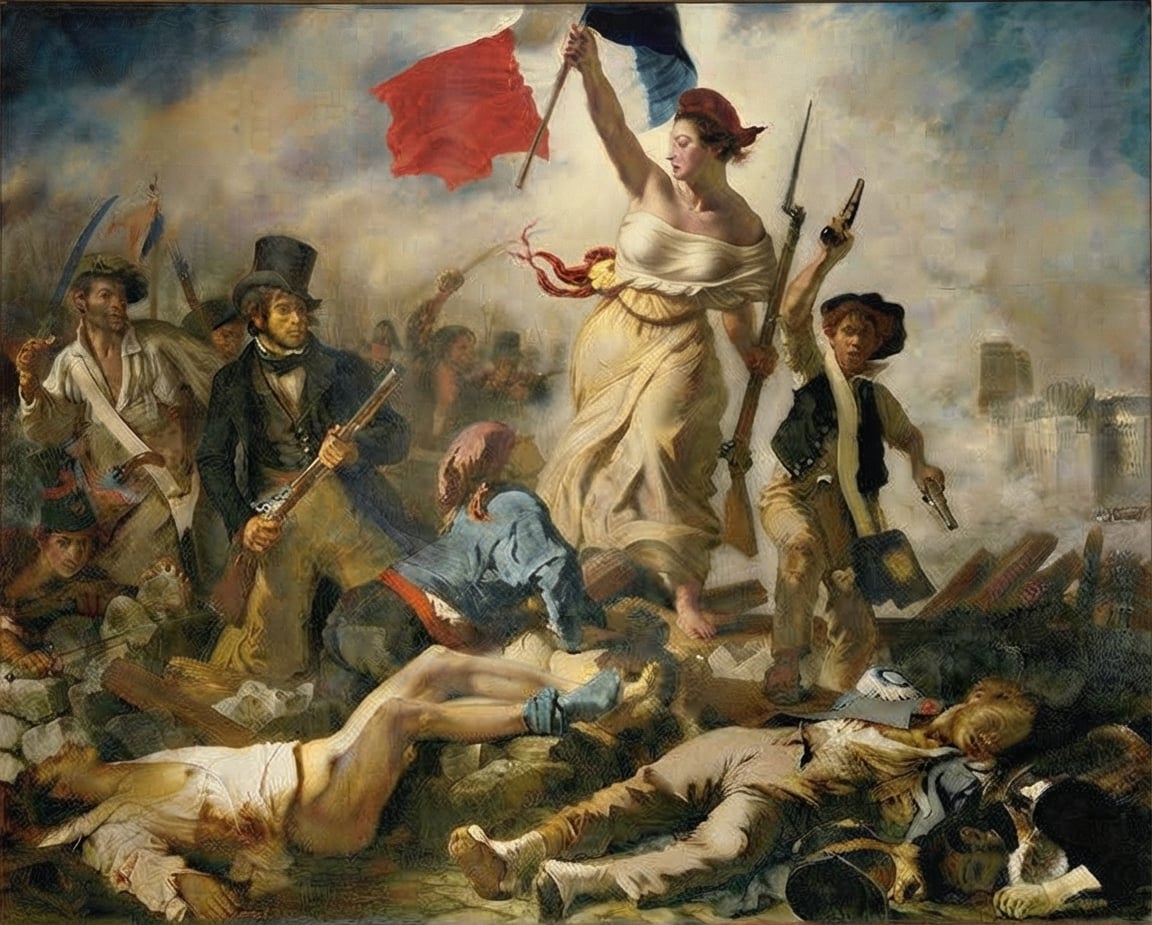
The painting “Liberty Leading the People” was painted in 1830 by Eugène Delacroix.
Nearly every major revolution of the twentieth and twenty-first centuries caught the international intelligence community off guard, not because there were no warning signs, but because intelligence systems struggle to translate social and psychological signals into a forecast of collapse. Iran in 1979, the collapse of the Soviet Union, and ideologically diverse movements across the modern era all unfolded despite abundant information, on-the-ground intelligence presence, and continuous reporting. In hindsight, the signs seem obvious: protest, economic erosion, political repression, and loss of trust. In real-time, however, those same signs were not converted into an alert about imminent breakdown. The reason is not a single error, but a deeper interpretive and structural failure well-documented in the academic literature.
Major intelligence failures stem not from a lack of information, but from how it is interpreted. Information about social unrest is almost always available, yet it is often framed as just another wave of protests, a temporary pressure point, or a deviation that can be managed. The surprise is not factual but perceptual: analysts see what they expect to see, rather than what disrupts their basic interpretive framework.
This is where the psychology of decision-making enters. Analytical systems struggle to imagine collapse due to deeply rooted cognitive patterns: status quo bias produces an assumption of continuity; confirmation bias reinforces data that supports stability; and normalcy bias makes it difficult to accept that an extreme event is actually approaching. In a hierarchical intelligence system, writing about regime collapse is seen as radical or even irresponsible and is therefore pushed to the margins.
Beyond individual biases, there is a deeper structural problem: processes of political change often unfold as a “cumulative surprise, ” where each indicator on its own appears minor, but their accumulation creates a breaking point. Revolutions do not erupt because of one clear factor, but from the combination of economic pressure, political repression, corruption, and sustained humiliation. Intelligence, which often looks for a single “trigger, ” struggles to identify the moment when accumulation becomes irreversible.
Revolutions can be understood as critical junctures, short moments of rupture in which an existing order breaks and a new historical trajectory opens. These are not linear processes, but sharp leaps. Intelligence, built around trend analysis and projecting the past into the future, has particular difficulty identifying such moments in real time.
Even when trends are detected, one variable remains decisive in determining whether a regime will endure, and it is rarely measured well by traditional intelligence tools: legitimacy.
One of the most significant failures, therefore, concerns legitimacy. Regimes survive not only through force, but through public belief in the rightfulness of rule. Military intelligence can measure force structure, unit loyalty, and coercive capacity, but it is far weaker at measuring the erosion of trust. A regime can appear strong on paper until the public stops believing, and the forces classified as “loyal” refuse to act. Collapse then becomes rapid, sharp, and surprising.
Contemporary research highlights the importance of identity and narrative processes. Big political change is built through collective identities, social networks, and transnational dynamics. These are “soft, ” elusive processes that often unfold outside the field of vision of state intelligence focused on elites, institutions, and the military. Yet it is precisely there that revolutionary mobilization takes shape.
The failure to predict revolutions, therefore, is neither accidental nor easily fixed. It reflects the limits of an intelligence system designed to identify clear threats, intentions, and capabilities rather than moments of psychological and legitimacy rupture. Revolution is not an information problem; it is a problem of understanding society. And it is within that gap that surprise is born, again and again.
In that sense, the crucial question is not how to collect more information, but how to build intelligence capable of detecting, while it is still happening, the loss of legitimacy, the convergence of narratives, and social threshold points, before they become historical facts.