
Why Is Israel Still on Trial?
Shabbat shalom!
After my recent essay on Zohran Mamdani, I received an email from a reader in Rockland County, New York. For those unfamiliar with the area, Rockland County is home to one of the largest concentrations of Orthodox and ultra-Orthodox Jews in the United States. Its neighboring village of Monsey has become a center of Jewish life for many Hasidic and Haredi communities.
The reader agreed with much of my Mamdani essay but suggested that the more interesting discussion wasn’t Mamdani himself. It was Zionism, or more specifically, the growing debate over Zionism and anti-Zionism.
His email arrived at an interesting moment because, truth be told, this is not an essay I particularly wanted to write. In fact, while researching it, I came across an argument by Sam Harris that almost convinced me not to write it at all.
Harris argues that perhaps the word “Zionism” has outlived its usefulness. No other country, he observes, possesses a special ideology devoted to explaining why it has a right to exist. France exists. Japan exists. Australia exists. Israel exists.
Why continue debating an “ism” that effectively serves as a permission slip for Jewish self-determination?
The observation stopped me in my tracks because, in a sense, this entire essay may be proving his point.
If Israel is approaching its eightieth birthday, why am I writing an essay explaining Zionism at all? Why am I once again defending a proposition that few other peoples are ever asked to defend?
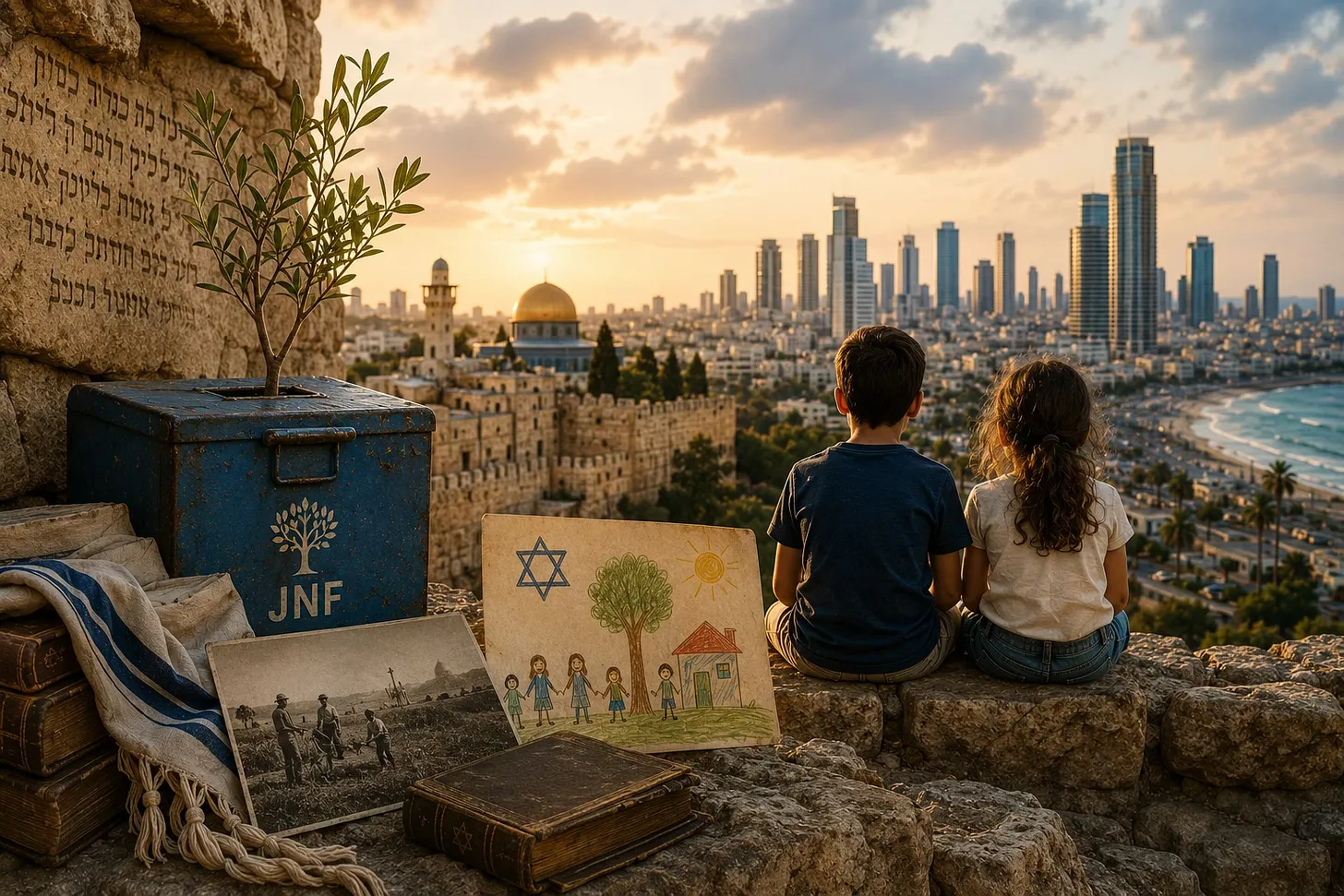
For most of my adult life, Israel was not something that required defending. It was something we supported. We planted trees through the Jewish National Fund. We dropped coins into blue boxes. We prayed for the peace of Jerusalem. We celebrated Israel’s achievements in science, medicine, agriculture, technology, literature, and democracy.
Like many American Jews of my generation, I grew up viewing Israel not as a political abstraction but as a source of pride and connection. Its existence was not the subject of debate. Its future was. Its policies were. Its leaders were. But not its legitimacy. What never occurred to me was that, nearly eighty years after its founding, I would find myself pulled backward into a debate over whether the Jewish state should exist at all.
Yet here we are.
The answer, I suspect, is that while Harris may be right in principle, we do not yet live in that world. The debate continues. The legitimacy of Israel continues to be questioned. So I am reluctantly participating in a conversation I thought had been settled generations ago.
To be fair, Israel occupies a unique place in the modern imagination. Since its founding, it has fought multiple wars for its survival and continues to face adversaries that openly call for its destruction. It also remains at the center of an unresolved conflict that generates fierce debate over issues ranging from settlements and Palestinian statehood to accusations of apartheid in the West Bank. In an age of social media, every military action, every tragedy, and every mistake is instantly broadcast around the world.
Those realities help explain why Israel remains controversial. They do not fully explain why Israel remains one of the few countries whose legitimacy itself is still treated as an open question. That, more than anything else, bugs the hell out of me.
And it is the question that sits at the heart of this essay.
Why Are We Still Having This Conversation?
Before we can answer that question, we need to agree on what Zionism actually means.
And there the confusion begins.
For many non-Jews, Zionism has become little more than another word for Jews. For some progressives, it has become synonymous with colonialism, nationalism, or occupation. Spend a few minutes on social media and you’ll discover that in some corners of the internet, “Zionist” has become shorthand for racist, oppressor, colonizer, or worse. Within the Jewish community itself, views range from enthusiastic support to theological opposition.
For purposes of this essay, I would like to set aside the slogans, assumptions, and accumulated baggage and focus on the simplest definition. Zionism is the belief that the Jewish people possess the right to collective self-determination in their ancestral homeland. Nothing more and nothing less.
Israeli journalist Haviv Rettig Gur offers an important counterpoint to Harris. While Harris questions whether the word Zionism remains useful, Haviv argues that it still describes one of the most consequential debates in modern Jewish history: how Jews would survive and flourish in the modern world.
I suspect they are both right. Historically, Zionism tells a profound story about Jewish vulnerability, survival, and self-determination. And as Rettig Gur often notes, Zionism was never merely an ideology. It was a practical answer to a practical question: what would happen to the Jews if they remained dependent on the goodwill of others for their safety? Yet Harris identifies something important as well. The very existence of the word often invites a debate that few other countries are required to have.
Which brings us back to the question that has been nagging at me throughout this essay. Why, nearly eighty years after Israel’s founding, is the legitimacy of the Jewish state still being debated at all?
Perhaps the best way to approach that question is to start with a few simpler ones.
Do peoples possess a right to self-determination?
Most of us would answer yes. We recognize that right when discussing Ukrainians defending their sovereignty, Tibetans preserving their culture, Kurds seeking autonomy, or Palestinians pursuing national aspirations.
Which leads naturally to the next question.
Do Jews constitute a people?
Jews are connected not only by religion but by a shared history, language, culture, memory, and sense of peoplehood. For nearly two thousand years, Jews prayed facing Jerusalem. The Passover seder concludes with the words, “Next year in Jerusalem.” Hebrew survived centuries of exile before being revived as a living language.
If peoples possess a right to self-determination, and if Jews constitute a people, then the burden of explanation begins to shift. The question is no longer why Jews should enjoy that right. The question becomes why they should be denied it.
Modern society places enormous emphasis on indigenous rights, cultural preservation, minority protections, and national self-determination. Yet when the conversation turns to Jews, something curious often happens.
Indigenous connection becomes colonialism. National liberation becomes nationalism. Cultural preservation becomes ethnocentrism. Self-determination becomes oppression.
Why?
Perhaps the answer is that nation-states themselves are illegitimate. Fair enough. But if that is the principle, it must be applied consistently. The critique cannot begin and end with Israel.
Perhaps the answer lies in Israel’s origins. Critics often argue that Israel’s creation involved displacement, suffering, and competing claims to the same land. They are correct. Like many nations born in the twentieth century, Israel emerged amid conflict, war, migration, and tragedy.
History is messy. But here again, consistency matters. Every nation has a birth story. Few are uncomplicated. The United States, Australia, New Zealand, India, and Pakistan all emerged from histories marked by conflict, migration, displacement, or partition. Yet despite those complicated origins, we generally accept a basic proposition: History cannot be endlessly re-litigated.
Americans are not expected to dismantle the United States. Australians are not expected to dissolve Australia. Pakistanis are not expected to abolish Pakistan. Nor should they be.
We may debate how nations confront historical wrongs. We may discuss reconciliation, minority rights, reparations, and accountability. But we do not generally question whether entire countries should cease to exist.
Curiously, Israel is often denied this consideration.
Imagine proposing that France should cease to exist as a French state. Imagine advocating for the dismantling of Japan as a Japanese state. Such positions would be considered radical. Yet proposals for a future Middle East without a Jewish state regularly appear in mainstream political discourse.
Again, why is Israel different?
Perhaps part of the answer lies in how different generations encountered Israel. My generation encountered Israel primarily as a story of survival and renewal. Many younger people encounter Israel first through its conflicts, filtered through social media, protest slogans, and viral videos.
That may help explain why conversations about Zionism often feel as though they are taking place in entirely different worlds. But it does not fully explain why Israel’s legitimacy remains uniquely contested.
To answer the larger question, I believe we need to ask a different one: not how Israel was created, not whether Israel is perfect, but what kind of society Israel is trying to build.
The Freedom To Be Ordinary
This is one reason I find Sam Harris so persuasive on this issue. He asks not merely who possesses the stronger grievance. He asks what kind of society each side is trying to build.
One does not have to believe Israel is perfect to recognize that the values animating Israeli society are fundamentally different from those animating many of the groups dedicated to its destruction.
That distinction matters. Israel’s critics often point, correctly, to its failures. Israelis themselves do the same every day. But criticism alone cannot answer a more important question. What kind of society is Israel trying to be? And what kind of society do its enemies seek to build?
The answers are not identical. Nor are they morally interchangeable.
Israel is a flawed democracy. Its governments make mistakes. Its leaders deserve criticism. Its citizens criticize them constantly. Yet it remains a society built around elections, dissent, independent institutions, religious freedom, freedom of speech, and individual rights.
Most Israelis are not waking up each morning wondering how to dominate their neighbors. They are wondering whether their children will be safe, whether they can afford an apartment, whether they will be called up for reserve duty again, and whether they can finally enjoy a stretch of normal life without missiles, sirens, bomb shelters, or terrorist attacks.
Like people everywhere, they want the freedom to focus on their families, careers, communities, culture, and dreams. They want the freedom to be ordinary.
That, in many ways, is what Zionism sought to achieve. Normalcy. The ability of the Jewish people to live, govern themselves, defend themselves, and pursue their future as other nations do. And yet, nearly eighty years after Israel’s founding, that aspiration remains uniquely contested.
That is what I think the reader from Rockland County was pressing me to see. The deeper question was never only about Mamdani. It was why a movement that challenges Jewish self-determination has become so influential in the first place.
Sam Harris may be right that the word Zionism itself helps perpetuate a debate no other nation is required to have. Israel should not need an ideological label to defend its legitimacy. Its right to exist should be treated no differently from that of any other nation-state.
But we are not there yet.
So here I am, writing an essay I never expected to write, about why the Jewish state is still being asked to justify its existence.
Which brings me back to the title.
Why Is Israel Still on Trial?
Exhibit A:
This essay.