Youth Ambassador.
Why Israel Owes More to Somaliland Than It Realizes
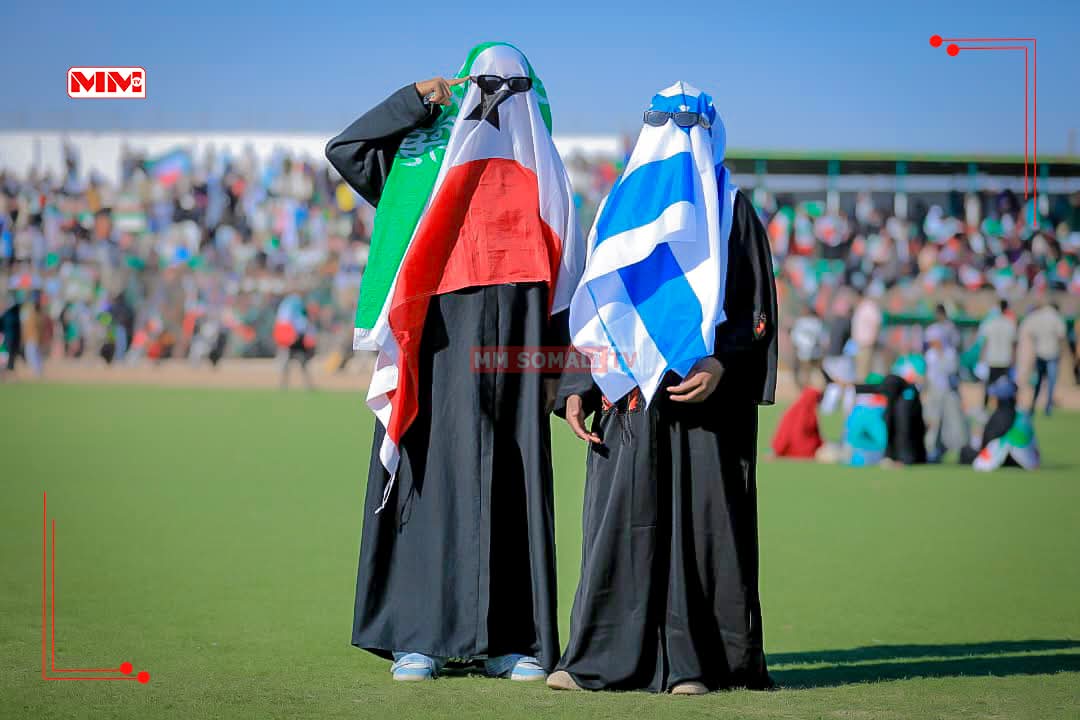
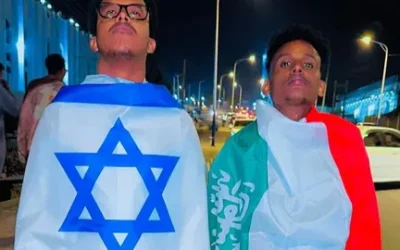
Two Somaliland girls wearing niqabs and the Israeli flag during a public display at Hargeisa Stadium of celebration.for Israel's recognition to Somaliland.
There are moments in history when friendship is measured not by what is given, but by what is risked.
In the Jewish tradition, there is a principle called Hakarat HaTov – recognizing and honoring the good that others have done for you. It is more than gratitude. It is the understanding that when someone stands beside you while others turn away, you do not merely thank them. You remember them. You stand with them in return.
Israel today faces such a test.
For decades, the people of Somaliland have lived in one of the world’s most difficult neighborhoods. To the south lies a Somali state that continues to reject Somaliland’s sovereignty claim and possesses every incentive to frustrate its international aspirations. Beyond it are extremist movements that have brought bloodshed and instability across the region. Further abroad are powerful geopolitical actors whose interests do not necessarily align with the emergence of a democratic and independent Somaliland.
Yet despite these realities, Somaliland chose a path few expected.
This was not a decision made in Washington, London, or Brussels. It emerged from a small Muslim nation in the Horn of Africa, a nation of nearly six million people whose mosques fill every city, whose faith shapes everyday life, and whose religious scholars command enormous influence.
And yet something remarkable happened.
At a time when support for Israel became increasingly costly across much of the world, ordinary Somalilanders openly carried Israeli flags through the streets. Some displayed the blue Star of David in their businesses, on their social media accounts, and in their homes. For many, the flag stood not as a rejection of their faith, but as an expression of friendship between peoples.
As a friend of mine always say , “Israel did not find a government willing to work with it. It found a Muslim people willing to accept it.”
There is something profoundly moving about that image: a Muslim household where the Israeli flag hangs beside family photographs, where it rests not far from the prayer mat upon which the family prays each day. Whether one agrees or disagrees with every policy of either government, the symbolism is undeniable. It represents a level of social acceptance that cannot be bought, lobbied for, or manufactured.
Governments can sign agreements, Governments can issue communiqués.But genuine goodwill from ordinary people is among the rarest commodities in international affairs.
The significance of that goodwill becomes even clearer when one considers what Somaliland stood to lose. Friendship with Israel carries risks in the Horn of Africa. It can invite criticism from neighboring governments. It can provide ammunition to political opponents. It can become a rallying cry for extremists. Somalilanders understood that hostile actors could seek to exploit tensions, that militant narratives could be weaponized, and that geopolitical rivals might use every available lever to undermine Somaliland’s stability and international standing.
Yet they chose friendship anyway.
That is why Israeli recognition of Somaliland, while historic and welcome, cannot be viewed as the final chapter. Recognition is not the fulfillment of Hakarat HaTov. It is merely the beginning.
If Israel wishes to honor Somaliland’s courage, it should become an advocate for Somaliland’s rightful place among the nations of the world. Israel possesses diplomatic relationships, technological expertise, and strategic influence that far exceed its geographic size. Those assets should now be used in support of a partner that has demonstrated uncommon goodwill.
Israel can help make the case for Somaliland in Western capitals. It can encourage deeper engagement from friendly democracies and regional partners. It can champion Somaliland as what it has long proven itself to be: a stable, democratic, and reliable actor in a turbulent region.
But diplomacy alone is not enough. The greatest expression of friendship would be partnership in nation-building.
Somaliland’s future depends on stronger infrastructure, greater technological capacity, modern agriculture, and improved water security. In a land where water remains one of the defining challenges of development, Israeli expertise could help transform lives. The effort to expand reliable water access across Hargeisa and beyond is not merely an engineering project. It is a national mission that will shape the future of generations.
Israel can also contribute to agricultural innovation, digital development, cybersecurity, education, healthcare, and defensive capabilities that allow Somaliland to protect its hard-earned peace in a dangerous neighborhood.
These are not acts of charity. They are investments in a friendship that has already proven its sincerity.
As Somaliland’s leadership and Israel’s leadership deepen ties and explore a shared future, Israelis should look beyond diplomatic ceremonies and official statements. They should look instead at the ordinary Somalilanders who, despite every pressure to do otherwise, chose openness over hostility and friendship over suspicion.
That is the essence of Hakarat HaTov. To recognize who stood with you when standing with you was not easy. And then to stand with them in return.
Related Topics
Related Posts