
Looking forward
Why Israel should recognize a Palestinian State
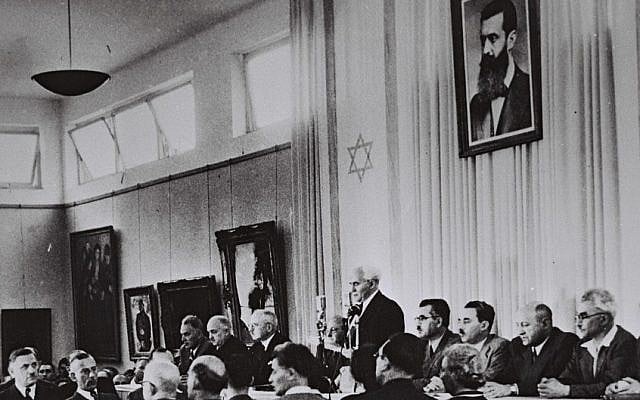
David Ben-Gurion, flanked by the members of his provisional government, reads the Declaration of Independence in the Tel Aviv Museum Hall on May 14, 1948. (GPO)
By joining in the recognition of the Palestinian State we can remind the world that living free in our land was our plan all along
Reading my daughter Exodus by Leon Uris in the shadow of October 7 has been one of the more thought-provoking experiences of my life as a Jew and Israeli. The book, of course, is a fictional account of the founding of the State of Israel. Yet the events Uris based them on were in large part real. My maternal grandfather was on one of those boats, taken to a displaced person’s camp. He made it to Israel, fought the forces of the Mufti in Mishmar Ha’Emek, lived through the chaos and near civil war of the forming of the State and its army. My paternal grandparents were the same pioneers Uris describes drying swamps, building communities, and defending our family’s and our people’s future with their lives.
One scene that made us pause was the story Uris told of the Zionist movement’s political maneuvering to advance a vote recognizing a Jewish State at the United Nations on November 29, 1947. My daughter, born in Tel Aviv and having lived through years of war sparked by the darkest day in our history since the Shoah, couldn’t believe there was an issue to debate. “But we were already living here,” she said, dumbfounded. “They can’t tell us we can’t be what we already are.”
And yet, as some of us heard from mentors and grandparents, the world felt it had the right to determine for us whether it would recognize our collective identity. Once it did, those same powers immediately issued an arms embargo and wished us luck to defend our ‘right’ on our own. Uris tells that story with a level of intrigue and adventure that puts Aaron Sorkin to shame: crosses and doublecrosses, alliances found in unlikely places. The late Ralph Goldman, the long-time head of the American Jewish Joint Distribution Committee and an aide to Ben Gurion (a near mythical man whose memory and actions continue to be a blessing to so many), shared with me how it felt to experience those moments in New York: the tension, the surprise, the rush to act to take advantage of the opportunity and legitimize what he and his comrades had established in the field. Of the understanding that we were on our own to build our own State, and no one would come to save us.
What I also took away from Ralph’s stories is that we recognized, in 1948, that there would be an Arab State living beside our own in what the British demarcated as Palestine under their “Mandate.” Each of the members of the Zionist council who voted for independence believed there would be an Arab state alongside the newly declared State of Israel. Our declaration of independence was, in other words, a request for the nations to recognize our separation from the Arabs among whom we lived.
77 years later, here we are: two years into the bloodiest war we’ve fought, following a terrible pogrom executed by the forces of the government of the Gazan non-State we insisted on maintaining to our southern border. 58 years after our conquest of Jordanian and Egyptian territory in 1967, acting as if there is no Palestinian State while separating our citizenry from half of the humans who live within the borders we control. Two years after October 7, claiming that October 7 should deny them statehood while ignoring the 20 years Israel’s government maintained their non-State and fostered their genocidal regime.
Were I advising Jewish leaders, I would recommend using the upcoming 2025 UN vote to recognize an Arab Palestinian State. I’d remind the world that recognition brings responsibility: for the welfare of one’s citizens (which means an end of UNRWA), maintaining peace with one’s neighbors (which means an end to the armed factions), and ultimate responsibility for the actions carried out by its citizens against the citizens of others (which means it must avoid acts that could be seen as declarations of war). I’d recommend that with the recognition must come an end to the unique recognition of Arab Palestinian refugee status, since, after all, there are no refugees if there is a State they can call home.
Further, I would remind the world of the many demilitarized States living peacefully with their neighbors, and that it would be wise for Arab Palestine to focus its limited budgets on non-military expenditures. I’d remind the world of the many States with ongoing territorial disputes, and extend our interest in resolving the outstanding questions of territorial integrity to ensure that Arab Palestinians under Israeli control who wish to be citizens of the new State can live within its borders. I would demand that the world commit to ensuring the Arab Palestinian State grant the same rights and privileges granted by Israel to its Arab citizens to those Jews who want to remain in their ancestral land after negotiations are successfully concluded.
Israel has not benefited from the Palestinian non-State reality on our borders. October 7 was not prevented by our decision to deny a Palestinian State. In fact, as countless Israeli generals and security officials have said both publicly and privately, the isolation of the Al-Aksa Flood to Gaza proved our cooperation with the Palestinian Authority and the potential for good relations between our peoples.
Recognizing an Arab Palestinian State doesn’t mean giving up our right to defend ourselves and our borders. Recognizing an Arab Palestinian State simply reiterates the message we sent to the world with our declaration of Independence in 1948: we are determined to live as a free nation in our ancient land, and “we extend our hand to all neighboring states and their peoples in an offer of peace and good neighborliness, and appeal to them to establish bonds of cooperation and mutual help with the sovereign Jewish people settled in its own land.”
Related Topics