


Why Israeli-Palestinian Peace Depends on American Leadership
Israeli society is traumatized, just as it was after the 1973 Yom Kippur War, which claimed the lives of 2,656 of our sons and daughters. That war, much like the current one, was the result of a colossal intelligence and political failure. Then, as now, Israeli society became more hawkish in the wake of tragedy, and most Israelis perceived those advocating for peace with Egypt as delusional.
One of the outcomes of the Yom Kippur War was the 1977 election victory of Menachem Begin. It was Prime Minister Begin who was most identified with the slogan “no territorial compromise.” Moshe Dayan, who became foreign minister in Begin’s government, reiterated on several occasions in the years after the 1967 Six-Day War that “Sharm el-Sheikh without peace is better than peace without Sharm el-Sheikh.”
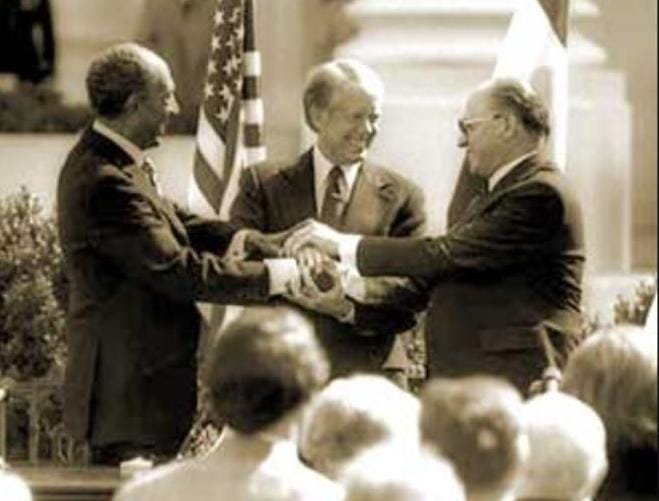
And yet, five years after the traumatic 1973 war, Menachem Begin signed a peace agreement with Egypt—the largest and most powerful country in the Arab world, which had been Israel’s number one enemy for many years. Contrary to his declarations of “not one inch,” Begin relinquished Israeli control over the entire Sinai Peninsula and dismantled the settlements there. Significantly, a decisive majority of the Israeli public supported this move.
American diplomatic engagement brought about the most positive and far-reaching strategic shift in Israel’s history, making peace with Egypt possible. This change was initiated by Henry Kissinger, the U.S. secretary of state in a Republican administration who mediated the negotiations to end the war and subsequently reoriented Egypt away from the Soviet Union and toward the United States. Later, it was Democratic President Jimmy Carter who committed himself personally, as well as the full might of America’s governing institutions, to bring about the 1978 agreement between Sadat and Begin at Camp David. For this, Carter was duly awarded the Nobel Peace Prize.
The same was true in the case of Israel’s peace agreement with Jordan, the country with which Israel has the longest border: it could not have been achieved without active American diplomacy. It was again a Republican secretary of state, James Baker, who took advantage of the momentum at the end of the First Gulf War to convene the 1991 Madrid Conference, which for the first time created an official political dialogue between Israel and Jordan that also included Palestinian participation as part of the Jordanian delegation. At that time, a security hawk—Yitzhak Shamir—led the Israeli government, and the Bush administration pressured him to participate in the Madrid peace conference. Somewhat ironically, the deputy foreign minister who was part of the Israeli delegation and its main spokesperson was none other than Benjamin Netanyahu.
The Madrid Conference initiated a process that, four years later, allowed a Democratic president, Bill Clinton, to help bring about the Israel-Jordan peace treaty, signed by Prime Minister Rabin and King Hussein.
During my tour of duty at the Israeli Embassy in Washington, I witnessed firsthand how the power of determined American diplomacy can change the world order. I saw how American diplomacy produced a sustainable agreement in the Balkans after the disintegration of Yugoslavia and ended the relentless bloodshed in Bosnia and Kosovo. The combination of input from all branches of the US government, along with the military power of Pentagon-led NATO, enabled Secretary of State Albright and Special Envoy Holbrooke to succeed on the international stage.
While studying at Harvard’s Kennedy School of Government, I researched in depth the process that led to the signing of the Good Friday Agreements. Here, too, the US was indispensable; President Clinton and Special Envoy Mitchell were instrumental in ending the bloodshed in Northern Ireland through proactive diplomacy. The process of disarming the Irish Republican Army, a terrorist organization, took many years. This may well take place in our region too, if American diplomacy were to lend its power and influence to bring about the disarmament of Hezbollah and Hamas.
American diplomacy has so far failed to resolve the Israeli-Palestinian conflict for two main reasons: The first is the mistaken belief that the conflict can only be resolved through bilateral negotiations between Israel and the Palestine Liberation Organization without the assistance of Arab states. This approach led to failures in Oslo, Camp David, and Annapolis because there is no Palestinian leader who alone can resolve such weighty issues as Jerusalem and refugees without the backing of the Arab world. As a result of these failures, the perception developed in Israel that it is possible to ignore the Palestinians and seek agreements with other Arab countries instead. The result of this policy, which includes Israeli unilateral disengagement from Gaza in 2005 that bypassed the Palestinian Authority and the sidelining of the Palestinians in the Abraham Accords, strengthened the Hamas narrative that only radical Islamic terrorism, not diplomacy, can bring about self-determination.
The second misconception was the long-standing American practice of adopting the positions of successive Israeli governments, which have acted and continue to act against any arrangement that would include an independent Palestinian state. The prevailing perception in the American Jewish community and across the American political landscape was that allying with Israel meant adopting the policies of the Israeli government without question or dissent.
This approach has changed recently, especially following the Gaza war and de facto West Bank annexation. For most Jews and indeed the vast majority of the Democratic Party, it is now clear that the way to save Israel, certainly as a Jewish and democratic state, is to promote the establishment of Palestinian statehood. The opportunity we now have in the region is unprecedented; the overwhelming majority of Arab countries share Israel’s aspiration to diminish the power of extremist elements throughout the Middle East, primarily Iran and its proxies.
Most American Jews and the mainstream of the Democratic Party understand that Israel’s integration into the region will not be possible without the establishment of a Palestinian state and that such a state will not be viable without wider regional integration that will also provide security guarantees for Israel.
If and when the Democratic Party returns to power in the US, there is a reasonable chance that America will become the last permanent member state of the UN Security Council to recognize a Palestinian state. This important move would position the US to bring Israel and the Palestinians together with the help of the Arab world and the international community.
With the notable exceptions of Iran and the right-wing government in Israel, the vast majority of the international community today supports the two-state solution. A new urgency emerged after the October 7 massacre, which proved beyond doubt that the status quo between Israel and the Palestinians is unsustainable. The scenes of the Hamas massacre and the immense destruction Israel subsequently wrought in Gaza unambiguously demonstrate that “managing the conflict” is not an option. Moreover, developments in the Israeli-Palestinian conflict impact not just Israel or the Palestinian territories but can also undermine the global economy, foment radicalism worldwide, embolden antisemites the world over, and erode security and stability well beyond the region.
It can be argued that only a leader of Anwar Sadat’s stature could have brought about peace with Egypt. But the truth is that every year since 2002, almost all Arab countries, as well as the Palestinians, have been telling us that they reaffirm the Arab Peace Initiative—which recognizes Israel’s rights subject to the establishment of a Palestinian state alongside it. This outcome was precisely what Sadat had in mind. When American leadership like that which brought about Israeli-Egyptian peace is shown, we may well get Arab leaders, such as Saudi Crown Prince Mohammed bin Salman, to come to Jerusalem and address the Knesset, as Sadat did in 1977.
Many argue that what is lacking is a leader on the Israeli side, like Menachem Begin, who transcended the ideology that had guided him for decades to bring about peace. There are yet others who despair over the reality that even if the Netanyahu government with extremist ministers like Smotrich and Ben-Gvir is defeated in the upcoming election, the next government will include right-wing figures like Naftali Bennett and Avigdor Lieberman, who are also opposed to a peace agreement with the Palestinians. To them, I say, Indeed, I do not expect Bennett and Lieberman to spearhead a peace initiative of the kind that Rabin and Peres did, but I can certainly envision a scenario in which they will act like Menachem Begin and sign an agreement with the Palestinians—backed by the US and regional actors.
I believe that Bennett and Liberman understand that Israel cannot afford, neither economically nor politically, to be a “super Sparta” and a pariah state. They realize that Israel must remain in the Western liberal democratic camp and seize the unprecedented opportunity for true regional integration. I believe there is a chance that they could sign off on the “23-State Solution” initiative, led by American diplomacy, in which Israel and Palestine will become partners in a regional alliance for peace, prosperity, and security.
We at J Street are laying the groundwork for such American leadership. The US midterm elections in November could change the congressional landscape, and come January 2029, Democrats could retake the White House.
There is also a significant possibility that for his own reasons, Trump will understand that for the sake of a Nobel Peace Prize and the many deals he is promoting in the Gulf, he needs to remove the main obstacle to stability in the region, i.e. the Israeli-Palestinian conflict. But of course, it is very difficult to predict what Trump will do. It is also hard to predict if Trump will be able to conjure up the diplomatic expertise required for such a complex move. This expertise still exists in various US government agencies, but not with Trump’s envoys, who may understand real estate deals but not the complexities of the Middle East and the global arena.
President Trump acted correctly in stopping the war in Gaza, enabling the return of Israeli hostages, and then presenting his 20-point plan—a document that includes a pathway to a Palestinian state. However, the implementation of the 20 points has stalled due to resistance from the Netanyahu government, the inability to disarm Hamas and empower a Palestinian technocratic government in Gaza, and the lack of attention on Gaza in the Trump administration after the ceasefire, as well as the settler terrorism and annexation occurring in the West Bank.
And yet, the possibility that Trump will come to his senses and promote an agreement cannot be ruled out, mainly because he has tremendous leverage over the Israeli right. However, we must remain attentive to ensure that even if Trump does not move in the right direction, a Democratic president who may well replace him will do so. The next president cannot repeat Biden’s mistake of refusing to apply the immense leverage the US has to save Israel and the region from the messianic right.
Anyone who cares about Israel, both inside and outside the country, must do everything possible to replace Netanyahu’s government. However, in and of itself, this effort is not sufficient. To save the founding Zionist vision from a binational catastrophe and prevent the continued deterioration of Israel’s standing around the world, determined American diplomacy with clearly defined goals is an imperative.