
Seeking honest leadership, and new narratives.
Why Israelis Misinterpret Queers for Palestine
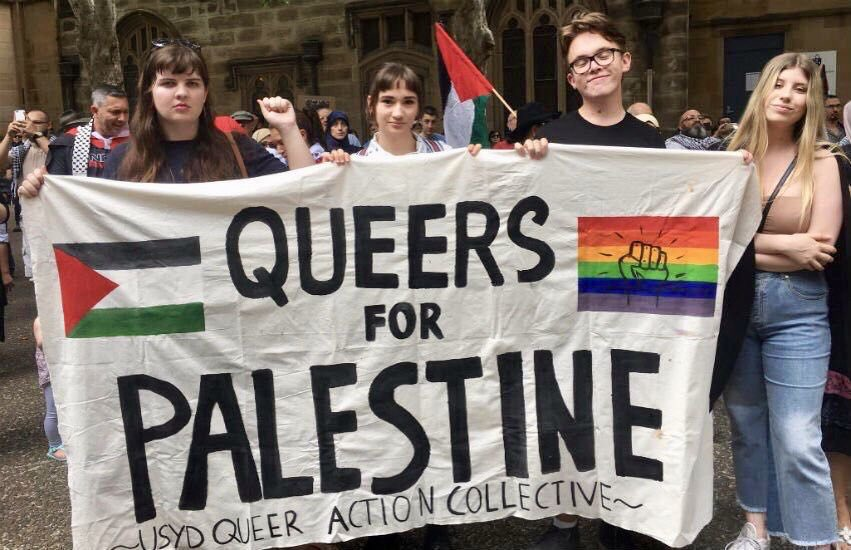
(via YouTube, September 2018)
The slogan “Queers for Palestine” often confounds or provokes many Israelis, including LGBTQ Israelis, who struggle to understand how individuals who openly identify as queer could align themselves with a national movement often associated with governments or factions that are hostile to LGBTQ rights. For Israelis—who live in a democratic society where LGBTQ rights have made significant legal and social advances—the alliance appears paradoxical. But this reaction misses a crucial point: Queers for Palestine is not primarily about gender or sexual identity politics in the Middle East; it is about solidarity with what they perceive as a globally oppressed people. Their motivation is rooted not in shared values with Palestinian political structures, but in shared experiences of marginalization, racism, colonialism, and systemic injustice.
Activists in Queers for Palestine and similar movements tend to view politics through the lens of intersectionality—a framework that connects struggles against various forms of oppression, such as racism, imperialism, capitalism, colonialism, and homophobia. For them, the Palestinian cause represents one of the most visible examples of state violence, occupation, and what they call settler colonialism. Their queer identity does not conflict with this; rather, it informs their worldview. They see their queerness not just as a sexual identity but as a marker of resistance to systems of power and marginalization.
This is a point that many Israelis—especially those who approach queer identity through the lens of liberal rights and Western frameworks of equality—often miss. For Israelis, progress is often measured in terms of legal protections, Pride parades, representation in the Knesset, and inclusion in the military. But for Queers for Palestine, queerness is radical. It’s anti-normative, anti-authoritarian, and inextricably linked to anti-colonial and anti-Zionist struggle.
A second reason many Israelis misunderstand this alliance is the concept of “pinkwashing”, a term used by critics to accuse Israel of promoting its LGBTQ-friendly policies to deflect criticism of its treatment of Palestinians. While Israel does indeed provide more rights and protections for LGBTQ individuals than virtually any country in the Middle East, critics argue that these achievements are used as a public relations tool to sanitize its image globally.
To Queers for Palestine, Israel’s liberalism on LGBTQ issues does not excuse or override what they see as structural injustices against Palestinians. In fact, they often view Israel’s celebration of LGBTQ rights as complicit in broader mechanisms of power that enforce racial and ethnic hierarchies. For this reason, pointing out that “Palestinian society is homophobic” doesn’t resonate with them. They believe liberation can’t be selective—oppression in one area cannot justify oppression in another.
Another challenge is that Israelis often judge political alignment through a pragmatic lens grounded in local reality, security concerns, and survival. Many see Hamas and other Palestinian factions as existential threats. They view queer solidarity with Palestinians as naive at best, or as betrayal at worst—especially when activists call for boycotts, divestment, and sanctions (BDS), which many Israelis interpret as delegitimizing the very existence of their state.
But Queers for Palestine activists are often far removed from these realities. They operate within Western academic, activist, or cultural circles where Israel is often viewed through the lens of postcolonial critique. Their understanding of the conflict is not shaped by living under rocket fire or serving in the IDF but by frameworks of power, race, and empire. This epistemological gap—how people know and experience the world—is vast and difficult to bridge.
Israeli society, while increasingly pluralistic, still retains a particularistic view of nationalism—one that roots legitimacy in Jewish identity, history, and sovereignty. For many Israelis, especially in the political center or right, national survival trumps abstract moral universalisms. LGBTQ rights are a hard-won part of the Israeli liberal order, but they are understood within the confines of a Jewish democratic state.
By contrast, Queers for Palestine embrace a universalist vision of justice that seeks to dismantle national borders, hierarchies, and structures they see as oppressive. They are suspicious of nationalism in all its forms, including Zionism, and view Palestinian liberation as part of a broader, global liberation struggle.
The fundamental misunderstanding between many Israelis and Queers for Palestine lies not in a disagreement about LGBTQ rights, but in radically different worldviews. Israelis often approach the issue through pragmatism, liberal nationalism, and a belief in gradual reform within a sovereign state. Queers for Palestine operate from a global, intersectional, and often revolutionary perspective, where solidarity is based not on shared identities or mutual interests, but on shared resistance to systems of power.
Bridging this divide will require more than pointing to Israel’s LGBTQ accomplishments or denouncing Palestinian homophobia. It will require an honest reckoning with the power of narrative, the politics of identity, and the deep chasm between lived experience and ideological solidarity. Until then, both sides are likely to continue talking past each other—each convinced of the moral clarity of their position.
Related Topics
Related Posts