Historian, Librarian, Educator, and Artist
Why Israel’s art world is afraid of honest criticism
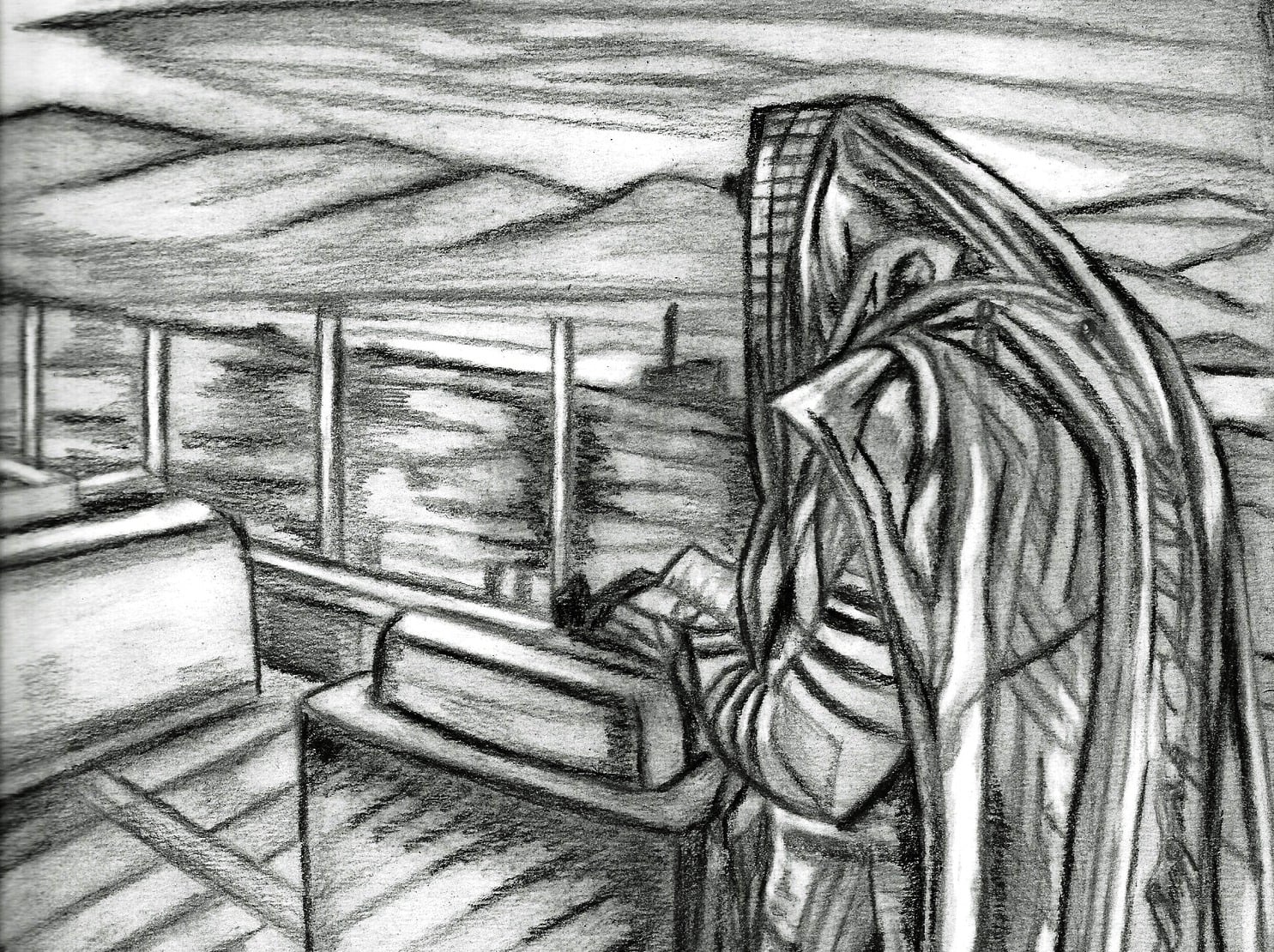
Morning Prayer in Morocco (2023) - Bonnie K. Goodman -
Charcoal and graphite on paper.
A rabbi greets the dawn in devotion — drawn from a photograph, yet rendered through spiritual immediacy. Created from distance, the work explores faith, memory, and artistic presence beyond geography.
Behind the beauty of Jerusalem’s galleries lies a fear of dissent — and a missed opportunity for artistic courage
Professional Distance and Creative Intimacy
As both a practicing artist and an art historian living in Jerusalem, I attend exhibitions not merely to look but to listen—to witness how ideas, emotion, and form converse in the same space. Israel’s art scene, small but fiercely expressive, has always fascinated me for this reason: it carries the tension of a country constantly negotiating between survival and self-definition, tradition and modernity, and faith and critique.
My approach to any exhibition is dual—that of the scholar observing patterns and of the artist sensing energy.
A leading member of a Jerusalem gallery collective personally invited me to attend an artist talk recently. I accepted with genuine interest—eager to hear a thoughtful discussion about process and meaning and to engage, if invited, in the kind of dialogue that nourishes the art world.
What actually happened was completely unique: an encounter that showed how fragile and defensive some artistic spaces have become, and how the fear of criticism can turn creative dialogue into social performance.
The Illusion of Openness
The event was framed as an intimate talk, a chance to explore an artist’s evolving vision. However, the atmosphere told a different story. The audience, largely composed of family and close friends, created an echo chamber of affirmation. Applause came easily; inquiry did not. Questions, when asked, seemed to puncture rather than expand the mood—especially if they countered the framed viewpoint.
When I gently raised an observation, the response was not engagement but sarcasm—a small, sharp deflection that carried a surprising chill. It was clear that even polite disagreement was unwelcome. This was not a conversation; it was a coronation.
Such insularity is more than discomforting; it is corrosive. The Israeli art scene, still small and personality-driven, sometimes mistakes intimacy for authenticity. Within these closed circles, artists perform openness while guarding fragility, curators curate affirmation, and any voice from beyond the inner circle becomes suspect.
However, we live in a social media age that has placed criticism—constructive or otherwise—on full display and in real time. Whether we invite it or not, critique has become ingrained in our public lives. Yet this constant exposure only mirrors what has always been true in the art world: criticism is not an intrusion but an integral part of creation itself.
When “Authenticity” Becomes Exclusion
One remark from that evening encapsulated the dynamic: the claim that true art can only arise from direct experience—from “standing in the place” one depicts. At first, the statement seemed poetic, but its implications were anything but.
That line, spoken to an audience predisposed to agree, created a subtle hierarchy, dividing those who have access, travel, and means from those who work from memory, imagination, or research. It dismissed not only methods but also realities: that many artists—women, immigrants, the disabled, the financially struggling—cannot stand in every place they wish to paint.
Throughout history, secular artists have envisioned worlds they could not touch. Caravaggio’s biblical dramas were less about theology than theatrical painted performances where light replaced faith. Turner’s tempestuous seas, though never fully seen, became metaphors for the human mind adrift in its storm. And Edward Hopper’s empty diners and city windows captured the solitude of modern life, places inhabited not by bodies but by longing itself. Each of these artists painted distance between people, between places, and between what is seen and what is felt, transforming isolation into vision.
To assert that art requires physical presence is to deny the very traditions that shaped Jewish and Israeli creativity. Even much of modern Israeli and Jewish art was created through exile, longing, and reconstruction. Art is not a passport stamp; it is empathy made visible.
Many Israeli artists create not from direct observation but from imaginative distance, transforming absence into creative presence. In such works, the imagined becomes the truest form of witnessing. From Chagall’s floating shtetls to Rubin’s imagined landscapes, Jewish artists have always painted where they could not stand, transforming absence into belonging.
As an artist, I know this intimately. My drawings often begin not in standing somewhere, but in seeing something—through another’s eyes, a photograph, or a fragment of memory. For many, the studio is a place of translation rather than documentation. To deny that creative legitimacy is to deny accessibility itself—to say that those without wealth, travel, or mobility cannot participate fully in the artistic conversation.
Authenticity is not about where one stands. It is about how one sees and understands.
When Theory Overshadows Art
What struck me most, however, was not the imagery itself but the language surrounding it. The talk unfolded entirely in Hebrew, though many in the audience were native English speakers. The choice of language created an additional layer of distance—whether intentional or not—between the artist and the audience. Translation became a form of gatekeeping, a way to define who belonged within the conversation.
The artist’s theoretical framework relied heavily on philosophical references. Yet these invocations, rather than illuminating the work, seemed to obscure it. The exhibition’s motifs resisted the theory meant to contain them. Their emotional charge spoke more through the canvas than through the citations attached to them.
In art history, ideas drawn from philosophy can enrich, but they cannot substitute for coherence in form. When explanation outruns observation, the work risks becoming secondary to the rhetoric around it. The truly original artist does not borrow profundity from philosophers; they paint it. Edward Hopper, for example, achieved through the simplest arrangement of space and light what many essays attempt through abstraction—the articulation of solitude, distance, and the interior self. His rooms are not explained; they are felt.
Listening that night, I sensed how the language of theory can harden into armor. Art, at its best, asks for exposure—the very nakedness, both physical and psychological, that vulnerability brings. When the intellectual scaffolding fails to meet the eye’s evidence, the audience feels the dissonance. What remains is not revelation, but retreat.
The Artist’s Perspective: Seeing beyond Standing
If standing in a place were the only way to tell if something is true art, then imagination would lose all power. But art has never needed anyone’s permission for its existence. For me, authenticity is not about where you are but how you see things. It’s about having the courage to turn what can’t be touched into something that can be felt. What we make from a distance can be just as real and vivid as what we make up close. That tension between being close and being far away is where I’ve found my most honest work.
As an artist, I know these facts not as theory but as lived experience. My recent works, Morning Prayer in Morocco (2023) and The Historian on the Balcony (2022), were never about standing in a place or recording what was in front of me. They came from distance—from faith that imagination can reach truth even when the body cannot.
In Morning Prayer in Morocco, a rabbi greets the dawn wrapped in tallit, his devotion rendered through charcoal and graphite. The moment’s essence, its stillness and surrender, emerged because nothing else competed for attention. Distance silenced the noise; it allowed me to see what was essential—faith itself. The image became less about geography and more about devotion, about the quiet strength of a man whose presence has guided me like a parent’s—steady, protective, unspoken. To draw him was to honor that steadiness, not through sentimentality but through form: line, light, and restraint.
The Historian on the Balcony shows a scholar above a European skyline, Herzl’s portrait in his hand, his gaze poised between reflection and revelation. I captured him not by proximity but through distance; the space between us offered clarity, not loss. In that remove, I could trace the curve of thought across his brow, the stillness of a man who lives in words yet reveals more in silence. His brow moves like punctuation when he speaks—the rhythm of intellect made visible, the architecture of persuasion drawn across the face. There is an intimacy that only distance allows—the kind that makes observation an act of care, not possession.
His expression held what language could not—that moment between looking and being seen, where intellect and intimacy blur. It was not observation but recognition—the artist’s gaze meeting the subject’s, equal, unflinching, unowned. To draw him was to translate knowing into line—not possession, but understanding. The intimacy was in restraint: the freedom to see without claiming, to hold through form what life could not.
I have drawn them both—the rabbi and the historian—not to claim, but to understand. Each portrait came from the same impulse: to honor, to listen, and to reveal what presence alone could not express. In each, the act of drawing became a kind of prayer—an attempt to hold stillness, thought, and faith in the same breath. My purpose was never to center myself within the image but to bear witness; to let the gaze move freely, not to possess but to perceive. Art, for me, is not about ownership but release—allowing what is seen to speak for itself.
They began with a photograph, but the act of drawing made them something else—closer, more intimate, as if I were there. Both belong to that uncertain middle space between memory and invention, the real and the remembered. These pieces were imagined, not witnessed. Yet imagination shaped by memory and longing has its own kind of truth. What the eye can’t touch, the heart often still recognizes. Distance, after all, is not absence; sometimes it’s the only way to see.
That may be the artist’s quiet privilege: to discover closeness inside what’s far, to turn yearning into shape, and to prove, with line and light and shadow, that connection can survive even when people, and words, cannot.
Real art asks for that kind of bravery—to face the gap, to turn emotion into image, and to welcome conversation instead of closing it off. Once a work leaves the studio, it no longer belongs just to the artist; it belongs to the world that responds to it. The best art scenes—in Paris, New York, and Jerusalem—understand this. Criticism isn’t an attack. It’s the echo of creation continuing its dialogue.
In that conviction—that art must breathe freely—I felt again how fragile that ideal can be when met with fear. In the arts, as in life, critique often reveals insecurity where confidence should reside—a reminder that the true test of creativity is how we respond to being seen.
The Inheritance of Art
I do not see myself as anyone’s rival—least of all in art. My practice is not born of competition but of inheritance. I grew up surrounded by art long before it became professionalized or commodified, filled with art books, materials, and creativity. My mother was a gifted painter whose life, like so many women’s, diverted her artistry into craft—wool, needlepoint, and cross-stitch—before returning to paint. Her canvases of houses, windows, and flowers captured light as language and memory as color. My father, an architectural draftsman, expressed beauty through precision: blueprints that became homes, dreams made measurable.
I began drawing as a child, painting by twelve, and teaching by my late teens. My studies in art and art history were natural continuations of that legacy, and though I later pursued library and historical research, the impulse was the same—to preserve, to interpret, and to make meaning visible. Painting, like writing, has always been the language through which I translate the world.
During the discussion, the curator described the artist as being “driven,” a word that lingered with me. It reminded me of one of my mother’s favorite Yiddish phrases—der tayvl treibt—“the devil drives.” It was her way of acknowledging the restlessness that often propels creativity, but also the toll it takes when making becomes a compulsion rather than a calling. Life, not ambition, interrupts the artist’s path; the true test is whether we keep returning to it in our own time.
By the late 1990s, I had already been painting for six solid years when I received a commission for a large-scale piece: a four-panel carousel scene. The client had envisioned something different, yet they were very pleased with the final work, which became one of my early milestones. I designed the composition in collaboration with my mother, artist Sheila Wolfe Goodman.
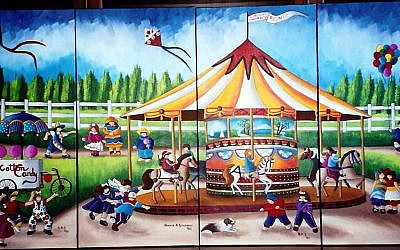
Acrylic on four canvases (12 x 24 in. each).
A collaborative work with my mother, reimagining the faceless figures of Quebecois painter Pauline T. Paquin through color, rhythm, and joy — a celebration of inheritance and shared creation.
Together we drew inspiration from Quebecois painter Pauline Paquin, known for her faceless figures that universalized emotion rather than erasing individuality. While Paquin’s influence is visible in the rhythm and play of the figures, the painting’s structure and sensibility were entirely our own. It captured the pulse of community and joy. For me, that work stands as proof that influence need not diminish originality.
My mother and I adapted that idea, reimagining it through our own shared language of color, light, and joy. The work, which stretches across four canvases, captures the movement of community, color, and imagination—the very opposite of what I now see too often in today’s insular art world. Artistic inheritance, when acknowledged and transformed, is itself a creative act. It reminds me that artistic inheritance isn’t imitation; it’s evolution, dialogue, and gratitude for the hands that taught us to see.
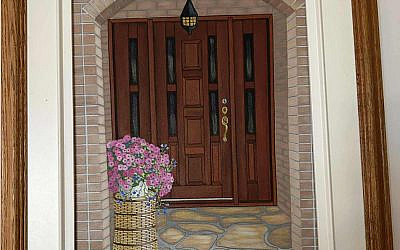
One of my mother’s paintings, which I often think about, quietly depicts the front door of our family home in Dollard-des-Ormeaux. My father, an architectural draftsman, had designed the door himself, and my mother later painted it with her characteristic care—the warmth of the wood, the soft light on the stone, and a basket of flowers resting by the threshold.
For her, it was not an abstract study of space but the embodiment of home: the place where art, love, and labor coexisted. I grew up within that doorway, sitting to study for exams on the stoop, where I learned to love reading as a small child. It was the last place my father was alive. Every time I see the painting, I am taken back there, standing not only before a structure but also before a life.
When I hear artists claim that one must “stand in a place” to depict it truthfully, I think of my mother’s painting. She did not have to travel far—she only had to see deeply. Art is not about distance or geography; it is about presence. And presence, in the truest sense, can exist wherever memory and meaning converge.
Maybe that is why I consider the culture of rivalry in the art world so hollow. True art is not a contest of status or ownership. It is continuity; it is a bridge between generations, between ways of seeing. To turn it into territory is to misunderstand its purpose entirely.
Echo Chambers and Closed Doors
The dynamic of echo chambers is not limited to one artist or one event. It represents a broader tendency in Israeli cultural life: to surround oneself with the comfort of familiar approval. The scene can be small, elite, and self-reinforcing. Too often, exhibitions function as private gatherings masquerading as public discourse.
The end result is an artistic echo chamber that is beautiful, curated, and stifling. Inside, art circulates like social currency, but outside, we do not hear voices that want to question or challenge. Criticism, which is the basis of artistic growth and evolution, is often considered hostility. In truth, criticism is the greatest compliment an artist can receive; it proves that their work is alive enough to provoke thought.
The artist talk that evening became a quiet case study in how small art circles can unintentionally harden into echo chambers. Around the room, the responses were polite, affirming, and self-contained. There was little risk, little challenge. In such settings, art becomes a mirror for the familiar rather than a window into the unknown.
In Israel, people often perceive criticism, which forms the foundation of artistic evolution, as antagonism instead of engagement. The ability to disagree thoughtfully—to expand rather than flatten conversation—is essential to the cultural health of any art scene. When criticism is dismissed as a threat, growth stops.
Leaving the event, I felt an unexpected sadness, not toward the artist, but toward the culture of fear surrounding dialogue. Art, which should thrive on curiosity and conversation, too often retreats into defensiveness.
Stepping out into the cool and breezy Jerusalem night, I let the hustle and bustle of the city bathe me, replacing the silence of the gallery. The streets were full and alive—music from cafés, shoppers in a rush, the laughter of tourists, and the flicker of light on stone. I began to walk, unsure where I was headed, only knowing that I needed to see art that breathed freely again.
In a city where every stone carries memories, history, and arguments, it seems fitting that art must also learn to listen—to absorb dissent, welcome imperfection, and hold space for the ongoing conversation that defines Israel itself.
Related Topics