
CEO of Time to Stand Up for Israel
Why Israel’s Existence Is No Accident
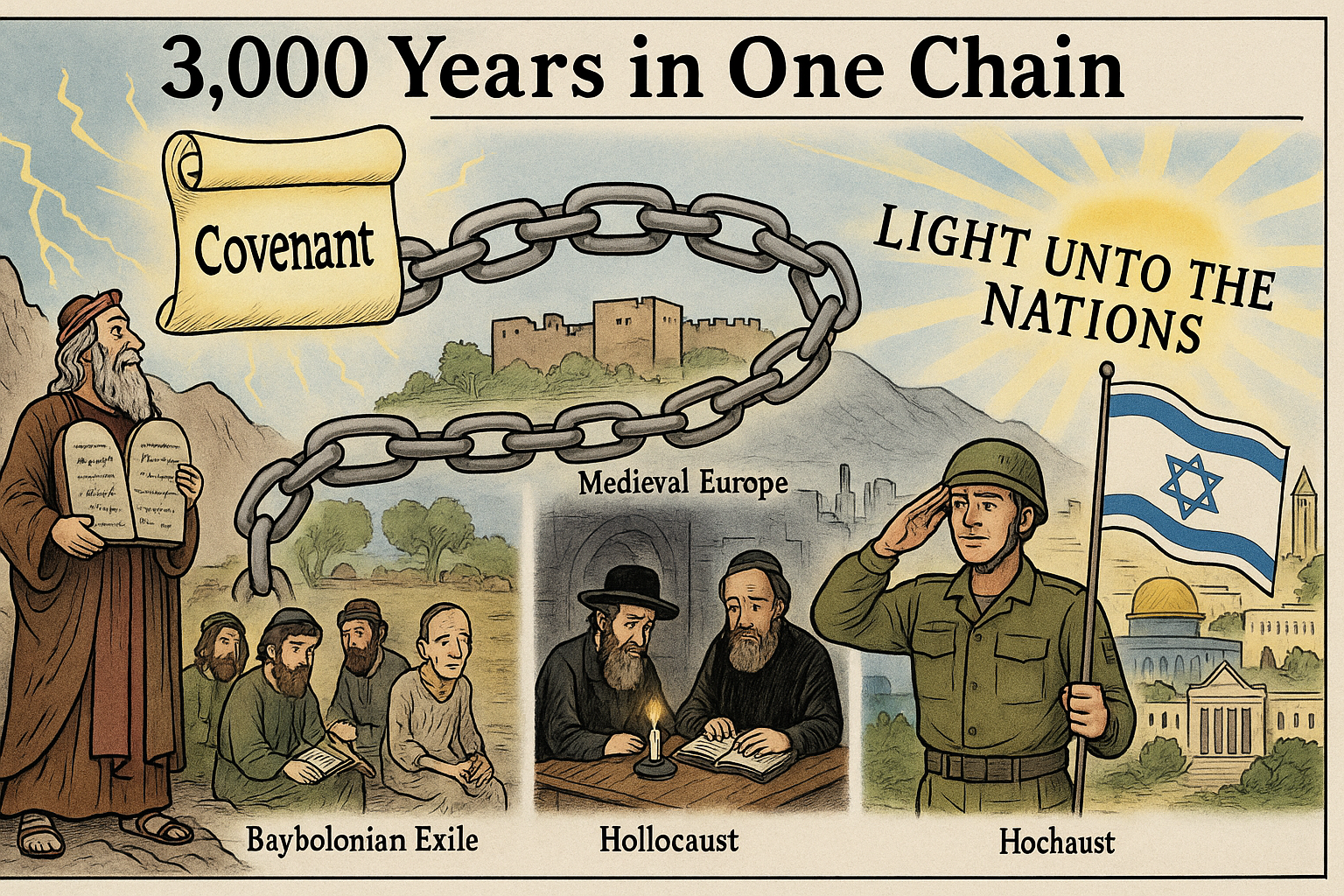
Photo credits: Sabine Sterk (AI)
Chosen for a Mission: Why Israel’s Existence Is No Accident
For more than 3,000 years, the Jewish people have carried an unusual idea: they were “chosen.” It’s a term that outsiders often misunderstand and critics sometimes weaponize. In truth, Jewish chosenness is not about superiority. It is about responsibility, a moral and spiritual mission that has shaped Jewish survival through exile, persecution, and ultimately, the rebirth of the modern State of Israel.
What “Chosen” Really Means
The concept comes from the Hebrew Bible. In Deuteronomy 7:6, God tells Israel:
“You are a people holy to the Lord your God. The Lord your God has chosen you…”
Similar, Exodus 19:5–6 calls them “a kingdom of priests and a holy nation.” This is the covenant made with Abraham, Isaac, and Jacob, renewed at Mount Sinai.
Being chosen means living by the Torah’s laws, upholding justice, and being a “light unto the nations” (Isaiah 42:6). Many rabbis compare it to being given a demanding job: high expectations, high accountability.
How Jews Live the Covenant
For centuries, Jews have shown their commitment through:
Religious practice: Shabbat, kosher laws, festivals recalling God’s deliverance.
Ethics: Justice, kindness, and charity (tzedakah) are central values.
Cultural continuity: Keeping Hebrew, traditions, and identity alive across continents.
Survival: Outlasting Egypt, Babylon, Rome, pogroms, and the Holocaust.
Judaism also teaches that all righteous people, Jewish or not, have a place in the World to Come.
The Myths and the Truth
Antisemites twist “chosen” into a claim of racial superiority. The Bible says the opposite: God chose Israel despite them being small, not because of greatness (Deut. 7:7). Others think Jews believe only they can know God, but Jewish law recognizes the righteousness of non-Jews. And while critics accuse Israel of using chosenness for land claims, the covenant is spiritual, predating modern politics by thousands of years.
Inside the Jewish world, some risk turning chosenness into arrogance, while others reject it entirely. The traditional view is clear: chosenness is a contract, and failure to live up to it brings greater accountability.
The Secret to Jewish Survival
When the First Temple fell in 586 BCE and Jews were exiled to Babylon, most ancient peoples would have vanished into the conqueror’s culture. The Jews didn’t because they saw themselves as bound by an eternal covenant, independent of land or king.
The Torah became a portable homeland. Rituals like Shabbat and festivals reminded Jews daily who they were. The prophetic mission to be a moral light gave meaning beyond survival. Resisting assimilation became a matter of sacred trust. Each generation passed on the Exodus story and the covenant at Sinai, embedding the belief that Jewish destiny was eternal.
In short, chosenness was a spiritual fortress: You are part of an unbroken chain from Abraham to now. No empire can erase you.
From convenant to Israel
When nationalism swept 19th-century Europe, Jews already had a national narrative thousands of years old. Daily prayers for a “return to Zion” were not poetry, but living memory. The Zionist movement saw the return to the Land of Israel as fulfilling prophecy.
That belief fueled perseverance against Ottoman restrictions, Arab hostility, and British roadblocks. The Torah’s geographic blueprint gave the claim to the land deep historical and religious legitimacy.
After the Holocaust, the covenant became a rallying cry: We live because we are meant to live. We must rebuild in our land. Survivors carried this conviction into the political fight that led to Israel’s rebirth in 1948.
Chosenness in Modern Israel
Today, not all Israelis are religious, but echoes of the covenant remain. Military service is often seen as defending the continuity of the Jewish people. Israeli humanitarian aid, from earthquake relief in Haiti to field hospitals in Ukraine, reflects the mission to be a light to the nations.
Why It Matters
Israel’s existence is not a historical fluke or a colonial experiment. It is the latest chapter in a 3,000-year-old mission, one that survived slavery, exile, persecution, and genocide. The belief in chosenness gave the Jewish people the strength to endure and the will to restore their homeland when the opportunity came.
This is why Israel’s legitimacy is unique: it rests not only on modern law and diplomacy, but on an unbroken chain of identity and purpose that no tyrant, empire, or ideology has ever been able to destroy.
Related Topics
Related Posts