

Why Jewish support for anti-Zionism is suicidal
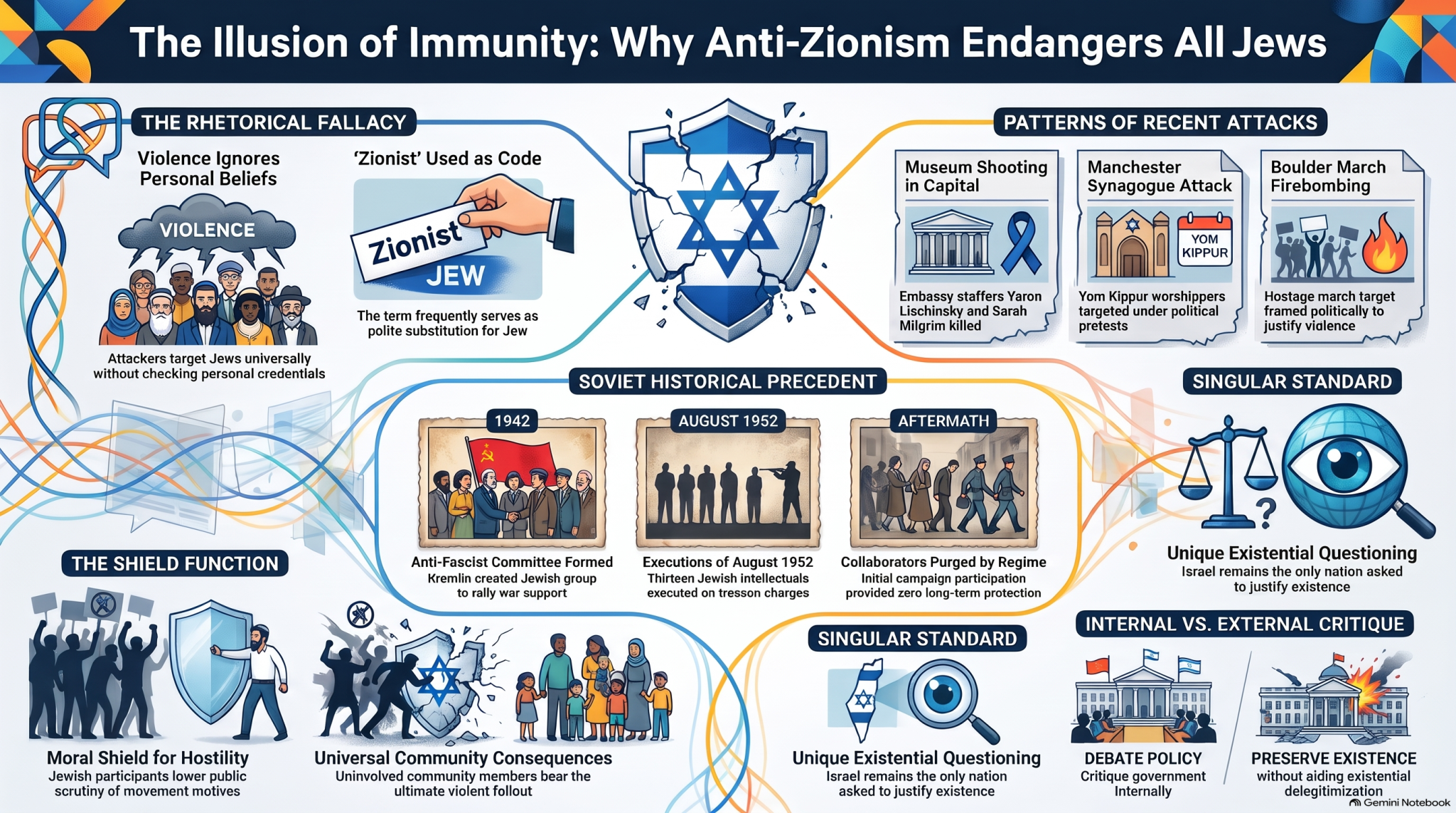
Anti-Zionism, whatever its reasons and whoever speaks it, feeds hatred of Jews in general, and Jews in general pay the price: the bearded and the secular, the Zionist and the indifferent, the professor and the child at a Hanukkah party.
A mob, a gunman or a regime does not check the résumé of the Jew in front of it. So the Jew who lends his name, his voice or his money to the anti-Zionist cause, however sincere his motives, is helping to forge the instrument that will be used against his own family. He should walk away from it. This is not a demand that Jews stop arguing with Israel’s government, which Israelis do daily and loudly. It is a demand that they stop joining the campaign against the Jewish state’s existence, because that campaign has never stayed inside the limits its Jewish supporters imagined for it.
The reason is simple. Hatred of a state is never aimed at a state alone. It needs people, and the people it can reach are the ones who look and sound like the state’s founders. Within hours of any crisis in the Middle East, Jews in Brooklyn, London and Los Angeles are handed the blame for decisions made in Jerusalem, by people they never elected, in a country many of them have never visited. The word “Zionist” was meant to describe a supporter of Jewish self-determination, but it has become a polite way of saying “Jew,” and those who use it know exactly what they are doing. When it is shouted in the street, nobody in the crowd stops to ask which kind of Jew is meant.
The record of the last two years shows where that road ends. A man who firebombed a march in Boulder for the release of hostages described his target as a “Zionist group” and insisted it had nothing to do with Jews. Two young Israeli embassy staffers, Yaron Lischinsky and Sarah Milgrim, were shot dead outside the Capital Jewish Museum as they left an event hosted by the American Jewish Committee. On Yom Kippur, a man drove a car at a Manchester synagogue and then attacked worshippers with a knife, reportedly shouting, “This is what they get for killing our children.” Each killer spoke the language of politics. Each victim was a worshipper, a museum guest or a marcher. The politics supplied the permission, and the victims were simply Jews who were within reach.
Nor is this new. The Soviet Union ran the experiment seventy years ago. The Jewish Anti-Fascist Committee was created in 1942, with the Kremlin’s blessing, to rally Jews abroad behind the war against Germany. Its leaders were later charged with bourgeois nationalism, treason and espionage, the accusations included a plot to establish a Zionist homeland in Crimea, and thirteen Jewish writers and intellectuals were executed on a single night in August 1952. Around them ran the campaign against “rootless cosmopolitans,” a phrase that became code for Jews. Historians note that the campaign did not begin as an openly anti-Jewish one, and that some Jews took an active part in it. That is the part worth remembering. Those Jews did not steer the campaign. They lent it cover, and then it turned on the whole community, its collaborators included.
A Jew who joins today’s version believes he is different, and the belief is natural. His reasons may be religious, humanitarian or ideological; he may be devout, or a professor, or a student, or an activist who has examined the question more carefully than anyone around him. None of it matters to the people on the other side of the barricade, and none of it matters to the movement either. The campaign does not sort its audience by motive. What it does with a Jewish speaker is use him: he becomes the proof that the cause is friendly to Jews, and a movement that can point to its Jewish members is a movement whose crowd stops asking whether it is hostile to Jews. The Jew at the podium is not making the crowd safer. He is lowering its guard against its own worst instincts. And the Jew in the next pew, who signed nothing and spoke nowhere, is the one who answers for it, held responsible for a war by a stranger with a knife.
The cause also fails the simplest test of whether it is safe for Jews. Ask whether any other people’s right to a state is treated this way. The world argues about borders, governments and policies everywhere, and almost nowhere does anyone campaign for a whole nation to lose the thing that protects it. Only one country is asked to justify its existence, and only one people is asked to explain why it deserves a home. A movement shaped that way will attract those for whom Jews are the problem. It has attracted them, and the old accusations about Jewish power, Jewish loyalty and Jewish guilt have come back wearing its vocabulary.
So the conclusion stands where we began. A Jew who supports anti-Zionism, for whatever reason, strengthens a movement whose consequences fall on Jews as a whole, whatever his credentials, his politics or his intentions. He can go on arguing about settlements, about the government, about the war, and about what Zionism should become, as Jews always have, from inside the family.
What he cannot safely do is lend a Jewish face to the project of ending the state that protects Jews, because the people holding the other end of that project have shown, from Moscow in 1952 to Boulder and Manchester in 2025, that they will not be checking who is Jewish enough to spare.