A Moroccan Journalist
Why Morocco Sat Out the Gaza Mediation
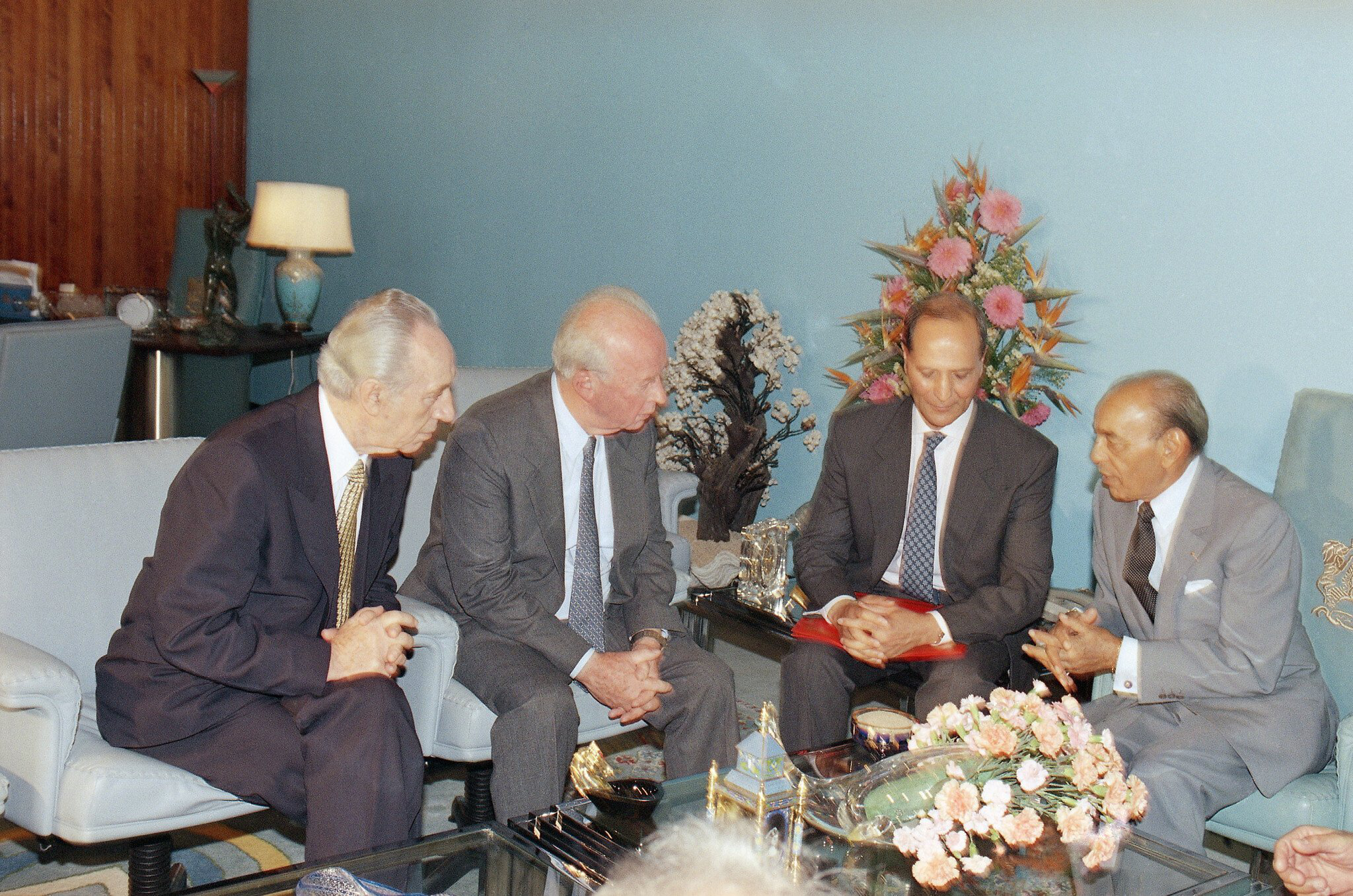
King Hassan II of Morocco, right, confers with Israeli Prime Minister Yitzhak Rabin, second from left, and Foreign Minister Shimon Peres, left , at the Skhirat Royal Palace in Rabat, Morocco, September 14, 1993. (AP Photo/Nati Harnik)
As Egypt and Qatar circulate new ceasefire formulas, shuttle envoys to Cairo and Doha, and brief Washington by the hour, Morocco is conspicuously absent from the room. On the ground, the war has hardened positions and made any truce both urgent and fragile, which is exactly why many now ask whether the kingdom has given up its historical role as an Arab bridge to Israel and the Palestinians. The answer is less about retreat than about leverage, alliances, and the cost of visibility in a polarized war. Egypt and Qatar hold the practical keys to Hamas, Egypt through borders and intelligence access, Qatar through a decade of political hosting and financing, and the current framework has been advanced primarily by those two capitals with US cover. Morocco does not own those levers, so it has chosen not to pretend it does.
From the outset, King Hassan II used Morocco’s royal prestige as a discreet diplomatic platform. In 1977, King Hassan II hosted secret talks in Morocco between Israel’s Defense Minister Moshe Dayan and Egyptian Deputy Prime Minister Hassan Tuhami, and also between Prime Minister Menachem Begin’s and President Anwar Sadat’s advisors; those meetings paved the way for Sadat’s November visit to Jerusalem and – down the road – the 1978 Camp David Accords and the 1979 Egypt–Israel peace treaty. Less than a decade later, in July 1986, he staged a precedent-setting public meeting with Israeli Prime Minister Shimon Peres at his summer palace near Ifrane, weathering Arab backlash to preserve a line of communication.
The same method carried into the Oslo years, when Morocco became both discreet broker and visible convenor. In September 1993, Hassan received Israeli Prime Minister Yitzhak Rabin and Foreign Minister Shimon Peres in Rabat on a surprise stopover immediately after the Oslo signing at the White House. Later that December, an Israeli delegation led by Jacques Neriah and MK Rafi Edry was received in the King’s grand chamber in Rabat to brief him on early Oslo developments; the King even offered a plane for Mahmoud Abbas to travel to Europe, illustrating his facilitative posture. In June 1994, he again welcomed Peres in his capacity as Foreign Minister, and that October received him at Bouznika on the eve of the Casablanca MENA Economic Summit. The summit, which Hassan personally hosted, gathered Rabin, Peres, the Palestinians, and Arab delegations to operationalize the multilateral track, effectively signaling the end of the Arab boycott. The following year, he went further, hosting Peres – still Foreign Minister – together with PLO Chairman Yasser Arafat in Rabat, issuing a joint communiqué.
Out of this period came low-level ties and reciprocal liaison offices: Morocco opened one in Tel Aviv in 1994, and Israel opened its own in Rabat in 1996. Israeli ministers would continue to shuttle in and out, including Foreign Minister David Levy in 1999 and Foreign Minister Silvan Shalom in 2003. What endured through all these episodes was the classic Moroccan method: wielding the monarchy’s prestige, convening power, strategic ambiguity, and a unique Jewish-Moroccan bridge, calibrated for state actors and PLO frameworks while staying clear of militia politics.
Rabat’s long-stated partner on the Palestinian side is the Palestinian Authority/PLO – the internationally recognized representative of the Palestinian people. Moroccan scholarship and official discourse consistently frame ties through Ramallah, not Gaza’s Islamist rulers. Within Western policy networks, Hamas is designated a terrorist organization; European and US diplomacy toward the conflict is constructed on that premise. For a country whose most consequential strategic chip in 2020 was US recognition of its sovereignty over the Sahara, making itself indispensable to Hamas talks would be a reputational gamble with Washington and Brussels, not a reward.
That world no longer maps neatly onto the present: with Hamas, the calculus changes. Doha has hosted the movement’s political bureau since 2012 and acts as banker and switchboard; Cairo controls the only non-Israeli exit from Gaza and runs a region-wide intelligence machine that mediates with militants. In this equation, prestige without proximity does not yield results. The latest 60-day truce proposal – and virtually every prior iteration – has been advanced by Egypt, Qatar, and the United States. Morocco’s diplomats understand that jumping into a file where others have day-to-day access would invite performative mediation without outcomes, which is the fastest way to erode credibility.
Normalization also redefined Morocco’s role: the 2020 tripartite declaration reopened liaison offices and aligned Rabat with a US-backed regional architecture, paired with Washington’s recognition of Moroccan sovereignty over the Sahara. That packaged gain came with handcuffs, a reputational constraint: in this new grammar, Morocco is read less as a “neutral Arab mediator” and more as a stakeholder with skin in the game. For Hamas and its ecosystem, that places Morocco on the other side of the wire; for Israeli politics, it ties Rabat’s utility to a file that can be weaponized by any domestic spat. The 2024 map fiasco made that clear, when Prime Minister Benjamin Netanyahu himself publicly displayed a map of Morocco without the Sahara, before his office issued an apology – an episode that triggered outrage in Morocco. A country cannot be perceived as a stakeholder one day and an honest broker to Hamas the next, nor can it serve as a trusted partner for Israel while still vulnerable to its red lines.
Morocco has also been edging away from Mashriq power plays toward an Africa-first horizon. Historically, Rabat read the Arab Cold War as a threat to monarchies and moved early to build quiet channels with Israel and Washington. Long before public handshakes, Rabat managed discreet, transactional contacts that enabled large-scale Jewish emigration in the late 1950s and early 1960s, from the 1961 “Operation Mural” exfiltration of children to the 1961-64 “Operation Yachin” air- and seaborne departures, which built a practical bridge to Israel without theatrical diplomacy. Since rejoining the African Union in 2017, the center of gravity has tilted south: counterterrorism cooperation and religious diplomacy across the Sahel, including formal imam-training programs now extended to more than a dozen countries through the Mohammed VI Institute; security services focused on Sahel-linked cells; economic interconnection projects like the Nigeria-Morocco gas pipeline that stitch West Africa to the Maghreb; access to the Atlantic for landlocked states via Dakhla; and the pursuit of integration with ECOWAS. In that frame, pouring political capital into Levantine factionalism offers low returns, while consolidating influence across West Africa and stabilizing the Sahel aligns with Morocco’s identity, security, and long game.
At home, the price of visibility is higher than the price of silence. Since October 2023, large anti-war and anti-normalization protests have persisted in Moroccan cities. Unlike in many countries where regimes fear such demonstrations might morph into anti-government protests, Morocco’s state has allowed them to proceed, managing a balance between public expression and sovereign policy.
The palace has defended the Israel track as a sovereign choice and has also policed the political space around it. On March 13, 2023, an unusually sharp Royal Cabinet communiqué rebuked the PJD for “irresponsible” statements that implicitly criticized normalization, warning the party to stop instrumentalizing foreign policy and reminding everyone that diplomacy is the King’s prerogative under the constitution – not a party platform. That backdrop also recasts Ismail Haniyeh’s June 2021 swing through Rabat: it was explicitly a party-level invitation by the PJD, with meetings across party and parliamentary figures, staged largely as face-saving theatrics after the party itself had signed the normalization agreement in 2020. That move cost the PJD much of its credibility and contributed to its crushing defeat in the 2021 elections, as the invitation was more about repairing its image than about state mediation. In short, the palace drew a thick line between a party’s post-normalization theatrics and the state’s foreign policy line.
In that climate, photo-ops with Hamas would invite charges of hypocrisy; photo-ops with Israeli officials would inflame the street.
If Morocco is not mediating, what is it doing? It has leaned into the lane it can defend at home and abroad, humanitarian relief under the Al-Quds Committee, which the King chairs. Aid convoys and airlifts have moved through Israeli crossings when possible and via partner corridors when necessary, a practical dividend of keeping channels open without advertising political intimacy. The message is consistent, Morocco supports Palestinian civilians, the two-state horizon, and Jerusalem custodianship, but it will not launder the legitimacy of an armed movement it does not back and cannot influence.
Critics say outsourcing the file to Cairo and Doha forfeits Morocco’s broker brand. The criticism stings because it is half true. The Hassan II playbook worked with states or with PLO officials under Arab cover, not with Hamas – a hybrid armed actor with external patrons and internal veto players, whose leaders live in Doha and whose battlefield is sealed by Egypt and Israel. It is embedded in a catastrophic war zone where mediators must either hold the keys (Egypt’s border) or the addresses (Qatar’s hotels). In today’s mediation market, access and enforcement capacity beat mystique. That is why Egypt and Qatar write the drafts while Washington guarantees the addenda. Morocco is not retreating from peacemaking; it is refusing to cosplay leverage it does not possess.
There is also a forward bet. Rabat is conserving capital with Washington and Europe, managing a difficult but strategic relationship with Israel, and keeping alignment with Gulf capitals – all while maintaining trust with Palestinian institutions that will matter in any day-after settlement. Morocco’s calculation is that preserving these strategic gains matters more than symbolic omnipresence in a process it cannot steer. The monarchy is also betting that the Moroccan-Jewish bridge – a million-strong community in Israel that keeps cultural and familial circuits alive regardless of headline turbulence – remains an asset for the “day after,” when reconstruction politics, Jerusalem custodianship debates, and PA reform inevitably come back to the table and will require credible Arab hands not tethered to Hamas.
Put bluntly: Morocco’s diplomacy is bold when legitimacy is clear and outcomes are bankable; it is cautious when engagement risks legitimizing an actor it does not back and cannot influence. With Hamas, the risks outrun the tools. For now, the kingdom is a conscientious bystander – funding relief, defending two-state orthodoxy, and husbanding capital with Washington and the Gulf – while Egypt and Qatar carry the file. The cost is reputational: less of the old mystique, fewer whispers of “Rabat did it again.” The wager is strategic: when the guns fall silent, the room will again need adults who can talk to Israel, the PA, and the West without disqualifying themselves in the process. Morocco wants to be in that room, and for now, sitting out the Hamas track is the price of admission later.
Related Topics
Related Posts