

Why my antizionism didn’t survive a Houthi missile
“On the ground. Now.”
I dropped.
Face down on the stones near a Ramle market, hands locked behind my neck. Somewhere above me, a piece of technology was trying to intercept a missile from Yemen. I had spent two years calling for the divestment of the very system I was now praying would work. The missile had not read my posts.
Thirteen days. That’s how long it took for the “Sit-in to Stop Genocide” tent to go up at Stanford after October 7. Hundreds of families still didn’t know if their loved ones were alive. Israel hadn’t launched its ground invasion, yet somehow, Stanford students had become genocide scholars overnight. And I was one of them. Before Columbia, before UCLA, there was us, and we outlasted every campus that copied us.
I was 16 the first time I saw Palestinian flags, at a Black Lives Matter protest in 2020. I asked an organizer why there were so many. “Because they feel our pain,” she said. “Palestinians have been fighting for Black liberation longer than you’ve been alive.” I nodded, grateful someone across the world cared.
My algorithm didn’t radicalize me. It just remembered for me. A week before October 7, my feed was memes, college basketball, and makeup tutorials. A week after, it was flags, keffiyehs, and, buried between the infographics, George Floyd’s face, painted on the separation wall in the West Bank. The same boot that had crushed his neck was on theirs. The debt had come due.
“No one is free until Palestine is free!” they chanted, and I parroted back the words I never chose.
Only one question mattered: Were you against genocide or not? Nothing recruits faster than the promise of being on the right side of history.
I just watched and copied. I unfollowed who they unfollowed. I learned to say “Of course October 7 was horrible, but…” I never once stopped at “horrible.” That fall, I wore my new keffiyeh to a candlelight vigil for Gaza. Hundreds of us stood in the dark, reading names aloud. On the way there, I’d passed a wall of hostage posters. “No justice, no peace” was scrawled across their faces. I had chanted those words at 16.
I was marching for a Palestinian state, not against an Israeli one. The one time I mentioned two states, my new friends from the encampment exchanged a look. One corrected me, gently, the way you correct someone embarrassing themselves: believing Israel should exist made me a Zionist. A slur. I said “you’re right” before I processed it. Next day, I was an antizionist. Like I’d always known.
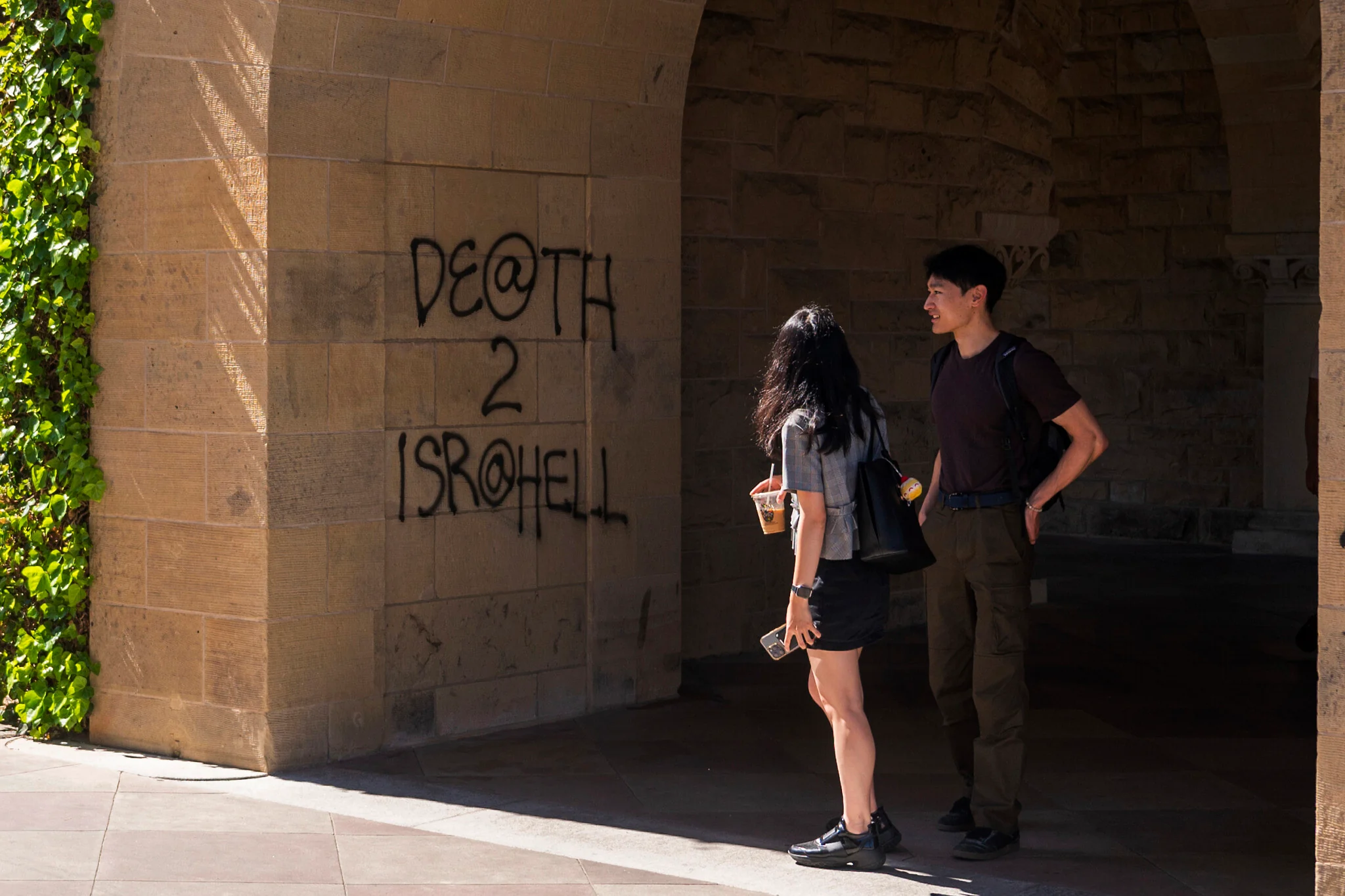
The morning after students broke into the Stanford president’s office and graffitied the walls, a man from facilities was already outside with a pressure washer. He’d clearly been at it for hours. I stopped to read what he hadn’t gotten to yet:
“Death to Israhell”
“Death to Amerikkka”
“Pigs taste best dead”
I looked for Gaza in those words. Then I kept walking.
Months later, someone sent me an email blast. An invitation: non-Jewish students, come witness an exhibit in LA about the Nova Music Festival massacre. My finger hovered over delete. Then I decided to go. Somebody had to fact-check it.
Instead, the exhibit had the real things: burned cars, rows of shoes left behind, and bright yellow porta-potties riddled with bullet holes where people had hidden. I’d seen thousands of images from Gaza that year, but I had never seen a single object from that morning.
I found a video looping on an iPhone. On the screen was a boy filming himself hiding. He was twenty, my age, and looked like someone I’d know. He was whispering into the camera, reaching for anyone on the other side of the screen. They found the video but not him, and I was a year too late to his funeral.
I couldn’t stop thinking about who else was twenty that morning, in the same crowd. Only one of them came for the music.
Then I came across a recording I still can’t forget. A young man, calling home on a dead woman’s phone. He’d just killed her. “Dad, I killed ten Jews with my own hands! Check your WhatsApp!” I waited for his father to scream. He didn’t.
“God bless you,” his father said. Then his mother: “I wish I was with you.”
This was what we’d been calling resistance? These were our martyrs?
He didn’t say he was freeing Palestine. He didn’t mention the occupation. He said “Jews.” Not soldiers, not settlers, not Zionists. Just Jews.
I stayed longer than I meant to. Every time I tried to keep walking, I stopped at one more name. I was fluent in the state’s sins but illiterate in its people.
So I went to meet them.
A Druze family in the Golan Heights invited our tour group for lunch. Their children played beside a missile remnant sitting in the grass. Just another thing that landed and stayed. Down the road in Majdal Shams, kids had been playing soccer the summer before when a rocket from Lebanon came down on the field. Twelve of them died. The youngest was ten.
Later that week, at a Shabbat dinner, an empty chair sat at the table and I stared at the glass of wine no one would drink.
“For the hostages?” I asked.
“Yes,” my friend said. “There have been empty chairs for three thousand years.” I had been certain for only two. The fear there was old. Then it was mine. In Ramle, the sky broke.
All I could think was: will it hit, will it hit, will it hit?
I turned my head and saw it: a thin white line climbing to meet another one. Even on the ground, part of my brain reached for the old sentence. Of course this is horrible, but... I couldn’t finish it. There was no ‘but’ for a missile coming at my head.
Ramle has mosques and synagogues a few streets apart. Whoever fired it was aiming at both.
Then the interception. The boom.
I stood up and brushed grit off my palms. Everyone just kept…walking. The marketplace reopened almost immediately. Vendors lifted their shutters. Someone bought knafeh. We ate pizza. My heart was still pounding, and the market had already moved on.
My first thought after was how fast I could leave. Watching the shutters go up, I realized that question had never been on anyone else’s mind. I thought about Rami, our Palestinian guide in East Jerusalem. Days earlier, I’d asked him what freedom would actually look like for him. He didn’t hesitate. He told me that as long as Palestinians waited for Israel to leave, they’d keep waiting.
I still wanted Palestine to be free. That hadn’t changed. But Rami had chosen his words. I had only ever borrowed mine.
I boarded my flight home. On the tarmac, another missile… I rolled my eyes.
When I landed, I checked my phone. My best friend had blocked me without a word. Another texted to ask me to scrub any photos of her from my Instagram. I hadn’t even left the terminal.
My friends had made up my mind for me. So in November 2025, I went public.
Strangers wrote things about me online I won’t repeat. The people I’d marched with shared them. None of it hurt like my brother’s name sitting at the bottom of my messages, the last text from weeks ago, unanswered. It was the lowest point of my life.
I survived it. And I would do it again.
Because somewhere, a 16-year-old is at a protest, asking an organizer why there are so many flags. She’ll get the answer like it’s obvious. She’ll nod, grateful someone across the world cares. And across the world, someone will be grateful she does.
The missile never read my posts.
But she might.