
Bridging faith. Defending truth. Confronting hate
Why Nobel Prizes Follow Civilization
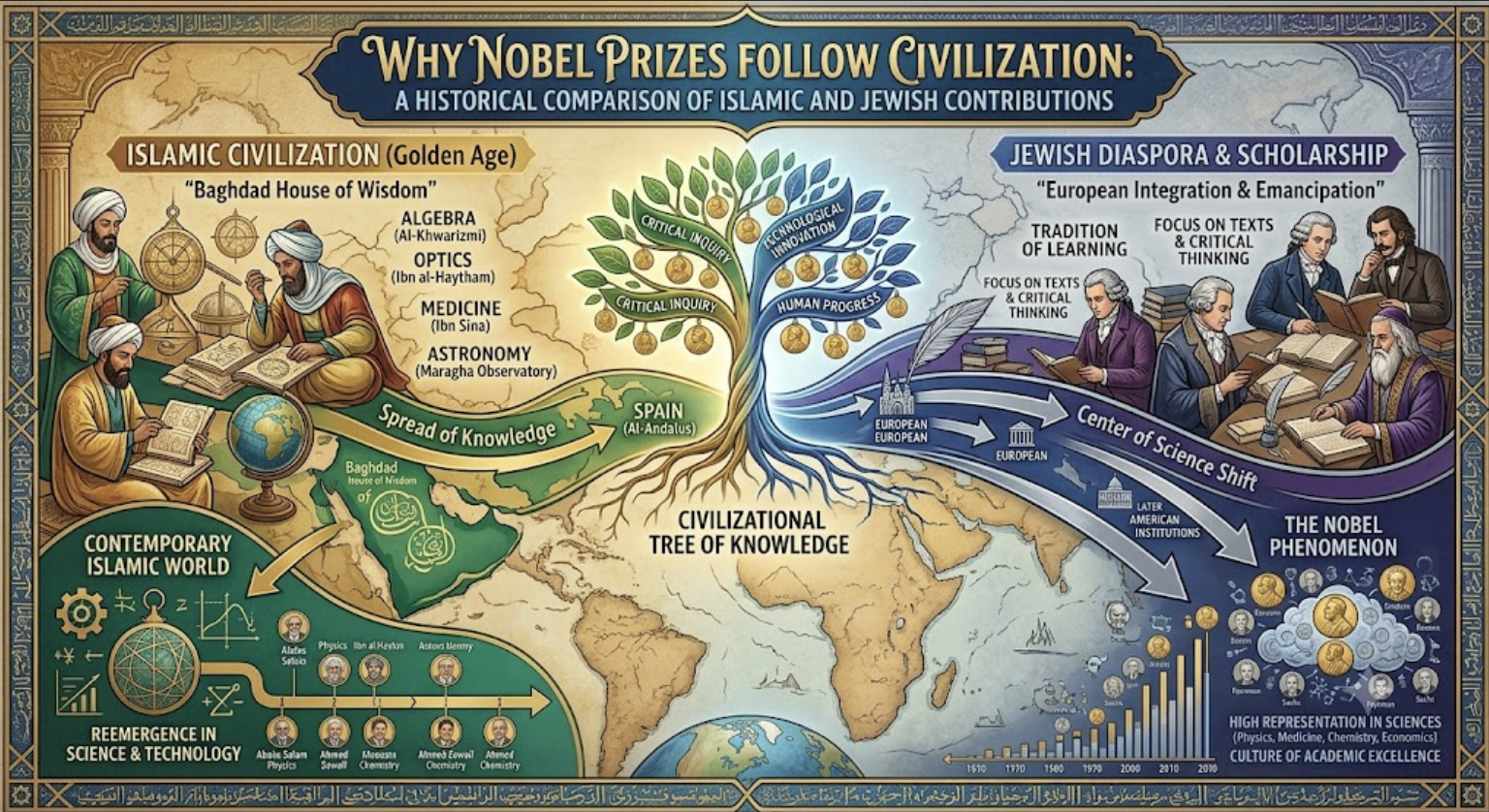
Image created from Google Gemini by Tim Orr
How can a people numbering only fifteen million account for roughly one-fifth of Nobel laureates, while a civilization of nearly two billion has produced only a handful in the sciences? Between 1901 and 2025, approximately one-fifth to one-quarter of individual Nobel laureates have had Jewish ancestry despite Jews comprising only about 0.2 percent of the world’s population. By contrast, only a handful of Nobel laureates in the sciences have been Muslims or of Muslim background, depending, of course, on how one classifies religious identity. This type of disparity invites simplistic explanations. Some opt for a charge of discrimination, while others charge it is a result of hidden Jewish influence or conspiracy. Neither asks the more interesting self-reflective question. Is there a problem within the culture that is being produced?
The more important question emerges: why the disparity? The two faiths built different cultures. Over many centuries, Judaism and Islam contributed to the formation of different intellectual traditions. Jews were trained to read difficult texts and to argue with authority. They were encouraged to enter elite institutions because there wasn’t an imminent threat of blasphemy, there was tolerance for abstraction, and not everything was always concrete. There was also a survivors’ ethic that developed, given the historical struggles that Jews have faced. Because of the diaspora, they built a portable culture that encouraged education, entry into urban professions like law and economics, and the development of strong diaspora networks.
Conversely, Muslim-majority countries did not build this type of infrastructure or build institutions that protected the independent heretical scientist, for instance. I’m not targeting Islam. Instead, I am simply offering a cultural analysis. Before offering a critique, I should note that the Medieval Islamic civilization made extraordinary scientific contributions. The question is not whether Muslims once produced great scientists. They unquestionably did. The real question is why modern Muslim-majority societies have not sustained those conditions in the same way that Western and Jewish intellectual cultures have.
During the Abbasid Caliphate, it stood at the forefront of scientific inquiry. There was Baghdad’s House of Wisdom, where great intellectual works from Greek, Persian, and Indian cultures in philosophy, mathematics, astronomy, and medicine were translated into Arabic.
Scientific achievement depends on not just intelligence or even education. It requires institutions that protect intellectual freedom and reward independent inquiry. Nobel Prize-winning discoveries happen when there is a climate in which scholars are free to challenge accepted ideas and pursue controversial research initiatives. They were then able to publish their findings in a peer-reviewed journal without fear of reprisal. These environments are not developed all of a sudden but take decades, even centuries.
Mere numbers do not produce Nobel Prize-level scientists. It is produced through a culturally constructed pipeline that moves from literacy to elite education to an emphasis on funding research. But it doesn’t stop there. There must be institutional freedom, the development of global networks, and the establishment of an ethic of dissent that is not penalized. After decades, as the system develops, there is a pipeline that is created that fosters success. Botticini and Eckstein believe that Torah literacy and an emphasis on education fostered unusual literacy, which was rare at the time.
I am not arguing that the Jewish achievements were not simply caused by religion. The existence of many secular and atheist Jewish Nobel laureates makes clear that Judaism’s influence is cultural as well as theological. So, religious inheritance did matter because it fostered a civilizational habit that cultivated respect for study, mastery of texts, sharpening of the memory, and family investment in education. Once Jews entered Britain and the United States, they had developed a portable capital that made them successful.
Jewish success reflects a broader historical development beyond its religious tradition, which contributes to its success. For centuries, Jews resided in urban areas and entered professions that required such things as literacy, analytical reasoning, and specialized knowledge in fields such as law, medicine, and finance. For diaspora communities, education became the de facto wealth that couldn’t be confiscated. When barriers were removed in universities, they were exceptionally well positioned to flourish within those institutions.
When one examines Islamic cultures, one sees, for the most part, the opposite. I am not arguing that Muslim cultures were incapable of scientific advancement, because there is spotted evidence that they can. But for the most part, many contemporary Muslim-majority societies have struggled to produce the institutional environments associated with Nobel-level scientific research.
In the vast majority of Muslim countries, the highest-status figure is not the one who discovers something that was previously hidden from everyone, but the one who serves as the guardian, the cleric, the patriarch, or whoever defends communal honor. Sure, the intellectual is tolerated when he confirms the nation’s greatness or success, but becomes dangerous when he reveals its stagnation. What this protectionism produces is a culture rich in memory, which remembers the Islamic Golden Age as proof of Islamic success rather than treating modern underachievements as proof of institutional failure.
There is high support for making Sharia law the law of the land, with some even supporting the death penalty for leaving Islam. This matters because a culture that attaches legal or social danger to religious dissent teaches the people that some questions are too dangerous to ask. But To get the results they do, Nobel Prize winners ask dangerous questions. So, the problem is not that Islam lacks intelligent people. It lacks the cultural institutional machinery to produce world-renowned thinkers who think outside of the box.
When there are Nobel Prize-winning Muslims, they do their research in Western institutions. The problem is that in Muslim-majority countries, they are not funding research. But they are creating an anti-intellectual climate that prevents freedom of thought.
I could sum things up this way. Civilizations produce what they reward. If a society prizes things like literacy, disciplined inquiry, institutional independence, and intellectual risk, discovery becomes increasingly likely. If it prizes conformity, discovery becomes more difficult. The disparity between Jewish and Muslim Nobel laureates is therefore less a mystery than a reflection of the kinds of institutions different societies have spent centuries building.
Works Cited
Pew Research Center, The World’s Religious Groups: How Their Sizes Changed from 2010 to 2020.
Nobel Foundation, All Nobel Prizes (1901–2025).
Jewish Virtual Library, Jewish Nobel Prize Laureates.
Maristella Botticini and Zvi Eckstein, The Chosen Few: How Education Shaped Jewish History, 70–1492 (Princeton University Press, 2012).
Dimitri Gutas, Greek Thought, Arabic Culture: The Graeco-Arabic Translation Movement in Baghdad and Early Abbasid Society (Routledge, 1998).
Pew Research Center, The World’s Muslims: Religion, Politics and Society (2013).
Related Topics
Related Posts