


Why Rahm Emanuel’s Middle East Strategy Will Fail
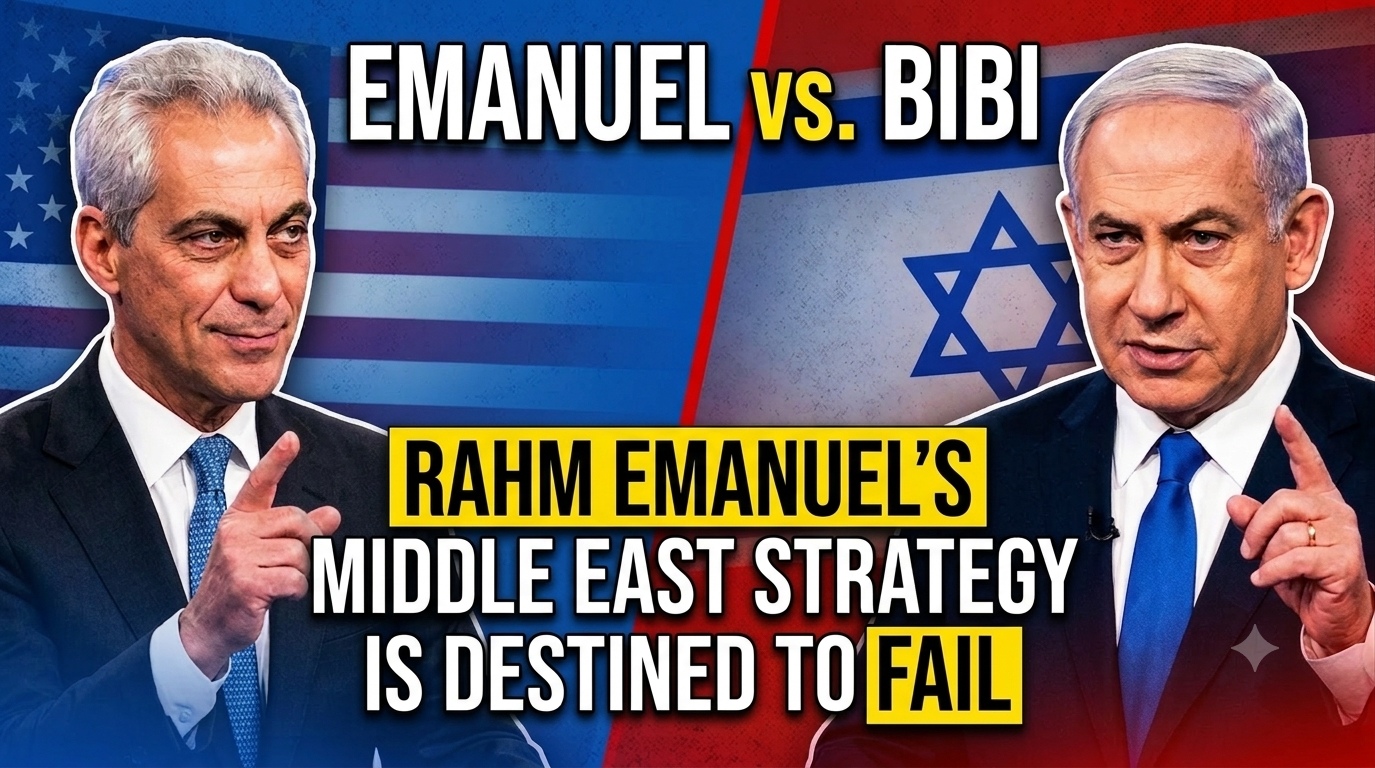
In a recent speech at Tel Aviv University, former White House Chief of Staff Rahm Emanuel outlined his vision for Israel’s future and the path to peace in the Middle East. While he correctly diagnoses many of Israel’s biggest challenges, his proposed policy solutions embolden Israel’s enemies and make the Middle East less stable.
Emanuel correctly identifies three of the most significant challenges facing the State of Israel today. While Israel has achieved strategic military victories on the battlefield in Gaza, Lebanon, and Iran, it has not been able to translate those successes into strategic political victories, such as disarming Hamas and Hezbollah, achieving regime change in Iran, or eliminating Iran’s remaining nuclear material. The second issue is Israel’s public relations problem and growing diplomatic isolation in the West, especially among younger generations who have lost sympathy for Israel and no longer believe in its right to fight. The third is the lack of a clear vision for the future of the region. While Prime Minister Netanyahu has hinted at elements of such a vision, including expanding the Abraham Accords and becoming more militarily independent, Israel has yet to fully articulate a comprehensive plan for the Middle East after the war is over.
While Rahm Emanuel has a strong understanding of the region’s history and has played an active role in the foreign policy of two American administrations, he does not understand the Arab mentality, which respects strength and exploits weakness. As a result, he fundamentally misdiagnoses the underlying causes of the conflict. Emanuel argued that October 7th was an attempt to derail peace in the region. But that is only part of the story. October 7th was a continuation of the longstanding Palestinian goal of destroying Israel. In many ways, Israel’s War of Independence, or the Nakba, as Palestinians refer to it, has never truly ended.
Emanuel’s proposed solution, the “23-state solution,” envisions Arab states doing more than paying lip service and instead taking an active role in reshaping Palestinian institutions. But because he fails to recognize the central obstacle to peace, the continued rejection by Palestinians and parts of the Arab world of any Jewish state in any form between the Jordan River and the Mediterranean Sea, the solutions he proposes are unlikely to succeed and will likely produce more instability, war, and suffering in the Middle East. Changing that mentality requires a thorough, long term re-education campaign similar to the denazification and reconstruction undertaken by the Allies in Germany after World War II.
Rahm Emanuel also proposes ending U.S. military aid to Israel as a way to improve U.S.-Israel relations. Yet he doesn’t mention that PM Netanyahu has already proposed phasing out American military aid, a proposal that even surprised President Trump. By portraying Netanyahu as the central villain, Emanuel is attempting to maintain his support for Israel while blaming Israel’s elected leadership for problems that are often outside of its control.
He criticizes Netanyahu for losing the public relations battle, yet he ignores the rise of the progressive movement and the radical shift that has taken place within the Democratic Party over the past three years. He also fails to mention the billions of dollars in Qatari funding that have flowed into American institutions from universities and media organizations to think tanks, corporations, and lobbying efforts in Washington which have helped to shape public opinion on Israel.
He also gives neither Prime Minister Netanyahu nor President Trump credit for signing the Abraham Accords. Emanuel presents those agreements as though they were the natural next step in regional diplomacy, when in reality they represented a major paradigm shift. By strengthening Israel as a regional power and creating an alliance between Israel and the Gulf states against Iran, the Trump administration fundamentally changed the strategic dynamics of the Middle East. That strategy, however, only works if you believe in peace through strength.
When President Biden took office, the United States no longer projected the same level of strength and support for Israel. I believe that rift helped to create the conditions for Hamas to launch the October 7th attacks. I am concerned that Rahm Emanuel’s strategy of restraining Israel using all available tools, such as economic sanctions, UN veto power, and restrictions on weapons sales, while placing greater faith in diplomacy over military deterrence, will only lead to more war, more turmoil, and greater suffering in the Middle East.
Rahm repeatedly blames the Israeli right, describing the idea of Greater Israel as “a fantasy chanted by fanatics who want endless, perpetual violence.” But expanding Israel’s borders is not an ideological project. In the case of buffer zones in Gaza and southern Lebanon, it is a practical security measure in response to ongoing threats. When an enemy invades your territory or uses its territory as a launchpad for rockets targeting your civilians, you have both the right and the obligation to defend your population. The buffer zones also serve as a deterrent against future aggression. In Rahm Emanuel’s framework, Israel is expected to give up hard won territory and accept vulnerable borders in exchange for nothing in return.