Why The Book of Ruth!
It has taken me a long time to come to this conclusion but Ruth is truly the perfect fit for Shavuot.
When I was younger, the Book of Ruth puzzled me. Among the five Megillot, the others made sense: Esther and Eichah (Lamentations) were historical narratives, tied to their festivals, though deeper than that. Song of Songs and Kohelet—cryptic allegories about our relationship with G-d and life’s meaning—were beyond my grasp but conceptually clear. Ruth, though—I couldn’t see its purpose. It’s a story of a Moabite convert, her bond with her mother-in-law, Naomi, and her marriage to Boaz, a local estate owner.
More than that, the fact that it was read on Shavuot morning confused me further. Shavuot was about intense Torah study—staying up all night, praying at 4 or 5 am. Yet the service pauses for this pastoral tale. As a London boy with no concept of harvests, it felt out of place.
But now, living in Israel, I see Ruth as essential to Shavuot, delivering three messages that, with Torah study, make us whole. Its juxtaposition with the Ten Commandments is a brilliant, subliminal lesson.
These messages are: first, Torah is more than a study hall text—it’s lived in the real world’s fields and relationships. Second, every small act of kindness can create a universe, as Naomi, Ruth, and Boaz’s choices turn exile into King David’s ancestry. Third, Ruth is a case study in complex halachic topics—conversion, tithes, pre-marriage relationships, and levirate marriage—showing Torah’s depth in a simple story. Ruth reinforces these truths when we focus on Torah’s details, making it Shavuot’s perfect companion.
Torah: From Study Hall to Fields
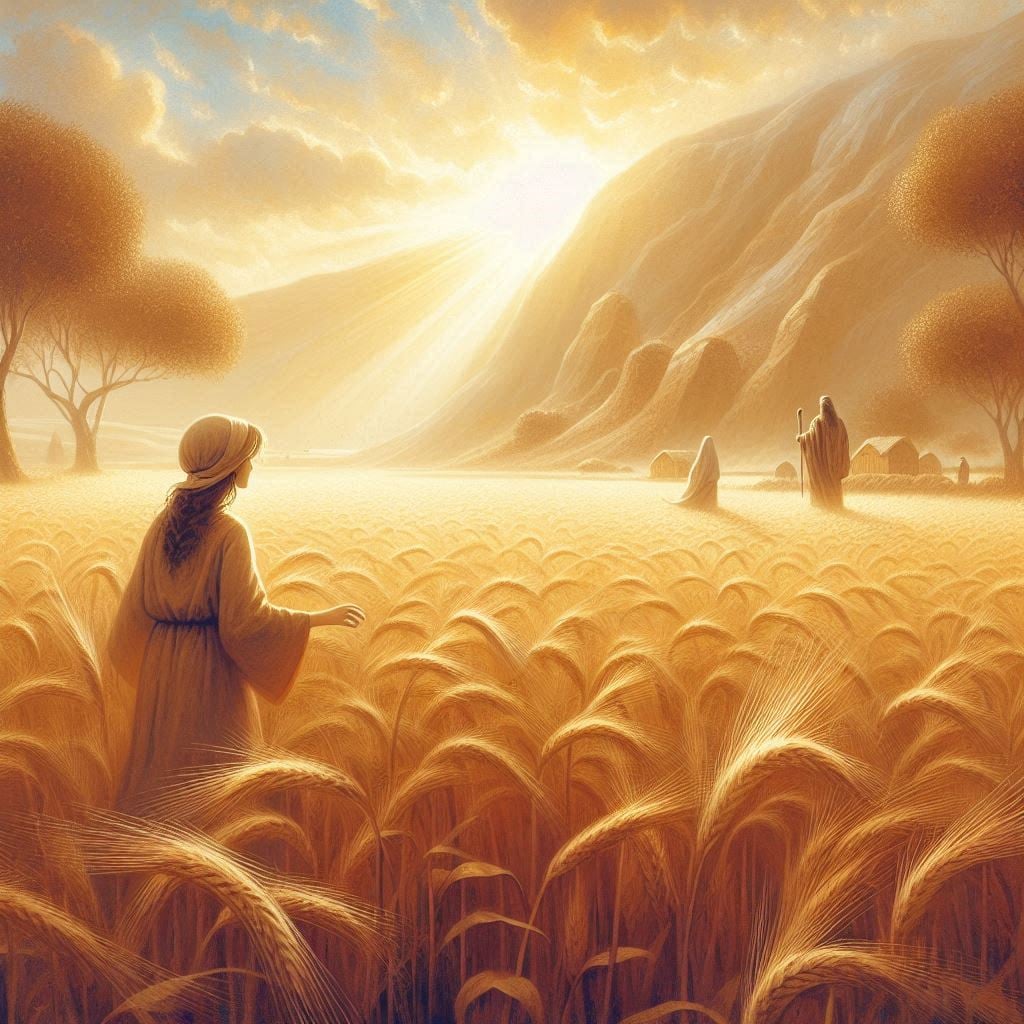
As a city kid in London, Ruth’s imagery—barley, gleaning, fields—felt foreign. Shavuot was about the beit midrash: all-night Torah study, debating texts until dawn. Ruth’s story seemed an odd interlude. Why pause for a tale of two women in Bethlehem?
Rabbi Jonathan Sacks offers clarity. In The Great Partnership, he writes, “Judaism is a faith that sanctifies the physical—food, family, the land itself—and turns it into a path to the spiritual.”
Ruth lives Torah in the real world. Her pledge to Naomi—“Where you go, I will go” (Ruth 1:16)—echoes Israel’s commitment at Sinai: “We will do and we will hear” (Exodus 24:7). Shavuot celebrates Torah’s giving, but Ruth shows it’s embodied in relationships and choices. Her fields are a living Sinai, where Torah takes root. I have no fields in London or now in Israel, but my “fields”—family, community, work—are where Torah must thrive in life’s messy reality.
Small Acts, Cosmic Impact
Ruth’s second lesson is profound: small acts of kindness can change the world. This tale of two widows ends with Ruth as King David’s great-grandmother, the root of Messianic hope. How? Through faithful choices.
The Lubavitcher Rebbe, Rabbi Menachem Mendel Schneerson, said, “Small acts of kindness can create a ripple effect of love and compassion in the world.”
Ruth’s gleaning, Naomi’s guidance, and Boaz’s compassion—each act of chesed weaves the Davidic line. Rabbi Sacks
adds in Covenant & Conversation: Numbers, “Ruth’s greatness lies in her choice. She chose to belong, to take on a destiny not her own, and in doing so, she became the ancestor of Israel’s greatest king.” On Shavuot, Ruth reminds us that a kind word or loyal gesture can echo into eternity. If Ruth’s courage shaped history, so can ours.
A Halachic Case Study
Ruth’s third message, often overlooked, is its engagement with complex halachic topics: conversion, tithes, pre-marriage relationships, and levirate marriage. This simple story is a Torah masterclass, ideal for Shavuot. Ruth’s conversion (Ruth 1:16) models joining the Jewish people. Boaz’s adherence to tithes, allowing gleaning (Ruth 2:2–3; Leviticus 19:9–10), reflects social justice. Their interactions (Ruth 3) show pre-marriage propriety. Boaz’s role as redeemer (Ruth 4:5–10) engages levirate-related laws as well (Deuteronomy 25:5–10).
Beneath its pastoral surface lies a complex halachic world. Rabbi Sacks notes in Covenant & Conversation: Leviticus, “Ruth is the paradigm of chesed. She acts out of love, loyalty, and kindness, and her story shows us that even in the darkest times, human beings can create hope through their actions.” This hope is grounded in halacha, making Ruth a perfect Shavuot companion.
Blending Torah, Chesed, and Halacha
Ruth is no longer a puzzle—it’s Shavuot’s perfect complement. As we study Torah, Ruth urges us to live it in our relationships. As we read the Ten Commandments, Ruth shows small acts can shape eternity. As we explore halacha, Ruth illustrates its real-world relevance.
Above all, Ruth offers hope. From exile and despair, it leads to return, renewal, and David’s lineage, pointing to the Messianic future.