
Where history exposes power and moral failure
Why the Third Reich Loved Paperwork
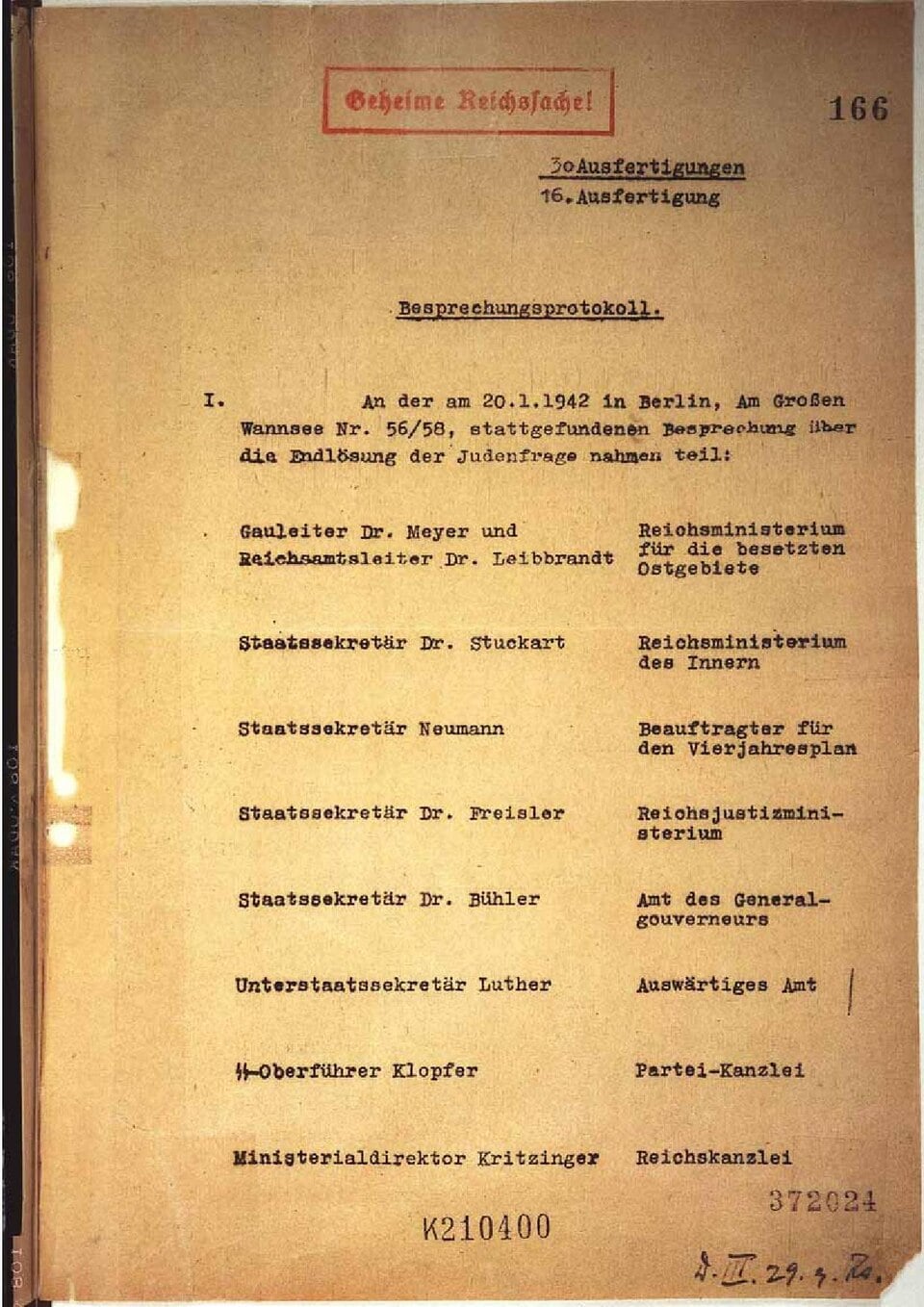
First page of the Wannsee Protocol, marked “Secret Reich Matter,” documenting the January 20, 1942 meeting at which senior Nazi officials coordinated the so-called “Final Solution of the Jewish Question.” Public domain via Wikimedia Commons.
The Holocaust is often imagined through its most visibly horrific images: cattle cars, skeletal surviving prisoners on liberation photography and film, crematoria, heaps of shoes, residents of surrounding villages standing at the edges of pits. But one of the Nazi regime’s most important instruments of persecution was considerably less cinematic.
It was the soulless drudgery of meticulous paperwork.
The Third Reich was obsessed with files, classifications, permits, registries, questionnaires, genealogies, transport manifests, stamped approvals, and administrative coordination. Not all at once. Not chaotically. Properly.
The Holocaust was not carried out solely through ideological hatred or overt violence. It was also enabled through desks, ink, and dossiers.
People often speak about Nazism as though it represented the collapse of modern civilization into pure barbarism, but the truth is colder. The Nazi state relied heavily upon the tools of modern administration. It did not reject bureaucracy. It radicalized it and refined it into deadly efficiency.
Mass murder on the scale of the Holocaust required not just war technology, propaganda, and Hitler’s personality cult, although such factors were important. The Nazis also needed and used systems capable of identifying people, locating them, depriving them of rights, seizing their property, moving them across borders, imprisoning them, exploiting their labor, and killing them.
Jews were carefully identified through census records, religious records, ancestry charts, and legal classifications. Property seizure of everything from family heirloom furniture to valuable art required inventories. Deportation required timetables and train maintenance. Filling and liquidating ghettos required registry work. Concentration camps were a hive of photographic and printed records such as intake, prisoner classification, labor assignments, punishment, transfers, illness, and death.
Human beings became entirely depersonalized. Zyklon B was commercialized for use in gas chambers by profiteering firms. Even extermination was embedded within administrative euphemisms that rendered atrocity mundane and procedural: deportation became “resettlement” (Umsiedlung), and murder became “special treatment” (Sonderbehandlung).
Administrative euphemism created distance between action and consequence and, with it, some comfortable form of plausible deniability for those who did not have boots on the ground in the camps. A clerk processing transport paperwork in Berlin did not have to smell crematoria in occupied Poland. A railway administrator coordinating train schedules could understand himself as solving a logistical problem rather than facilitating mass death. Bureaucracy fragmented responsibility into thousands of small tasks, many of which appeared routine despite their unprecedented nature when viewed separately.
No single form said, “Murder these children.” No form needed to be so blunt; the cumulative effect of routine paperwork sufficed.
Instead, one document authorized deportation while another confirmed rail capacity. Another recorded confiscated property, and others tracked labor allocation and updated population totals after liquidation. It was all precise, alarmingly so to the Allied eye immediately after the war in a manner that facilitated the unprecedented Nuremberg trials. The genocide had emerged through accumulation and had been recorded with cold, comprehensive bureaucratic capability.
This is part of what makes the Holocaust historically terrifying in a specifically modern way. The machinery of destruction often resembled ordinary state administration. Raul Hilberg demonstrated that the destruction of European Jewry depended not only upon fanatics, but upon ministries, offices, rail systems, accountants, typists, and bureaucratic coordination spread across the state apparatus.
This does not mean that bureaucrats were merely innocent functionaries trapped inside events beyond their control (see Browning 1992 on Reserve Police Battalion 101). Nor does it mean that all bureaucracy that occurred within the Third Reich was inherently genocidal. That flattening is tempting, of course, but it is historically inaccurate and useless, and it is intellectually lazy. The problem is more uncomfortable than that.
Administrative systems can create psychological and moral insulation between individuals and the consequences of their actions. Procedure can generate legitimacy. Official stamps, memoranda, filing systems, and chains of command create the impression that what is happening is lawful, rational, necessary, and properly governed. Violence processed through institutions often appears less visibly violent to those participating in it.
That is one reason Adolf Eichmann remains such a strangely disquieting and unnerving figure in history. He is not remembered primarily as a battlefield butcher foaming at the mouth with theatrical sadism but as a composed coordinator, a manager, a facilitator of deportation systems. His role forces historians to confront the relationship between administrative normalcy and catastrophic violence and mass murder.
The Holocaust also demonstrates how bureaucracy can cause people to dissociate so quickly and easily from one another once identity becomes formalized and legalized. Human beings ceased to exist as neighbors, classmates, musicians, tailors, mothers, rabbis, or children. They became entries within systems of racial classification. Names became numbers. Lives became files and ties were severed. Once human beings are reduced to categories, administrative cruelty becomes easier to justify. The state no longer believes it is harming persons. It believes it is processing populations.
Holocaust historiography cannot focus exclusively upon charismatic leaders or spectacular acts of violence at the expense of quieter interrogation of how the genocide was sustained by ordinary institutional mechanisms operating at enormous scale. Filing cabinets, railway operations, census bureaus, and carefully completed forms were enormously significant and did perhaps as much damage as any shouted speech or rally that directly incited a fiery pogrom.
The Holocaust was not only a story of outwardly vicious hatred but of chillingly calm and euphemistic administration. The bureaucracy of the Third Reich did not soften violence; it made mass violence scalable and systematic.
Bibliography
Allen, Michael Thad. The Business of Genocide: The SS, Slave Labor, and the Concentration Camps. Chapel Hill: University of North Carolina Press, 2002.
Aly, Götz, and Karl Heinz Roth. The Nazi Census: Identification and Control in the Third Reich. Translated by Edwin Black and Assenka Oksiloff. Philadelphia: Temple University Press, 2004.
Arendt, Hannah. Eichmann in Jerusalem: A Report on the Banality of Evil. Revised and enlarged edition. New York: Viking Press, 1964.
Bauman, Zygmunt. Modernity and the Holocaust. Ithaca, NY: Cornell University Press, 1989.
Black, Edwin. IBM and the Holocaust: The Strategic Alliance between Nazi Germany and America’s Most Powerful Corporation. 20th Anniversary Edition. Washington, DC: Dialog Press, 2021.
Browning, Christopher R. Ordinary Men: Reserve Police Battalion 101 and the Final Solution in Poland. New York: HarperCollins, 1992.
Feldman, Gerald D., and Wolfgang Seibel, eds. Networks of Nazi Persecution: Bureaucracy, Business, and the Organization of the Holocaust. New York: Berghahn Books, 2005.
Friedländer, Saul. Nazi Germany and the Jews, Volume II: The Years of Extermination, 1939–1945. New York: HarperCollins, 2007.
Gruner, Wolf. Jewish Forced Labor Under the Nazis: Economic Needs and Racial Aims, 1938–1944. New York: Cambridge University Press, 2006.
Hayes, Peter. From Cooperation to Complicity: Degussa in the Third Reich. Cambridge: Cambridge University Press, 2004.
Hilberg, Raul. The Destruction of the European Jews. 3rd edition. New Haven, CT: Yale University Press, 2003.
Lozowick, Yaacov. Hitler’s Bureaucrats: The Nazi Security Police and the Banality of Evil. Translated by Haim Watzman. London: Continuum, 2000.
Mommsen, Hans. “The Realization of the Unthinkable: The ‘Final Solution of the Jewish Question’ in the Third Reich.” In From Weimar to Auschwitz, translated by Philip O’Connor, 224–253. Princeton, NJ: Princeton University Press, 1991.
Wolf, Gerhard. Ideology and the Rationality of Domination: Nazi Germanization Policies in Occupied Poland. Bloomington: Indiana University Press, 2020.
Related Topics