
Urban Sociologist and Global Affairs Commentator
Why the US Must Not Waste Iran’s Strategic Opening
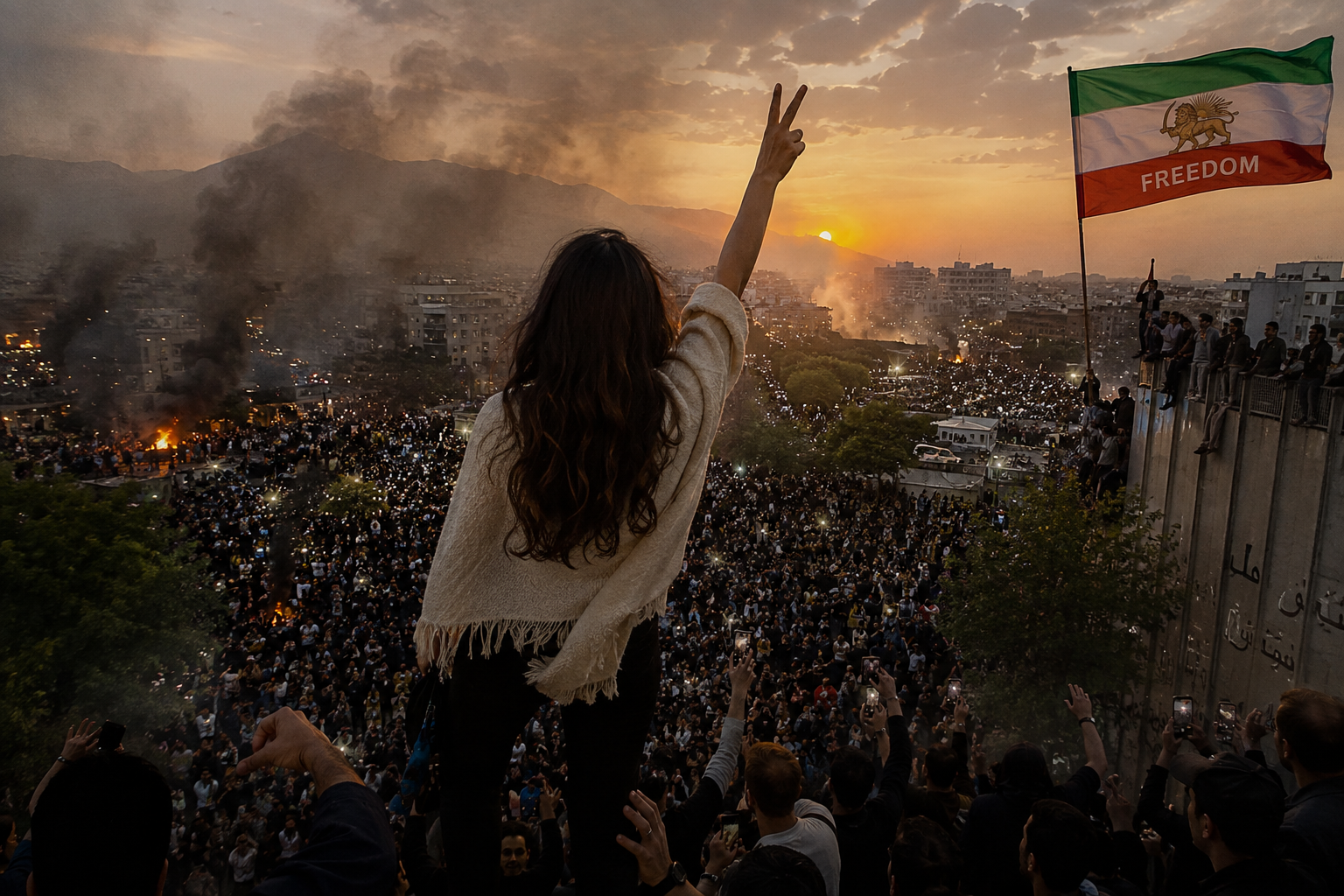
Free Iran. An AI Illustration.
Regime change in Iran is no longer a question of preference. It is a question of arithmetic.
For four decades the Islamic Republic ran on a simple formula: stay dangerous enough to deter, stay opaque enough to avoid decisive defeat, and use time as a weapon against opponents whose attention spans are shorter than its own. Missiles substituted for air power, proxies substituted for alliances, nuclear ambiguity substituted for an actual arsenal, and revolutionary ideology substituted for statecraft. The formula did not require Iran to win. It only required Iran to make losing too expensive for anyone else to attempt.
That formula broke in February 2026. Israeli and American strikes killed Ali Khamenei inside the compound that had organized Iranian power for thirty-six years. It was the single deepest penetration of an adversary state’s command structure in the modern Middle East, and it exposed something more important than a security failure: the Islamic Republic’s apparent solidity was never institutional. It was personal. Remove the person, and the state does not adjust; it convulses.
Here is where the argument for finishing the job, rather than declaring victory and going home, actually begins. Because the convulsion did not produce collapse. It produced succession, and not toward moderation.
The regime answered assassination with consolidation, not reform
Within days, Mojtaba Khamenei, his father’s hardline son with a career built inside the IRGC’s Basij apparatus, was installed as the new Supreme Leader. He has not appeared in public since. He governs, by every available account, as a name attached to a security establishment that now runs the state directly. Iran’s “pragmatist” faction, notably President Pezeshkian, Foreign Minister Araghchi, Speaker Ghalibaf, has spent the months since arguing for compromise over the Strait of Hormuz to relieve an economy under an eighth round of sanctions (before the US Department of the Treasury, at President Trump’s direction, “finally” announced “Operation Economic Outcast”). They have been consistently overridden. The IRGC controls the forces still attacking shipping in the strait. It calculates, correctly or not, that it can outlast Washington. The Supreme Leader’s office spends its time managing the optics of unity rather than the substance of negotiation.
This is precisely the outcome the war was supposed to prevent, and it is the outcome that makes the argument for regime change urgent rather than merely desirable. A decapitated Islamic Republic did not become a chastened Islamic Republic. It became a smaller committee of the same security establishment, now unconstrained by even the clerical brake that a seven decades old ayatollah’s institutional caution once provided. Strip away the theology and what is left is not moderation. It is the IRGC governing in its own name behind a hereditary figurehead; the “Putinization” of the revolution, arriving on schedule.
That’s the warning nearly all cautionary tales on regime change in Iran have understated. It is not a hypothetical risk to be managed later. It is the observed trajectory of the last six months.
Why the window is temporal, not permanent
The strategic case for regime change rests on a fact that is easy to state and uncomfortable to act on: Iran’s vulnerability and the West’s leverage are both perishable.
The military balance has been rewritten. Iran’s air defenses, missile production infrastructure, and command architecture have absorbed direct, repeated, high-precision damage that took years to inflict and will take years to rebuild, but not forever. The Gulf states have watched an American-Israeli operation demonstrate a level of penetration they did not think possible, and they will not indefinitely accept a security order premised on Iranian restraint that no longer looks credible. Iran’s regional proxy network (Hezbollah, the Iraqi militias, the Houthis) has taken reversals it has not fully absorbed. And the Iranian economy, squeezed by war costs, sanctions, and a contested strait that Tehran itself depends on for trade, is bleeding in a way that compounds rather than heals with time.
None of this is fixed. All of it is reversible if the regime survives long enough to rebuild. That is what six months of post-Khamenei Iran has already demonstrated: given a survival window, this state does not liberalize, it hardens. It replaces one command structure with a leaner one, reshuffles military leadership, as Mojtaba did this month, installing a new IRGC commander and armed forces chief of staff, and settles in for a war of attrition it believes it can win by outlasting American patience. Every month that passes without a change in the character of the regime is a month the IRGC uses to convert battlefield damage into institutional consolidation.
This is the sense in which regime change is not an ideological project but a closing arbitrage. The conditions that make transformation possible – a fractured elite, a wounded security apparatus, a population that has just watched the state’s invincibility myth die in real time – do not recur on command. States get this kind of opening once, if at all.
The stakes reach far beyond Tehran
The reason this argument deserves to be stated without qualification is that the payoff, if the window is used rather than wasted, extends across the entire architecture of Middle Eastern and Eurasian order.
For the Gulf states, an Iran whose strategic legitimacy no longer depends on confrontation with Riyadh and Abu Dhabi opens the possibility of an actual regional security architecture, rather than the current arrangement of competing deterrence postures aimed at a common threat none of them can independently manage. For Israel, the relevant adversary was never simply Iranian missiles; it was the institutional machine, comprising IRGC, Quds Force, the ideological apparatus, for which permanent confrontation with Israel is a structural requirement rather than a policy choice. Remove that machine’s political dominance and the strategic geometry of the region changes in ways a ceasefire cannot achieve. For Lebanon, Iraq, Syria, and Yemen, Iran’s client relationships stop being extensions of Tehran’s revolutionary depth and become ordinary, negotiable state-to-state relationships.
For Moscow and Beijing, the loss is real but asymmetric. Russia loses a genuine strategic partner and an important source of missile and drone cooperation it has leaned on throughout its own war; its capacity to rescue Tehran has already proven far more limited than its rhetoric suggested. China’s relationship with Iran, by contrast, has always been transactional rather than sentimental; Beijing wants energy and access, not theocracy, and its notably cautious posture throughout 2026 already tells you how little it is prepared to sacrifice for the regime’s survival. A transformed Iran costs China political leverage, not commercial opportunity, and Beijing knows the difference.
For India, the stakes are more constructive than punitive. A stable, internationally integrated Iran restores the connective corridor linking the Indian Ocean to Central Asia and Europe, and it restores the predictability of energy markets that the war has already disrupted, pushing India toward supplies it would rather not depend on. India does not want an American client in Tehran. It wants a sovereign Iranian state that can trade with everyone, which is, not incidentally, the best argument for why this transformation should be understood as an Iranian project and not a Western one.
The one hazard that must be taken seriously, and why it argues for action rather than caution
There is a genuine danger in this scenario, and it deserves to be named plainly rather than waved away: a security vacuum in Tehran could open the country’s ethnic fault lines – Kurdish, Azeri, Baluch, Arab – into competing territorial projects, with consequences that would radiate into Turkey, Pakistan, Azerbaijan, the Caucasus, and Europe’s migration politics simultaneously. This is the strongest objection available to skeptics of regime change, and it is a serious one.
But it argues for a particular kind of intervention, not against intervention itself. The objective cannot be Iran’s dissolution; it must be the Islamic Republic’s replacement by a state that keeps the country’s territorial shell intact while gutting the security apparatus that currently rules it. That means distinguishing consistently between the Iranian military as a national institution and the IRGC as a political-repressive one: a distinction the last six months have made easier to draw, since it is precisely the IRGC, not the conscript military, that has driven both the succession and the war’s continuation. It means treating the coming transition as an argument about Iranian sovereignty, not Western imposition, because the Islamic Republic’s most durable claim to legitimacy has always been that it alone embodies Iran’s independence from foreign domination. The counter to that claim is not complicated: Iran does not need a clerical-security establishment to be independent. It is independent because it is Iran.
What “success” has to mean
The decisive variable is not whether Washington and its partners can inflict further military damage. They plainly can. It is whether enough of the Iranian security establishment concludes that its own survival is no longer identical to the regime’s survival. Mass protest supplies legitimacy; it does not by itself topple governments. Regimes fall when the people who operate the machinery of coercion stop believing the machine is worth running. That is a narrower target than total military victory, and a more decisive one.
The honest admission is that the form the successor state takes cannot be dictated from Washington, and should not be. It may be nationalist rather than liberal. It may retain a strong conventional military. It may look nothing like what American policymakers would design on a whiteboard. That is acceptable, because the requirements that actually matter are few: Iran must stay territorially whole; it must stop exporting revolutionary war; it must not become a nuclear-armed security state; and its government must have enough legitimacy to hold the country together while rejoining the ordinary community of states. Everything past that is for Iranians to decide.
What is not acceptable is the outcome the last six months have been quietly producing by default: a regime that trades theology for nationalism, keeps the missiles, keeps the proxies, keeps the chokehold on Hormuz, and tells its own population that it survived the greatest assault in its modern history. That story gets more persuasive, not less, with every month the current arrangement is allowed to calcify. The strategic defeat inflicted in February has not yet become a political one. The interval between the two is where this is actually decided, and it is closing.
Related Topics
Related Posts