


Why the Wines on My Table Are 100% Blue and White
What does an 18th-century controversy over which etrogim are kosher have to do with the wine that I buy for my Shabbat table? Quite a bit.
The Great Etrog Polemic
Before 1891, the Jewish debate over “Corfu etrogim” centered on the question if etrogim from Corfu were grown on grafted trees. After the 1891 Corfu blood libel and anti-Jewish violence that followed, a group of visionary Rabbis shifted the discussion, calling for a boycott of the very pretty Corfu etrog, first as a way to punish the perpetrators but later as a form of solidarity with the new Jewish settlements.
They argued that a “pretty” Greek citron was spiritually inferior to a “pioneer” citron grown in the dusty soil of Petah Tikva and other new Jewish colonies. This wasn’t just about citrus; it was the birth of economic Zionism.
From Etrog to Wine on My Shabbat and Holiday Table
Today, that same logic dictates that it’s time to retire the California, Italian, and Australian wines from your Shabbat table. If you want to honor the spirit of the return to Zion, your holiday table belongs to the vineyards of Israel. Drinking Israeli wine is about solidarity and sustainability.
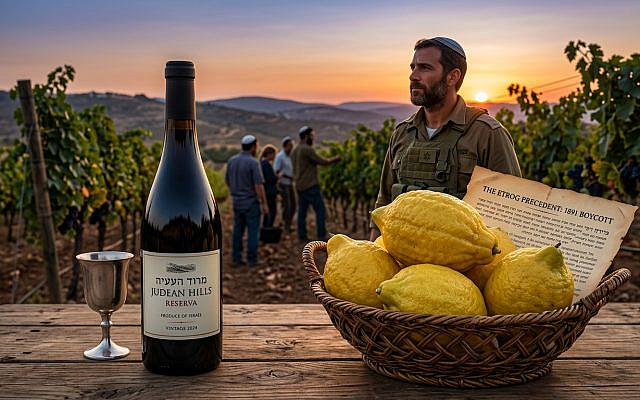
The “Etrog Precedent”: More Than a Beverage
The early Zionists understood that you can’t build a nation on prayers alone; you need an economy. When Rabbi Shmuel Mohilever urged the Diaspora to buy Israeli etrogim, he wasn’t just giving a kashrut certification—he was issuing a mandate.
By choosing Israeli wine today, you are performing a modern act of settling the land. You are directly funding the farmers in the Galilee, the pioneers in the Negev, and the vintners in the Judean Hills. In a world where the BDS movement tries to “cancel” the fruit of our land, every cork popped is a quiet, sophisticated act of defiance.
Pouring Israeli wine connects you and your family to Israel. When you serve a bottle from a Judean vineyard, you aren’t just a consumer; you are a witness to joint peoplehood.
The Greek etrogim of the 19th century were eventually replaced by the Israeli ones because the Jewish people realized that their identity belonged to their own soil. Why should our wine be any different?
My Son’s Meeting with Vintners Under Fire
After the September 2024 beeper operation, the IDF moved into Southern Lebanon on October 1st, the day before Rosh Hashana. Heading north to root out Hezbollah, a group of soldiers, including one of my sons, encountered a group of farmers from the Recanati vineyards preparing for the grape harvest just south of the border
The lead officer jumped out of his vehicle to warn the farmers to leave. The area was under intense fire. The vintners replied simply, “This is our land, and these are our grapes. If we don’t harvest next week, we won’t have wine to sell next year. Our workers and our families and our towns depend on us.”
The Bottom Line
In the 1890s, the “Zionist Etrog” was a symbol of a dream yet to be realized. In 2026, the Israeli wine on your table is the proof that the dream is alive, thriving, and delicious.
You don’t have to choose between your Zionist principles and your gourmet palate anymore. You can have both. For your Shabbat or holiday table, don’t just “bless the wine”—bless the land and the people that grew it. Buy Israeli. L’chaim.
For an extensive scholarly review of the Etrog polemic: Yosef Salmon: “The Corfu Etrog Citron Polemic.” AJS Review, Vol. 25, No. 1 (2000–2001), pp. 1–25.