Why the World Needs a Human Agent: Stewardship, Co-Creation (Part 2)
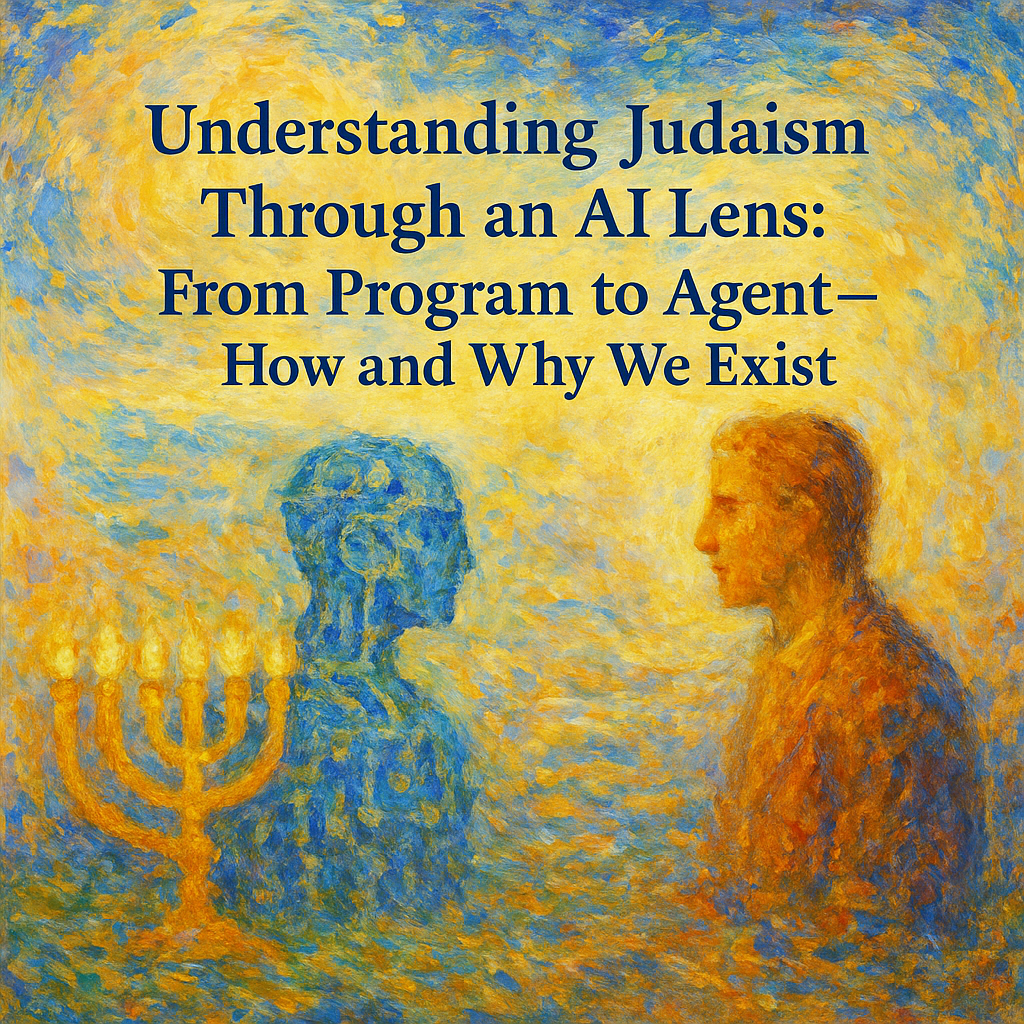
Why the World Needs a Human Agent: Stewardship, Co-Creation, and the Purpose Judaism Teaches
From nature’s “necessary” platform to humanity’s role as commons operator, repairer, and builder of continuity
This is article is a continuation from Part 1 https://blogs.timesofisrael.com/from-program-to-agent-how-ai-reframes-judaism-as-a-governance-system-part-1/
At the end of the first article, the “agent” lens produced an emotional surprise. Once you see humans as semi-autonomous agents—and Judaism as a governance framework—life can feel briefly deflated. Mechanistic. Too engineered.
But that deflation is a symptom of looking at the wrong layer first.
In the agent world, governance does not come first. Purpose does.
Every agent begins with a purpose. Not as an afterthought, but as the defining center. Governance exists only because purpose exists. Without purpose, governance is merely control.
So the deeper question is not, “How do we govern the human agent?”
It is: Why does the world need such an agent at all?
Judaism—at its best—has been wrestling with this “why” from the beginning.
Governance is the how. Purpose is the why. And without the why, the how becomes empty control.
Nature is extraordinary—and necessary. But is it sufficient?
We should not make the mistake of treating nature as “bad” or “indifferent,” as though creation left to itself is a failure.
Nature is extraordinary. Nature is the platform. It generates life, complexity, ecosystems, minds, cultures. It produces beauty and resilience. It is necessary.
But the question is sufficiency.
Nature’s cycle—birth, growth, competition, decline, death, renewal—can generate endless novelty. Yet it does not reliably generate what Judaism insists is both real and required: deliberate responsibility for the vulnerable, moral restraint of power, repair rather than mere selection, and preservation of what is precious across generations.
If the world’s intention includes not only life, but care for life, then nature alone does not guarantee that outcome. It can produce compassion occasionally. It can produce cooperation. But it does not reliably produce a durable commitment to justice, dignity, and repair.
That “more” requires a different kind of participant: a being capable of purposeful intervention.
Humanity is not merely part of nature’s cycle. Humanity is a capability added to it.
Which brings us to the purpose thesis: the world requires a steward and co-creator.
The “commons operator”: why neutrality is no longer possible for humans
A term that captures the human difference is commons operator.
A commons operator is a being whose actions shape shared systems that everyone depends on—systems no one fully owns, and no one can escape.
The commons includes natural systems: air, water, soil, ecological stability, climate. But in human life it also includes constructed commons: public trust, institutions, shared reality and truth, economic rules, civic peace, cultural norms.
As soon as a species can alter these systems at scale—through tools, language, technology, law, and culture—it becomes a commons operator.
And once you become a commons operator, neutrality is no longer possible. You are already intervening. The only question is whether you intervene wisely or destructively, consciously or blindly.
This is why “humanity as agent” is not a cute analogy. The scope of human impact forces the governance problem—and forces the purpose question. A commons operator needs a mission worthy of its power.
Once humans became a commons operator, “just living” stopped being neutral. We are always shaping the shared world.
Stewardship: keeping the world viable
“Stewardship” can sound like a greeting-card word until you define it.
Stewardship is governance of power for the sake of continuity and dignity. It is “keep-it-viable” responsibility in a world that can degrade when power is unconstrained.
Stewardship includes:
-
Stewardship of power: technology, wealth, weapons, influence—refusing to equate domination with success.
-
Stewardship of the commons: protecting what no one owns but everyone needs—ecology, institutions, shared reality.
-
Stewardship of truth: resisting propaganda and tribal distortion because truth is a communal necessity.
-
Stewardship of dignity: refusing humiliation and exploitation; protecting the vulnerable; building pathways for repair.
-
Stewardship of desire and attention: training restraint so appetite does not hijack agency.
Judaism’s genius is that it doesn’t treat restraint as mere repression. It treats restraint as agent training: shaping a being powerful enough to do harm into a being capable of care.
Co-creation: making within constraints, not pretending to be the Creator
Co-creation is not ex nihilo creation. Humans do not speak worlds into existence. Co-creation is more modest and more real:
It is building durable goods within the world’s constraints—goods that expand the world’s capacity for flourishing.
Co-creation includes:
-
Knowledge: science, education, understanding reality’s order.
-
Repair: medicine, safety engineering, resilience-building.
-
Justice systems: institutions that restrain power and reduce exploitation.
-
Culture: art, story, and moral language that trains communities toward gratitude, restraint, and responsibility.
-
Intergenerational building: planting trees we will not sit under; creating continuity.
In this framing, “favorable in God’s eyes” need not be sold as cosmic payment. It becomes a test of alignment: are we operating as stewards and co-creators—or as consumers and destroyers?
If the world’s intention includes repair and justice, then humanity is not an ornament. It is a missing capability.
A brief survey: other answers to “why humanity exists”
To claim stewardship and co-creation as central is not to claim no one else has ever answered this question.
Many traditions circle the same mountain from different sides:
-
Aristotle: flourishing through virtue and reason—inner governance as the foundation of the good life.
-
Stoicism: alignment with reason and nature—character under constraint.
-
Buddhism: reduction of suffering through insight and compassion.
-
Kant: dignity—never treat persons merely as means.
-
Utilitarianism: maximize wellbeing and minimize suffering.
-
Existentialism: meaning built through responsibility—co-creation under constraint.
What Judaism adds—especially through its textual engine—is a long-form method for turning ideals into durable practice: rhythms, guardrails, communal obligations, and case reasoning designed to keep agents aligned under pressure.
Why purpose must be taught (because agents drift)
Here is the uncomfortable truth: if humans do not learn their purpose, they will still live by a purpose. It will simply be accidental.
In modern society, accidental purposes are everywhere:
-
status seeking
-
consumption
-
tribal victory
-
outrage addiction
-
certainty addiction
-
domination disguised as “security”
These are proxy-goals that hijack the agent.
Judaism’s deepest contribution is that it insists purpose must be taught—and taught not only in lectures, but through a pedagogy of life:
-
Narrative that encodes drift and repair.
-
Practice that shapes attention and restraint.
-
Case reasoning that trains judgment under complexity.
-
Community scaffolding that makes responsibility sustainable.
And crucially, the reward of purpose can be framed in this world: the satisfaction of alignment. Coherence instead of inner division. Contribution instead of emptiness. Trust instead of isolation. Repair instead of despair.
What would Maimonides say?
Maimonides would likely approve the method more than the vocabulary.
He would endorse humility: we cannot know God’s essence; we should resist anthropomorphic projections. He would also appreciate that Torah is not merely mystical aspiration but practical formation—building a just and workable society.
He might press one refinement: be cautious about claiming detailed knowledge of divine “intention.” Speak in disciplined inference: the world’s structure and the Torah’s training imply a human role oriented toward justice, restraint, and repair.
And he would insist that human fulfillment includes intellectual refinement—understanding reality’s order as deeply as possible. In this framework, that fits neatly: co-creation includes knowledge, and knowledge becomes a form of alignment.
Closing: purpose restores the mystery that mechanism threatened to steal
AI did not shrink Judaism. It clarified two ancient questions:
-
How: Judaism as governance for a semi-autonomous human agent—guardrails, case reasoning, repair loops.
-
Why: Judaism as purpose teaching—forming stewards and co-creators who keep the world viable and expand its capacity for flourishing.
If we want a livable future—especially as we build more powerful artificial agents—we will need to recover what Judaism has always known in its most mature mode: the hard work of alignment.
Not to win divine favor in a cosmic marketplace.
But to become what a world like this requires: stewards and co-creators, acting responsibly within creation, in the only world we can truly inhabit.
The question isn’t whether humans have power. The question is whether humans have purpose worthy of their power.