
Middle East Analyst
Why Trump is pivoting on Iran
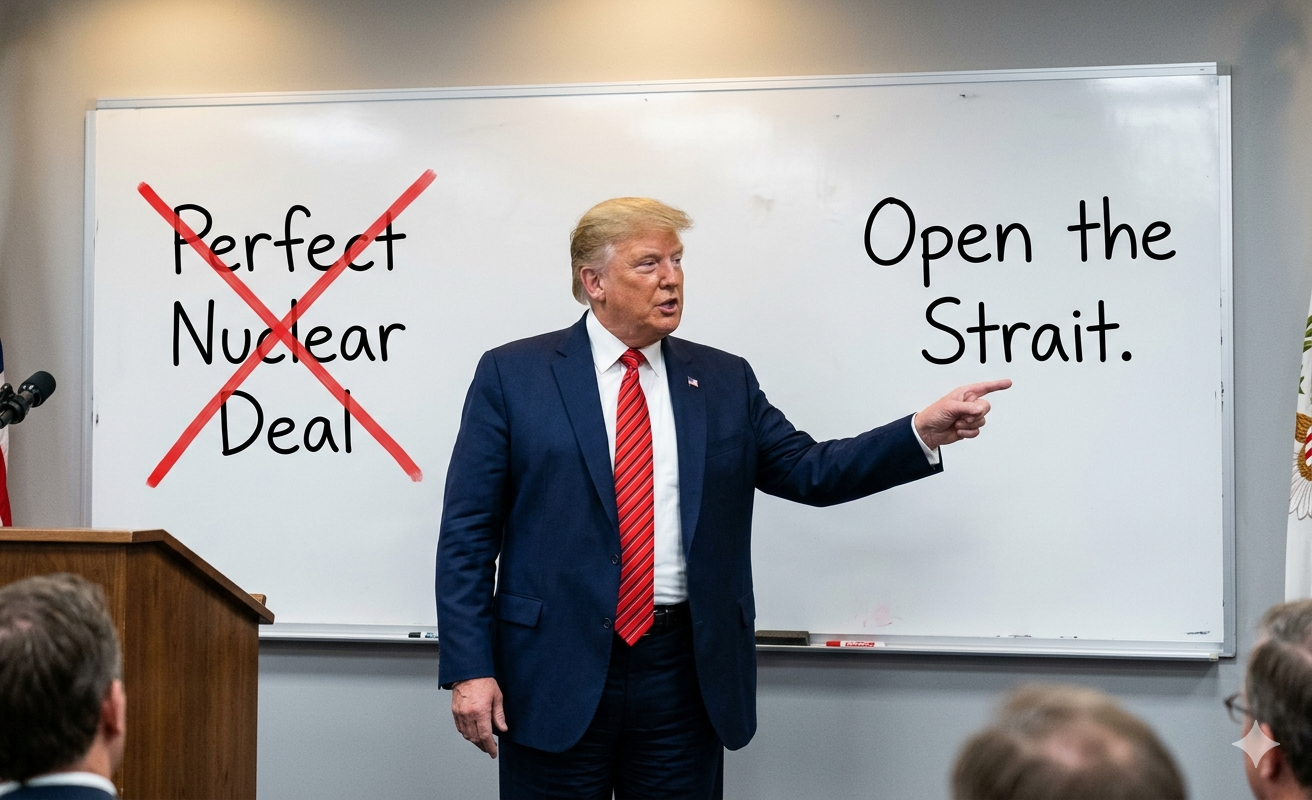
by author (AI)
“If we go and bomb — which we can do very easily — and we spend another two or three weeks bombing, they’ll have nothing left whatsoever, but you won’t have the Strait open for months.”
That sentence, delivered to reporters at JFK on Monday, is not a threat. It is a public accounting of a trade-off Trump has most likely already made, and it indicates that his Iran strategy has shifted from maximalist military pressure to the far more urgent imperative of reopening the world’s most critical energy chokepoint.
It is also the clearest public signal yet that the White House now sees the energy crisis not as a distant geopolitical inconvenience but as a direct threat to the American economy, the Republican congressional majority, and, perhaps most importantly in Trump’s own mind, his legacy as the president who strengthened the business community rather than presided over its collapse.
The shift is not theoretical. According to reporting by Barak Ravid, Global Affairs Correspondent for Axios and Washington correspondent for Israel’s Channel 12, Trump warned Prime Minister Benjamin Netanyahu in a phone call on June 8 that Israel would have to go it alone if it proceeded with a major planned strike on Iran. Trump’s words, as he relayed them directly to Ravid, were unambiguous: “Bibi, you better be careful, or you will be on your own very soon.” Netanyahu stood down.
The timing is specific: at approximately 4:30 p.m. that day, Netanyahu had already approved the operation, with aircraft prepared for takeoff, when Trump called and instructed him to halt. Channel 12 reported that the standdown produced considerable confusion within the Israeli military high command. Some Israeli officials described the exchange as mutual understanding; others characterized it as a directive. The distinction matters less than the outcome: Trump intervened decisively to stop an escalation that could have reignited a wider regional war and prolonged the closure of the world’s most important energy chokepoint.
A senior US official’s assessment, also reported by Axios, captured the underlying tension with unusual candor: “Bibi needs the war to continue to stay politically alive in Israel, and Trump needs the war to end to stay politically alive in the US.” That is not diplomatic framing. It is a structural diagnosis, and it explains nearly everything about the current moment.
The Clock Is Now Working Against Him
For months, Trump insisted publicly that he was not worried about the Strait of Hormuz being closed. He dismissed concerns about tanker traffic, downplayed the global economic impact, and projected total confidence. That posture now looks less like genuine indifference and more like a deliberate attempt to avoid signaling vulnerability to Iran. In the early stages of the crisis, admitting concern would have invited Tehran to test American resolve, probe for concessions, and exploit the perception of US economic pressure.
The situation has changed. Every day without a deal translates directly into higher gasoline prices, tightening credit markets, rising inflation, supply chain disruptions, and investor anxiety that eventually becomes congressional anxiety. Trump may not face reelection this year, but House and Senate Republicans do. Vulnerable incumbents in swing districts are already warning that a prolonged energy shock could cost the party its majority. Governors are complaining about fuel prices. Donors are calling with concerns about market instability. The business community – Trump’s most natural constituency – is sounding alarms about the risk of a global recession triggered by a Middle East war that shows no sign of resolution.
This is the pressure that matters. Trump’s political instincts have always been shaped by the intersection of business sentiment and congressional anxiety. When CEOs panic, markets wobble, and lawmakers fear for their seats, Trump listens, not because he is deferential, but because he understands that economic instability is the one force capable of fracturing his coalition, damaging his brand, and staining his legacy.
Maximalist Demands Are Meeting Their Limits
For months, Trump insisted that Iran must accept sweeping nuclear restrictions before the United States would consider easing pressure. That was the core of his strategy: maximum leverage, maximum demands, maximum pressure. But leverage is not static. It erodes when the costs of maintaining it rise faster than the benefits of holding it.
That appears to be what is happening now. The longer the Strait remains closed, the more the economic and political costs accumulate, not only for Iran, but for the United States and its allies. Tanker insurance rates have exploded. LNG shipments are delayed. Refinery feedstock is uncertain. European markets are jittery. Asian supply chains are strained. At some point, the strategic calculus shifts. The perfect nuclear deal becomes less important than preventing a global economic shock, and the theoretical benefits of maximalist demands are outweighed by the very real costs of waiting too long. Trump appears to have reached that point.
The Public Messaging Shift Has Begun
Trump’s earlier insistence that he was unconcerned about the Strait was a tactical posture, meant to project strength outward, toward Iran, toward the Gulf states, toward the international community. But now he must begin projecting a different message inward, toward the American public. He must prepare voters, donors, and lawmakers for the possibility that the United States may need to accept a less-than-perfect nuclear deal in order to reopen the Strait and stabilize the global economy.
His remarks at JFK are the opening move in that shift. By saying openly that continued bombing would keep the Strait closed for months, he is not threatening Iran — Iran already knows this. He is telling Americans that the math has changed, that the pursuit of total military victory carries a pricetag he is no longer willing to ask the country to pay, and that a negotiated outcome — whatever its imperfections — is now preferable to the alternative. This is not weakness. It is political realism — and the distinction matters, because Trump will need to sell whatever deal emerges as a victory rather than a compromise.
Netanyahu, the Opposition, and a Deepening Domestic Crisis
Trump’s demand that Netanyahu stand down landed in an Israeli political environment already under severe strain. For weeks before the June 8 standdown, opposition leaders – Lapid in particular – had been publicly accusing Netanyahu of excessive deference to Washington. The charge was specific: that Netanyahu threatened bold military action repeatedly, only to pull back whenever American pressure mounted, allowing the war’s stated objectives to recede without ever being formally abandoned. Lapid had argued that Netanyahu failed to achieve a strategic victory over Iran, that he was permitting the Americans to dictate Israel’s military posture, and that the result was a war without a clear endpoint and an Iran without a decisive defeat.
Gantz had been equally pointed on substance, insisting that Israel should not end the campaign until Iran’s uranium was destroyed or extracted, its long-range ballistic missile production halted, and its funding of proxies dismantled. The opposition’s position was not dovish. It was a hawkish critique of Netanyahu’s execution — the argument that he had the mandate for decisive action and repeatedly failed to use it.
Trump’s intervention on June 8 sharpened that criticism considerably. For the Israeli opposition, the image of Israeli aircraft prepared for takeoff and then stood down on an American phone call was not merely a single instance of US pressure overriding Israeli judgment. It was confirmation of a pattern. Bennett, positioning himself as the hawkish alternative ahead of October’s election, accused Netanyahu of being behind the leak of the stalled operation — framing the disclosure as a deliberate attempt to cast himself as a leader constrained by Washington rather than one who chose restraint. “The Netanyahu doctrine,” Bennett said, “is to threaten, threaten, threaten and then leak that he meant to but was prevented from doing it.”
For Netanyahu, the bind is structural and has no clean exit. He faces an election in October. He cannot afford to be seen as an instrument of American policy. But he also cannot openly defy a president who has stated plainly — on the record, to a named reporter — that Israel would be on its own if escalation continued. The gap between those two imperatives, electoral survival and alliance management, is where Israeli strategy is currently being made, and it is a gap that is widening rather than closing.
The Legacy He Cares About Most
Trump’s legacy is not primarily about foreign policy doctrine or ideological consistency. It is about the economy. He wants to be remembered as the president who strengthened American prosperity, empowered the business community, and delivered results where others failed. A Middle East war that destabilizes global energy markets and tips the world toward recession would destroy that legacy – and the business community he has always relied on would not forgive it.
The Strait must reopen. The energy crisis must be resolved. And the pursuit of a perfect nuclear agreement cannot continue indefinitely while the global economy hangs in the balance. That is the reality driving Trump’s shift – and it is the reality that will likely define the next phase of American policy toward Iran.
Related Topics