NAnews - Nikk.Agency Israel News
Why Ukraine Proposes a Joint Historical Commission With Israel
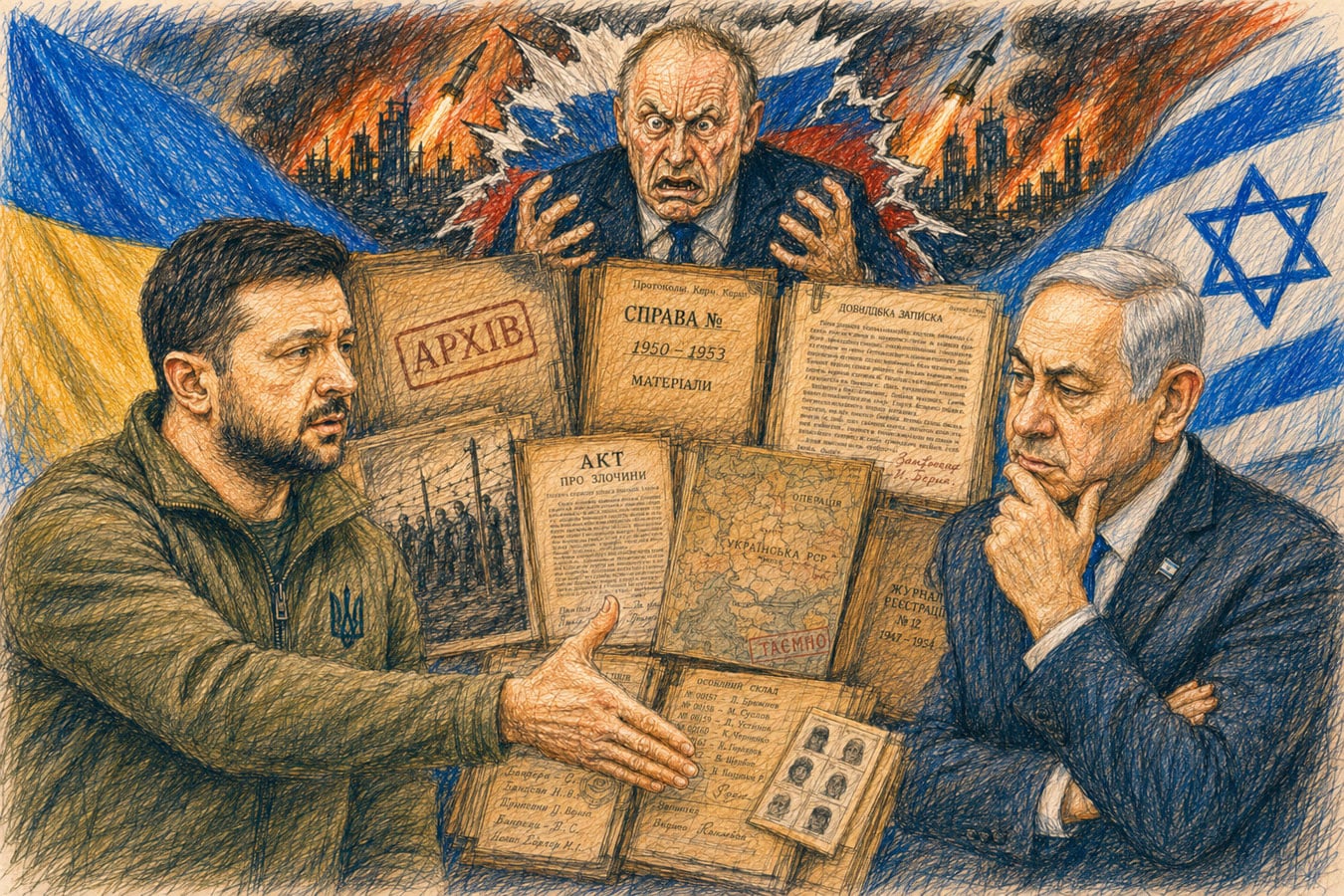
Why Ukraine Proposes a Joint Historical Commission With Israel. The image was created using AI.
The immediate reason for this essay is the dispute that erupted after Ukraine reburied Colonel Andriy Melnyk, one of the historical leaders of the Organization of Ukrainian Nationalists. The ceremony in Ukraine drew criticism from Israel’s Ministry of Foreign Affairs and Yad Vashem, because for Israel the history of the OUN, the Second World War, the Holocaust, and the memory of the victims of Nazism remain deeply sensitive subjects.
Ukraine has now officially responded to that criticism and proposed moving the sharp public dispute into a professional format: a joint Ukrainian-Israeli dialogue of historians, archival research, and the work of an expert commission.
This is not only about one ceremony in Ukraine.
For Israel, any discussion of nationalist movements in Eastern Europe during the Second World War immediately touches the memory of the Holocaust, collaboration, persecution, and the murder of Jews. These are not abstract historical questions. They are part of Israel’s national trauma, family memory, and state identity.
For Ukraine, which has been fighting Russia’s full-scale aggression since 2022, the question of a national pantheon and the return of historical figures has also become part of a broader politics of memory. Ukraine is trying to reassess its history after decades of Soviet and Russian narratives that often reduced the Ukrainian struggle for independence to hostile propaganda formulas.
It is exactly at this intersection of two traumatic histories that a new diplomatic nerve has been exposed.
The joint statement on the reburial of Colonel Andriy Melnyk was published on May 29, 2026, by Olha Vasylevska-Smahliuk and Viktoriia Kinzburska — co-chairs of the Ukrainian parliament’s group for interparliamentary relations with the State of Israel.
This is the parliamentary group responsible for contacts with the Knesset: meetings between lawmakers, political dialogue, issues of support for Ukraine, security, historical memory, and ties between Ukrainian and Jewish societies.
The group has been operating in the current ninth convocation of the Verkhovna Rada since 2019. According to the official page of the Ukrainian parliament, it includes 63 members of parliament.
There is another important detail. A Ukrainian parliamentary delegation led by Olha Vasylevska-Smahliuk visited Israel on June 7–13, 2025. In the Knesset, the visit was presented as the arrival of a Ukrainian parliamentary delegation headed by the leader of the friendship group with Israel.
According to the Knesset, the Ukrainian lawmakers met with Knesset Speaker Amir Ohana, Chairman of the Foreign Affairs and Defense Committee Yuli Edelstein, co-chair of the Israel–Ukraine parliamentary friendship group Ze’ev Elkin, and Knesset members Boaz Bismuth and Vladimir Beliak.
The main topics of those meetings were Russia’s war against Ukraine, interparliamentary dialogue, security, sanctions pressure, humanitarian issues, and Ukrainian-Israeli cooperation.
That is why the current statement should not be seen as a random comment by individual politicians. It comes from representatives of a parliamentary Ukraine–Israel channel that has already held direct dialogue with the Knesset.
In their statement, Vasylevska-Smahliuk and Kinzburska emphasized that Ukraine deeply honors the memory of the victims of the Holocaust, strongly condemns Nazism, and highly values Israel’s support in Ukraine’s resistance to Russian aggression.
But Kyiv also made another point.
Ukraine considers categorical judgments about figures of the Ukrainian liberation movement inappropriate when they are made without taking the full historical context into account. According to the authors of the statement, these figures acted in an era when the peoples of Eastern Europe found themselves between Nazi and Soviet totalitarianism, while the struggle for independence often involved difficult moral and political dilemmas.
This is not an attempt to erase painful questions.
It is an attempt to insist that painful questions must be studied seriously — through documents, archives, historians, and professional debate, not through Soviet or Russian propaganda frames.
Ukrainian Ambassador to Israel Yevgen Korniychuk has previously said that even before Russia’s full-scale invasion, the Ukrainian diplomatic side proposed to Israeli partners the creation of a joint expert commission on issues of historical heritage.
According to the ambassador, that initiative did not attract interest from the partners at the time. Today, Kyiv believes returning to the idea could be an important step toward constructive and professional dialogue.
For Israel, Holocaust memory cannot be treated as a matter of diplomatic convenience.
For Ukraine, the history of the liberation movement cannot be left to Moscow’s interpretation, especially when Russia is waging a war that is also a war over identity, memory, and legitimacy.
This is why this dispute should not be left to Russia.
If Ukraine and Israel want to speak honestly about the past, they must do so through archives, documents, and experts.
Not through mutual accusations.
Not through short, sharp statements.
And not through sources that were written for decades in the service of Soviet — and now Russian — memory politics.
The difficult truth is that Ukraine and Israel do not have the luxury of avoiding hard historical conversations. Both societies know what it means when memory becomes a weapon. Both know how quickly history can be used not to understand the past, but to destroy trust in the present.
The question now is whether Kyiv and Jerusalem can create a professional space for this conversation before others fill that space for them.
Because if historians do not work with the archives, propagandists will.
And if Ukraine and Israel do not speak to each other directly, someone else will gladly speak in their place.
NAnews – Nikk.Agency Israel News will continue following how this story develops, because it is not only about one historical figure. It is about whether two societies, both carrying deep wounds from the twentieth century, can discuss the hardest chapters of the past without turning them into weapons against each other.
Related Topics
Related Posts