

Will Abdul El-Sayed Change Course to Unite the Democrat Party?

Five days ago, Abdul El-Sayed won the Democratic nomination for the United States Senate in Michigan after an extraordinarily close primary.
He was not my candidate.
Before the primary, I publicly endorsed his opponent, Haley Stevens. I have also written repeatedly about my disagreements with the Democratic Socialists of America (DSA) and with the increasingly hostile tone toward Israel.
But the primary is over.
And now comes the call for unity.
Abdul El-Sayed is now the Democratic nominee for the United States Senate from Michigan, one of the most competitive states in America. He will face a flawed Republican, Mike Rogers, in November in a race that could help determine control of the United States Senate.
And Democratic leaders are quickly rallying behind Abdul El-Sayed.
Kamala Harris has joined the call for unity. Senator Elissa Slotkin, Chuck Schumer, Kirsten Gillibrand and others have moved toward party unity. Haley Stevens, after losing an extremely close and bruising primary, has also backed the Democratic nominee.
I understand why.
But I have a request for Abdul El-Sayed.
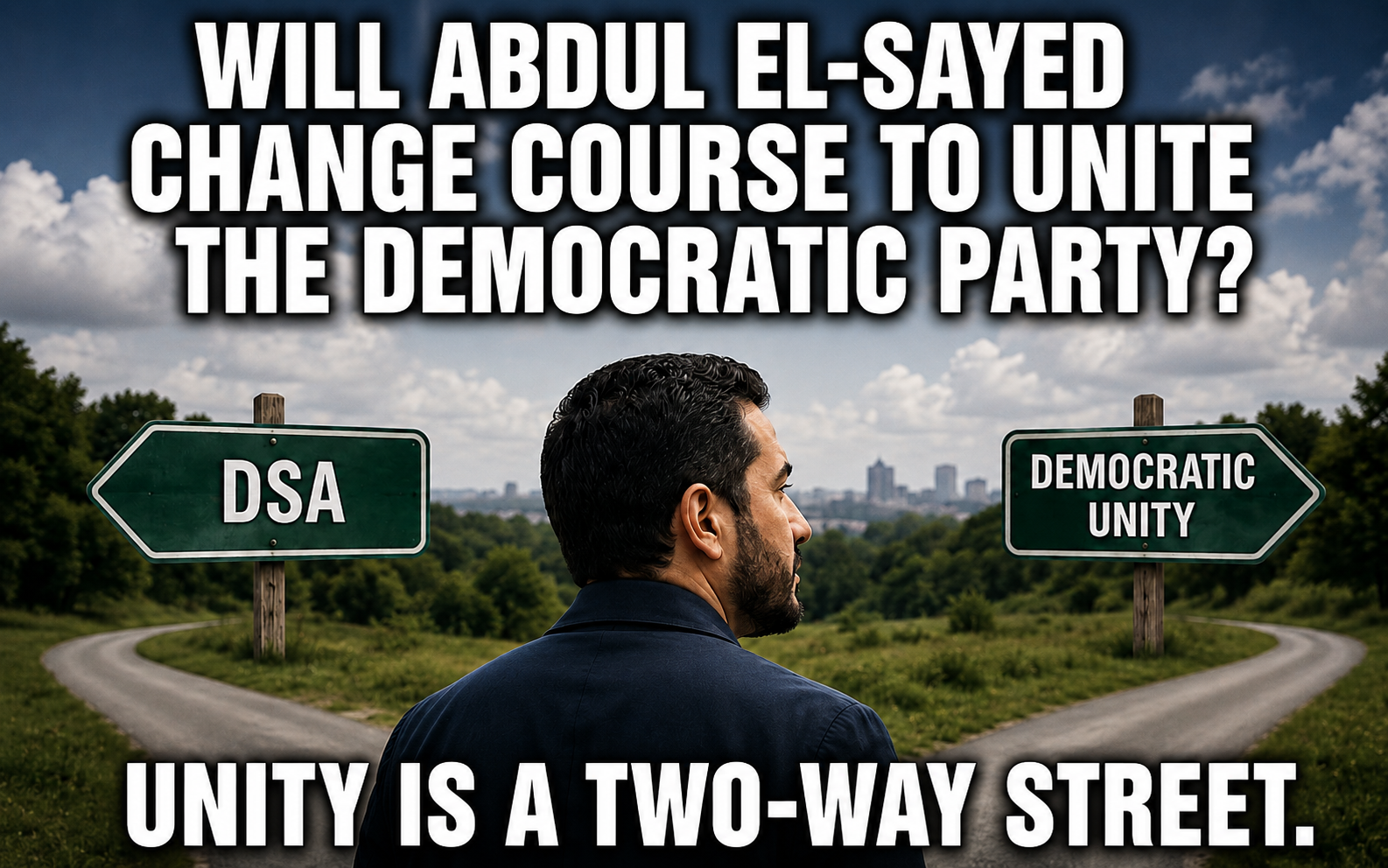
Unity is a two-way street.
Those of us who supported another candidate are being asked to reach toward him.
Now he should reach toward us.
This means embracing democratic values. In fact, many of the economic issues El-Sayed talks about have been Democratic principles for generations.
Democrats have fought for stronger unions, better wages, a livable minimum wage, livable Social Security benefits, Medicare for All, civil rights, environmental protection and a tax structure that asks wealthy Americans to contribute fairly.
None of those ideas requires embracing the DSA’s entire agenda.
Democrats have long warned about the growing concentration of wealth in America. Federal Reserve data continue to document that concentration at the top and the widening wealth gap between the richest Americans and everyone else. That means companies can afford to pay people a liveable wages and more and a fair tax system means taxing the rich the government can afford social programs.
Democrats have been arguing for a stronger middle class for as long as I have been involved in Democratic politics, going back to the 1970s.
That is precisely why El-Sayed has an opportunity now to define himself independently of the DSA.
He has described himself as a capitalist rather than a socialist.
Good.
Then say it louder Abdual.
The DSA’s current program contains positions far outside the mainstream of the Democratic Party. They call for ending military and economic aid to Israel and describes Israel’s actions in Gaza as falsely genocide.
They’re calling for the end of the constitution the end of capitalism they want to replace it with a parliamentary system and an economic system of communism.
Those are not minor policy differences. They represent a fundamentally different vision of American government.
El-Sayed does not have to adopt those positions merely because Bernie Sanders and Alexandria Ocasio-Cortez supported his candidacy.
This is his campaign now.
He should tell Michigan voters where he agrees with the DSA and, equally importantly, where he does not.
El-Sayed is the son of Egyptian immigrants and has spoken about his family’s American story and the opportunities this country provided him. He was born and raised in Michigan, attended the University of Michigan, became a Rhodes Scholar and earned degrees in medicine and public health.
It is an extraordinary American story.
And with extraordinary opportunity comes extraordinary responsibility.
If elected, El-Sayed will swear the same oath as every United States senator: an oath to support and defend the Constitution of the United States.
That oath will not be to the DSA. It will be a commitment to the Constitution.
That is why now is the moment for El-Sayed to make unmistakably clear his commitment to constitutional government while showing that he can champion long-standing Democratic priorities without embracing every position associated with the DSA.
And then there is Israel and the Jewish community.
This is where El-Sayed has considerably more work to do.
He has called what is happening in Gaza falsely genocide. He has called for ending American military aid to Israel, including defensive assistance, the Iron Dome for one. He also has declined to embrace Israel’s right to exist specifically as a Jewish state. Those positions have understandably created deep anxiety among the Jewish community.
That anxiety is real. Before the primary, some prominent Michigan Jewish Democrats were already saying they might support the Republican rather than vote for El-Sayed.
Lecturing those voters about Democratic unity will not solve that problem.
Reaching out to them might.
El-Sayed has spoken about fighting antisemitism and protecting Jewish Americans. I heard that message loudly and clearly, and I welcome it.
Now build much further upon it.
Meet with Jewish leaders who supported you and Jewish leaders who opposed you.
Meet with mainstream pro-Israel Democratic organizations.
Ask to sit down with Israel’s ambassador to the United States.
Not for a photo opportunity. Not so either side can lecture the other.
Go into the room asking a simple question:
Where can we find common ground?
El-Sayed does not have to agree with every policy of the Israeli government. I certainly don’t.
He can advocate passionately for Palestinian dignity, Palestinian economic opportunity and Palestinian self-determination while also recognizing that Israelis deserve security and that Israel deserves to live in peace.
El-Sayed can also condemn Hamas terrorism without qualification and embrace Hamas disarming.
El-Sayed can pledge that, as a United States Senator, he will work toward a future in which Israelis and Palestinians can live beside one another in peace rather than perpetuating a conflict that has already consumed far too many lives.
That would be leadership.
It would also be politically smart.
Michigan is not a deep-blue state where winning the Democratic primary guarantees election. El-Sayed won his primary by one percent. November will require voters considerably beyond the coalition that carried him through August.
That means reaching out to Jewish Democrats.
It means reaching out to Democrats who supported Haley Stevens.
It means reaching out to moderates.
It means reaching out to independents.
And it means making clear that while Bernie Sanders and Alexandria Ocasio-Cortez may have enthusiastically supported him, Abdul El-Sayed will define Abdul El-Sayed.
I want Democrats to defeat MAGA candidates in November.
I also believe Democratic candidates have a responsibility to give the entire Democratic coalition something worth uniting around.
So I will accept the challenge Democratic leaders are issuing to people like me if El-Sayed also reaches to people like me.
I will listen.
I will watch.
I am willing to reach toward Abdul El-Sayed.
Now, Abdul, please reach back.
Because unity cannot simply mean, we won, now fall in line.
Real unity is built.
And this is Abdul El-Sayed’s opportunity to build it.
Don’t be what some now perceive you as: “the Communist/Jihadist candidate.”
Be the well-regulated capitalist who fights for a fairer distribution of wealth, Medicare for All, and peace between Palestinians and Israelis.
You’re more likely to unite us.
And you’re more likely to win!