


Will the Voices Raised in Davos Save Gaza From Trump’s Clutches?
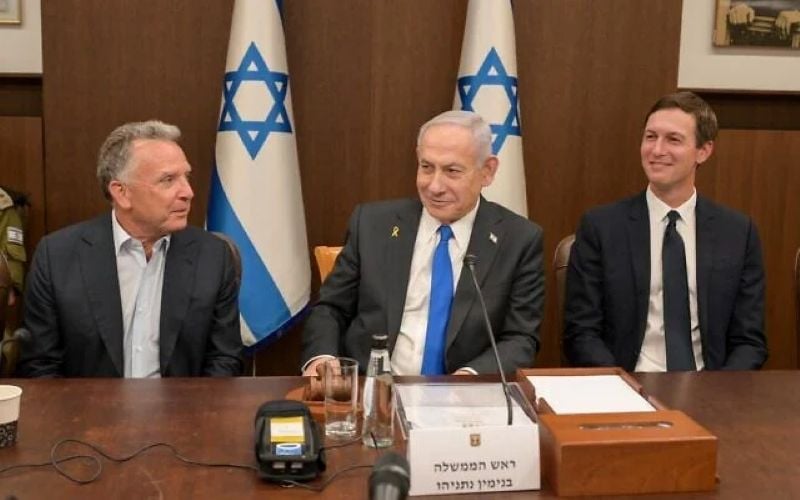
It remains to be seen whether the Western leaders who found their voices in Davos will now raise them to insist on implementation of a comprehensive plan to end the occupation of the entire OPT and not just “the beautiful piece of property” spotted by Trump on the Gaza coastline.
As is typical at any event organized by President Donald J. Trump, he was the subject of lavish praise from the attendees at what the White House described as “an historic ceremony” at which the so-called Board of Peace (BoP) was ratified in Davos on Thursday. It is doubtful, however, that the adulation that spewed out of the mouths of Steve Witkoff, Jared Kushner, and Marco Rubio, his band of thieves, and other assembled guests helped him get over the scathing criticism of US foreign policy that he heard from key European leaders and particularly his neighbor to the north. The ceremony was meant to be a repeat of the “Peace 2025” circus that convened in Sharm el Sheikh in October for the signing of the “Trump Declaration for Enduring Peace and Prosperity,” where world leaders lined up to shake the hand of the man who was supposedly bringing peace to the Middle East. Instead, Trump’s invitation to join the BoP was rejected by many major US allies, casting a shadow over the festivities in Davos.
From the outset, there was no need to zoom out very far to see that the vision behind Trump’s 20-point Gaza ceasefire plan was inspired by the money to be made from reconstruction of the Gaza Strip. To paraphrase what Trump has said repeatedly over the past year and spelled out at the inauguration of the BoP: location, location, location! Using all the bells and whistles at his disposal to try to paint a path from real estate to real peace, Kushner, Trump’s son-in-law and consigliere, went through a presentation meant to show that bringing economic prosperity to Gaza means achieving peace for the Palestinian people. What Kushner failed to acknowledge is that Gaza is home to only some 15-20% of the global Palestinian population and less than half of the total number of Palestinians in the Occupied Palestinian Territory (OPT).
Coming on the heels of the United Nations General Assembly’s endorsement of the New York Declaration on implementation of the two-state solution and the wave of recognitions of the State of Palestine in September 2025, the limited scope of the Trump plan constituted a significant step backward. This made it all the harder to watch the leaders of the Western world enabling Trump to peddle the myth that he has resolved the Israel-Palestine conflict. Notably, among the enthusiastic supporters of the Trump plan was Canadian Prime Minister Mark Carney, who at the time welcomed it as no less than an “historic new Middle East peace plan.”
It was only after Trump’s imperialist aspirations hit close to home with his threat to take Greenland by hook or by crook that the Canadian leader took to the stage in Davos to take on President Trump. Carney eulogized the rules-based world order and urged his counterparts to stop, as Václav Havel called it, “living within the lie” or, in other words, keeping their heads down when it suits their interests.
France and the UK demonstrated their comfort within the lie when they voted in favor of UN Security Council Resolution 2803, which gave the Trump plan international legitimacy. They accepted Trump’s insistence that the preamble say “noting” rather than “reaffirming” previous UNSC resolutions on the Palestinian issue, loosening the ties between 2803 and its historic predecessors 242, 338, and 2334, to name just a few.
They did so only two months after officially recognizing the State of Palestine, at which time Prime Minister Starmer had declared that the UK was fulfilling “a moral responsibility” and President Macron had proclaimed that “the time has come to deliver justice to the Palestinian people.” Even Denmark, whose territorial integrity was already in Trump’s sights, voted yes at the UNSC. Perhaps they hadn’t bothered to read the fine print, or perhaps it took Trump’s invitation to the Russian president to join the BoP for them to realize that they had given birth to a monster.
In recent days, the kowtowing to Trump appeared to be diminishing, as liberal world leaders began to refuse invitations to sit on the BoP. It would be a mistake, however, to attribute this awakening to a commitment to Palestinian independence. Their objections came from the realization that Trump intends his position as BoP chair to be a lifetime appointment, that he intends the BoP’s mandate to extend beyond Gaza to other conflict areas (with an eye to eventually replacing the United Nations), that countries can purchase permanent membership through payment of a $1 billion fee, that leaders under indictment for war crimes have been invited to join – in brief, that Trump overreached.
Although the West’s rejection of the BoP so far has been more about confronting Trump’s lust for power than defending the Palestinian people’s right to self-determination in a sovereign state, Spanish Prime Minister Pedro Sanchez deserves credit for taking a different stance. He stood out from his European allies by citing the absence of Palestinian representation when declining the invitation to join the BoP. Sanchez said that “peaceful and secure coexistence” must be decided “primarily by Israel and Palestine through a dialogue-based process that implements the two-state solution,” using language that has been disappearing from the international stage since the introduction of the 20-point plan.
It remains to be seen whether the Western leaders who found their voices in Davos will now raise them to insist on implementation of a comprehensive plan to end the occupation of the entire OPT and not just “the beautiful piece of property” spotted by Trump on the Gaza coastline. Unfortunately, the more likely scenario is that the “values-based realism” proposed by Finnish President Alexanders Stubb and touted by Carney, which rests on the premise that there are times when it is necessary to compromise one’s values in order to solve major crises, will become the new standard. In that case, there is cause to fear that Palestinian sovereignty will be sacrificed as the West picks its battles against the megalomaniac who resides in the West House.