
Will Trump Fold to Iran or Crush It Before Beijing Meeting Next Week?
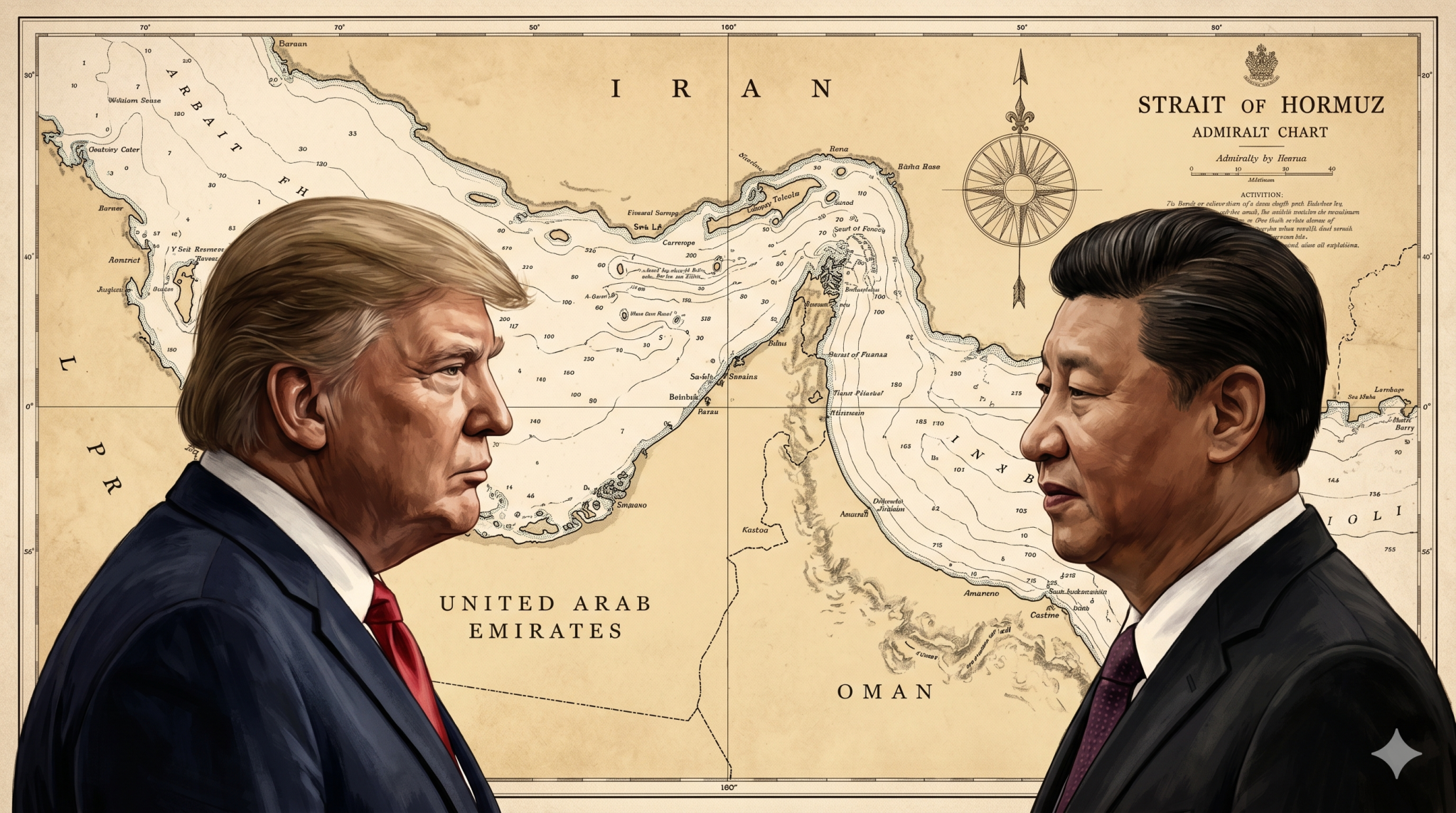
Air Force One departs for Beijing on May 14. Between now and then, President Trump must decide whether he lands in the Forbidden City under a sustained ceasefire or with a war reopened and closed. No third option would serve him at the table with President Xi.
Beijing as deadline
The summit with Xi Jinping is fixed for May 14 and 15. The trip was originally scheduled for late March and pushed back as the Iran war absorbed the administration’s bandwidth. It cannot be delayed again. The Chinese have prepared the protocol. The cabinet has cleared the calendar. The news cycle has been positioned around it.
Diplomatic activity continues without convergence. The Islamabad talks collapsed in April. Iran passed a fresh proposal through Pakistani mediators in early May. On May 5, President Trump announced “great progress” and ordered a pause to US naval escorts in Hormuz, while the Iranian foreign minister landed in Beijing. On May 6, Trump posted on Truth Social that if Iran agrees to terms, Operation Epic Fury ends and the strait reopens. He paired the offer with a threat: “If they don’t agree, the bombing starts, and it will be, sadly, at a much higher level and intensity than it was before.”
Diplomacy without convergence becomes delay. Delay is never neutral when the deadline is Beijing.
The American military posture, however, has consolidated rather than relaxed. The US Navy has imposed a blockade on Iranian ports since April 13. Project Freedom deployed guided-missile destroyers, more than 100 aircraft, and unmanned platforms to escort commercial shipping through Hormuz. On May 4, two US destroyers transited under coordinated Iranian fire, defended by Apache helicopter air support.
The words have de-escalated. The force has remained.
The asymmetry of arrival
Trump arriving with the war still open arrives as a supplicant. He needs Xi to press Tehran, restrain Chinese military exports to Iran, contain the energy shock squeezing the global economy. China’s leverage is structural. Beijing imports roughly one-third of its oil and gas through Hormuz, and has spent the war pricing that leverage rather than spending it.
David Shambaugh has warned that Xi will use the meeting to seek shifts in declaratory US policy on Taiwan, including changes to the precise vocabulary that has anchored American strategic ambiguity for decades. A weak arrival makes those concessions cheaper. Concessions on Taiwan tend to last beyond the administration that grants them.
Trump arriving with three deliverables in hand inverts the dynamic: a regime in Tehran further weakened, the strait under American escort, the Isfahan stockpile recovered. Hormuz secured by American force becomes American leverage. The implicit phrase in every conversation that follows: Washington holds the key to the flow. Beijing’s energy security becomes contingent on American forbearance.
The historical pinch is familiar. Nixon arrived in Beijing in 1972 with SALT (Strategic Arms Limitation Talks) in motion. Carter arrived in Tehran in 1979 with a crisis collapsing around him. Position shapes everything that follows.
Scenario one: the closing operation
If the order comes, the shape will be a closure operation. Seventy-two hours, compressed across components running simultaneously. Recovery of Iran’s enriched uranium stockpile at Isfahan, whose location was established in earlier reporting in this column. Decapitation of the residual command structure that survived Operation Epic Fury on February 28. Clearance of the strait beyond the two American-flagged vessels that managed passage on Monday.
The architecture is not speculative. By April 30, Israeli cabinet ministers were bracing for negotiations to collapse and expected Washington to “give a push” through strikes on Iranian energy and government infrastructure. Plans presented to President Trump that week reportedly included deploying ground forces to take control of part of the strait. Defense Minister Israel Katz said publicly on April 30 that Israel may “soon be required to act again” and that President Trump, in coordination with Prime Minister Netanyahu, is leading the effort to complete the campaign’s objectives.
The operation has been designed. What remains is the order.
The architecture describes intent. Wars rarely unfold as their planners draft them. The earliest written records make the same point: intent meets contingency, and contingency wins. The Iranian regime, however weakened, retains the capacity to surprise. Whether the design produces closure is a question the design alone cannot answer.
The LeMay question
A 72-hour closure operation against Iran would have no comparable precedent in modern warfare. The 12-day conflict of June 2025 produced significant degradation of Iran’s nuclear program without producing capitulation. The second round opened on February 28 and has now extended past 60 days. A third round compressed into 72 hours would require an intensity unseen since the Second World War.
Curtis LeMay’s doctrine held that overwhelming strategic bombing, applied without restraint and compressed in time, breaks an adversary’s capacity faster than any graduated approach. He demonstrated it over Japan in 1945, where firebombing campaigns reduced major industrial cities to ash.
The Iran scenario invokes LeMay’s compression. The targets: air defenses, IRGC missile sites, the national power grid, the Isfahan tunnel complex itself. Thousands of cruise missiles. Hundreds of stealth sorties around the clock. Special forces inside Iran. Three days of munitions expenditure that could exceed everything spent in the first two rounds combined. President Trump’s May 6 threat of bombing “at a much higher level and intensity than it was before” reads as official preview of exactly that doctrine.
The question doctrine cannot answer is whether such intensity produces closure or escalation. The Iran case adds a variable LeMay never faced: 440 kilograms of near-weapons-grade uranium that, if not secured in the first hours, could become the cornerstone of an Iranian nuclear breakout under the cover of war.
The cost of holding
Either path has its own operational reality. The American military posture currently arrayed around Iran cannot sustain peak readiness indefinitely. Two carrier strike groups since January and February. More than 100 aircraft on patrol. Tankers staged in Israel and Jordan. Daily costs run into the single-digit millions per carrier strike group, with munitions stockpiles bounded by what theater logistics can resupply. Public reporting drawing on US officials has warned that high-intensity operations could be sustained for only seven to ten days before depletion forces a pause.
The buildup creates a window. The window closes regardless of Trump’s announcement schedule. Either he uses the force he has assembled, or he begins drawing it down before degradation makes that drawdown a retreat. There is no third path that costs nothing.
The weekend’s double geometry
The civil defense argument from February still holds. Israeli families on Saturday are at home, near reinforced safe rooms. Shelter access on a weekend is a question of where civilians already are.
A second layer now overlays the first. Wall Street and the NYMEX close from Friday afternoon through Monday morning. The Pentagon gets thirty-six hours to consolidate a public narrative before global oil markets reopen. The president declares objectives achieved Tuesday, departs for Beijing Wednesday with the operation framed and behind him.
Civilian geometry and financial geometry pull in the same direction. The only weekend remaining before Beijing is May 9 and May 10.
Scenario two: Trump does not strike
Trump may simply decide that striking before Beijing is not strategic. He arrives without three deliverables. With a paused crisis rather than a resolved one. With China credited as part of the diplomatic mechanism that produced the pause.
The May 6 framework gives that scenario specific shape. Iran’s three-stage proposal calls for thirty days of nuclear talks following a formal end to the war. Chinese Foreign Minister Wang Yi met with his Iranian counterpart Abbas Araghchi in Beijing on May 6, the same day Trump posted his conditional offer. If Tehran accepts, Trump arrives at the summit with a process underway and Xi visibly credited as facilitator. The asymmetry shifts. Beijing wins the optics regardless of substance.
What is curious is that the summit has been on the calendar since late March. If the decision not to strike is genuine and recent, it represents last-minute improvisation over a schedule that has been firm for weeks.
The alternative is that the offer is structured to fail. Iran’s framework includes demands Washington has previously rejected: postponing nuclear talks until after war’s end, lifting the blockade, paying reparations. If Trump knows the terms cannot be reconciled, his May 6 offer doubles as casus belli for the more intense bombing he threatened in the same post. The June 2025 strikes were preceded by a documented public deception campaign in which Trump declared his preference for negotiated solution hours before Israeli aircraft entered Iranian airspace.
Deciphering Trump is, practically speaking, impossible. The pattern of his pronouncements is the absence of pattern. Whether the May 6 framework holds through the weekend is something even his own staff may not know.
Closing
Project Freedom underway. Iranian attacks on the UAE this week. American war materiel arriving in theater. Katz stating Israel may soon be required to act again. Trump briefed on fresh strike options. Air Force One bound for Beijing. On May 5, claiming progress in talks while pausing naval escorts. On May 6, offering Tehran a deal and threatening bombing “at a much higher level and intensity than before” if it refuses.
The pieces are aligning toward a third round of the war that began in June 2025. And possibly the last. Or toward a deal that lets Trump arrive in Beijing with diplomacy as cover and the strike option preserved for after the summit.
If the strike comes, it could come this weekend.
Or after Beijing, if Iran rejects the framework and Trump returns to Washington with the casus belli his May 6 post pre-positioned.
In February the variables pointed to a Saturday and were correct. They are pointing again. Whether Trump follows them is the question only the weekend will answer.