Founder & Principal, Line of State
With Law, Without Illusions – Rabin, Leadership and Responsibility
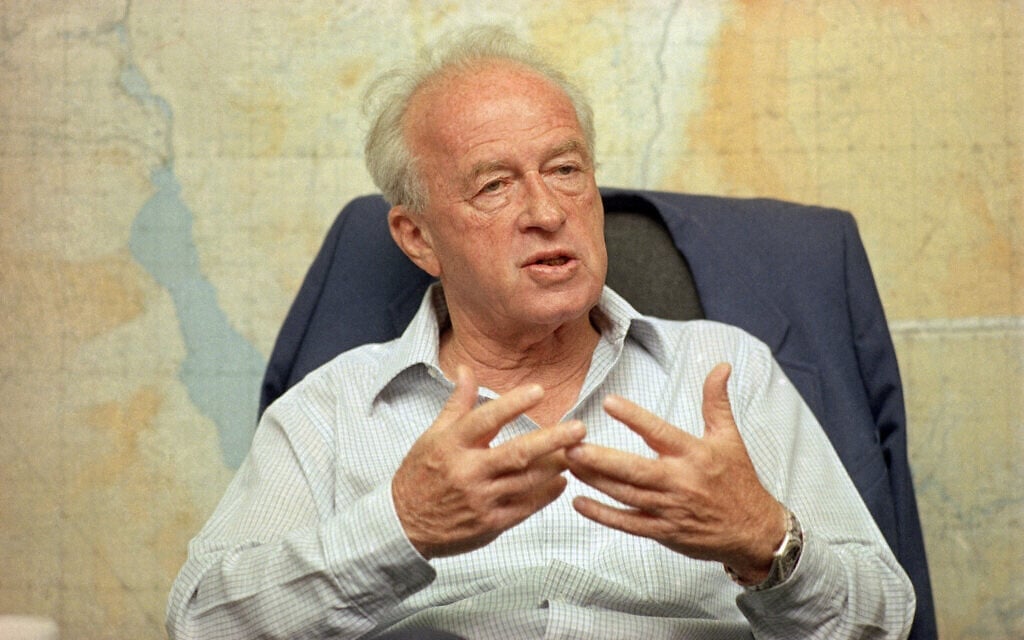
Israeli Defense Minister Yitzhak Rabin during an interview May 18, 1989, at the Tel Aviv Ministry of Defense office. (AP Photo/Anat Givon)
Rabin’s phrase “Without the Supreme Court and without B’Tselem” captured the mindset of a commander, not a populist – the belief that a democracy under fire must fight by its own laws and still prevail. His legacy is a reminder that moral clarity and military strength are not contradictions, but the essence of Israel’s survival.
In an age when democracies question their own resilience, it is worth revisiting what Yitzhak Rabin meant when he spoke of acting “with law, without illusions”.
In Israel, those words carried a weight far beyond rhetoric; they drew a moral map between conscience and survival – between the weather vane that drifts with public mood and the compass that holds a course through the storm.
Thirty years after the assassination that shook Israel’s foundations, his now-famous phrase – “Without the Supreme Court and without B’Tselem” [1] – deserves to be heard again. It was not defiance. It was a definition: a precise, disciplined, and moral articulation of leadership and responsibility in a democracy that must defend itself to survive.
Rabin said it in March 1994, at the height of relentless terror attacks. Israel was struggling to protect its citizens without forfeiting its conscience. His intent was never to sidestep the law or silence criticism, but to remind a weary nation that power must remain bound to law even in war. He did not say “without law”. He said, “with law – but without illusions”.
It was not rebellion against the gatekeepers of democracy but a delineation of their mandate – a sober recognition that law must empower governance, not paralyze it.
“Without the Supreme Court and without B’Tselem” did not repudiate Israel’s watchdogs; it defined their boundaries. It was an affirmation of order and responsibility, not rebellion or resentment. For a state confronting adversaries who reject both its legitimacy and its restraint, moral boundaries are not a luxury – they are strategy. A democracy must clarify authority, purpose, and the discipline to act, even when the sword must be drawn.
Democracy, Rabin understood, is not a suicide pact. It draws limits in order to endure – and must defend itself to remain itself. Israel faces that test every day. It is not a choice between morality and security: morality endures through security, and security stands upon morality. That is the Israeli equation, and a universal one – safeguarding freedom is not merely a right, but a duty.
From Principles to Leadership: Rabin’s Compass Under Fire
Leadership, in Rabin’s view, is tested not in calm but in crisis – when uncertainty clouds every choice and hesitation costs more than action. He decided early, not when outcomes were certain but while they could still be shaped. He refused to wait for the last moment; he acted so that such a moment would never come. That is the gulf between management and statesmanship: a manager reacts to circumstance, a leader reshapes it. Between the weather vane that turns with the wind and the compass that points north even in a storm.
Yet Rabin did more than set a compass – he steadied the helm. “I am the navigator”, he declared, not as bravado but as a vow. The compass defines direction; the helm demands mastery. He did not seek excuses for a wheel that refused to turn. He steered regardless – because leadership, for him, meant taking responsibility when the storm itself is the test. He offered no alibis when the wheel resisted, knowing that responsibility begins where excuses end.
The courage to decide is the twin of the courage to err. A genuine leader does not hide behind the mantra “We’ll wait and see”. He faces the mirror, discerns where his choices have led, and corrects course. The one who can say “I was wrong” earns the trust to say “I know”. Responsibility, for Rabin, was born of candor – the moral stamina to admit human fallibility rather than feign perfection.
In that rare admission lies the core of moral authority: a leader who can face his own fallibility stands taller than one who hides behind perfection. In Israel’s unforgiving public square, such candor is an act of courage. Rabin’s strength lay not in certainty but in the refusal to hide behind it.
He carried the weight of decisions that left no one unscarred – neither those who bore them out nor those who bore their consequences. That burden, too, was part of his courage.
The peace he pursued was never naïve. He knew that real peace rests upon credible strength – that a peace divorced from security is a piece of paper without meaning. He built peace from power, not in its place: the quiet confidence of a state that understands restraint not as weakness but as mastery of power – the confidence of a nation that believes in its strength, builds it, and never surrenders it.
Rabin did not deny reality; he sought to reshape it. He did not gild it in rhetoric or hide behind slogans, nor did he crave affection. He spoke with candor, even when truth exacted a cost. “Without the Supreme Court and without B’Tselem”, he said, was no rejection of morality but an assertion of duty – the leader’s obligation to defend his citizens, even amid criticism or external pressure. It was not moral weakness, but a sovereign discipline of responsibility: the capacity to wield power without surrendering conscience.
True morality, Rabin believed, was never self-righteousness. It was the discipline to act within limits – and the strength to accept that limits do not make a nation weak; they make it worthy of its power. For Rabin, the duty of leadership began with the duty of defense – to safeguard his citizens even under the glare of criticism or diplomatic isolation.
That is why Rabin’s message resonates far beyond Israel’s borders. Every democracy that seeks to survive in a harsher world must learn the same lesson: moral restraint and strategic strength are not opposites – they are twins.
There is no need to reinterpret Rabin; one only needs to listen. Leadership is not the pursuit of affection, but fidelity to a compass, even when it stings. Responsibility is not fear of power, but its judicious exercise when necessity commands. Foresight is not prophecy, but clarity of sight.
In the long view of history, “Without the Supreme Court and without B’Tselem” did not dilute Israel’s values – it deepened them. It remains the credo of a nation determined to preserve its humanity while confronting its enemies – and, in doing so, to face not only those who threaten its borders but also a world often too cynical to understand the burden of moral clarity under fire. And, when no alternative remains, to fight: with law, without illusions. [2]
That was his legacy – not perfection, but the belief that even in the hardest place on earth, a nation can be both strong and decent, both armed and humane.
—
[1] What is B’Tselem (and what its name means).
B’Tselem is an Israeli human-rights organization founded in 1989 in Jerusalem. Its work focuses on documenting and addressing human-rights issues arising from Israel’s control in areas beyond its recognized borders and advocating adherence to the principles of law and human dignity. The Hebrew word “b’tselem” means “in the image [of God]”, drawn from Genesis 1:27 – reflecting a universal and Jewish belief in the sanctity of human life.
[2] Rabin’s exact wording and context (March 1, 1994).
Rabin used the phrase in a Channel 1 television interview on March 1, 1994, during a surge of terrorist attacks and as the Palestinian Authority’s police were being established under the Oslo framework. His remark was: “The Palestinian Police will fight Hamas without B’Tselem, without the High Court, and without Mothers Against Silence”. In context, he was referring to the difference between Israel’s own legal and moral constraints and those of the emerging Palestinian security forces. Rabin was not advocating bypassing Israel’s rule of law, but highlighting that Israel’s democratic limits require others to shoulder part of the security burden.
—
Originally published in Hebrew in Maariv, this essay now appears in English in an expanded and updated version reflecting the author’s own translation and adaptation for an international audience.
Related Topics