

Without Disappearing
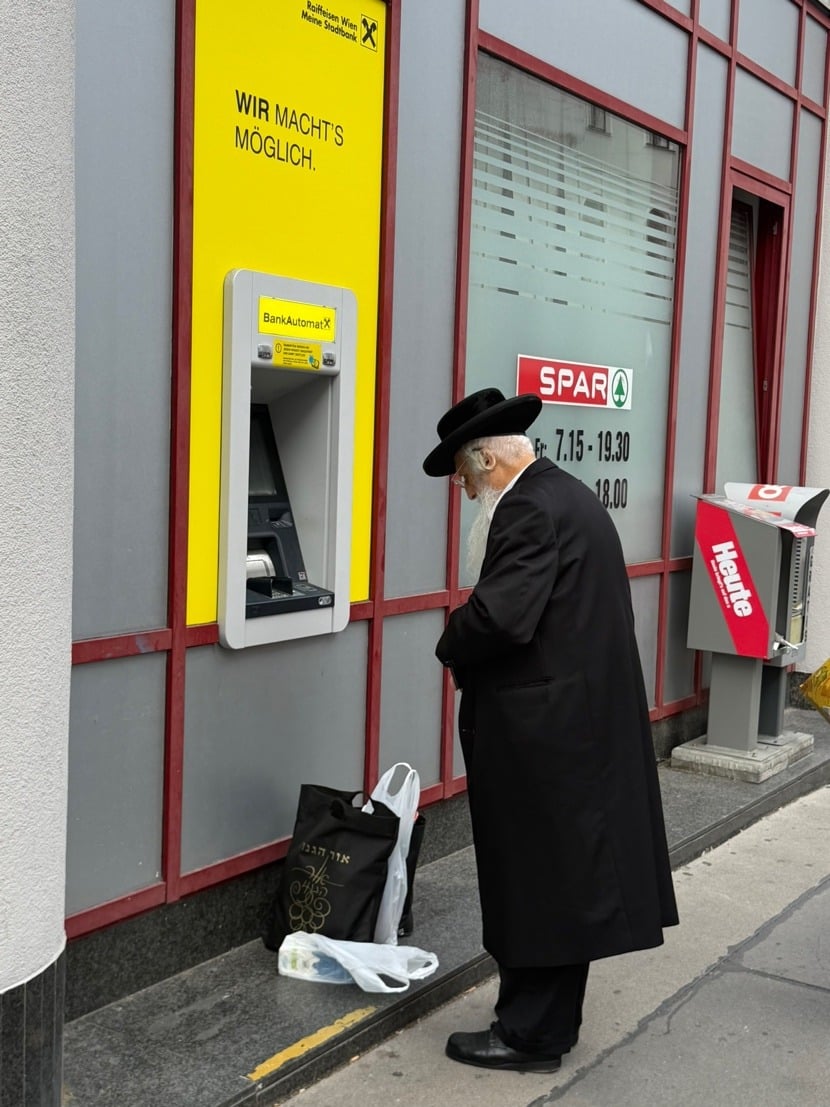
A Hasid at a bank machine on a Vienna street. (Julian Ungar-Sargon, July 2026)
I have spent a lifetime
learning how to enter spaces
The university room,
the hospital room,
the officers’ room,
the room lined with books
whose authors I never thought I could engage
I learned Bach and Mozart
Freud and Jung,
the upper middle class manners of the English
(though my skin color was a little too olive for my teachers)
the double-blind rules of science,
that reason and the correct shprach might finally make me
a stranger to no one.
And somewhere along the way
I learned another art:
how not to announce myself
Not to deny my ethnicity
(after all I never relinquished my skull cap in those spaces)
But (maybe fooling myself that I could be)
a man first,
a physician,
a scholar,
a political left-leaning European enlightened socialist—
and let the Jew arrive later.
Then I returned to Vienna,
the city my father lost.
How beautiful it was.
The buildings still stood upright as if nothing had changed since they ruled an empire.
The melange was served carefully.
Mozart still belonged to everyone.
The Ringstrasse glittered
as though history still had impeccable manners.
(though many of those buildings had been authored by emancipated wealthy Jews)
And I understood better, my father.
How could one not have loved this?
How could a Jew,
coming from narrow streets
and inherited prohibitions,
not have looked upon Europe
and felt pride
Then I saw him—
a Hasid walking through Vienna,
black coat in the summer light,
hat, beard, peyot,
carrying his Jewishness
before him, unabashed
And something in me tightened.
Must you be so visible?
Must you advertise your Yiddishkeit?
Could you not, just once,
walk unnoticed like me! (sic)
Perhaps what disturbed me
was not his difference
but his freedom.
He did not ask Vienna
whether he belonged.
He did not need Goethe
to certify him.
He carried another geography
under his coat—
Ostjude
Mezritch,
Berditchev,
Ger,
Belz,
Mea Shearim—
And I,
who had crossed oceans
to find the graves
and names
that Europe had tried to erase,
found myself wanting him
to be less noticeable.
What an inheritance!
My father wanted to belong
to the city that ruled an empire
Educated in the gymnasium that taught him Greek myths over Abaye and Rava
that eventually decided
he was no longer welcome
The teacher measuring his forehead in front of the other gentile students to demonstrate Semitic phrenology
And I return
a generation later,
educated,
credentialed,
comfortable among other spaces
still asking the same question
in better English:
May I be accepted — with the yarmulke, despite the yarmulke?
But perhaps I have misunderstood
the journey.
Perhaps I did not return to Vienna
to prove that I belong there.
(they would now allow me to adopt Austrian citizenship!)
Perhaps I returned
to discover that I no longer
require its permission.
I can love Bach
without baptism.
I can read Jung
without surrendering the Zohar.
I can stand beneath
the vaulted ceiling of a cathedral
and feel wonder
without needing to explain
why a Jew is looking upward.
And I can enter the beit midrash
without leaving
the rest of humanity
at the door.
Still,
I confess I remain envious of
the anonymous man.
The man without adjectives.
No Jew.
No Orthodox.
No secular.
No Zionist.
No American.
Only a human being
walking down a street.
But there is no such man.
There never was.
Even the man who calls himself
universal
has ancestors pulling at his soul
So I will carry mine.
Not as a badge.
Not as a wound.
Not even always proudly.
Sometimes uncertainly.
Sometimes arguing.
Sometimes exhausted
by the ancient obligation
to remember.
I will carry them
because they carried me.
And perhaps one day
I will again see that Hasid
walking down a Viennese street.
This time
I hope I will not look away.
I will look at his black coat,
then at my Western suit,
and understand
that both of us
are wearing uniforms.
His is simply
more honest about being one.
We chose differently.
Yet somewhere beneath
his peyot
and my carefully acquired
cosmopolitanism,
we are answering
the same frightened,
stubborn question:
How does a Jew
walk through the world
without either building a wall
or disappearing into it?
I do not know.
Perhaps that is why
I am still walking.
But I know this much:
I no longer wish
to disappear.
I only wish
to belong
without disappearing.