
Women of Valor: Revisited
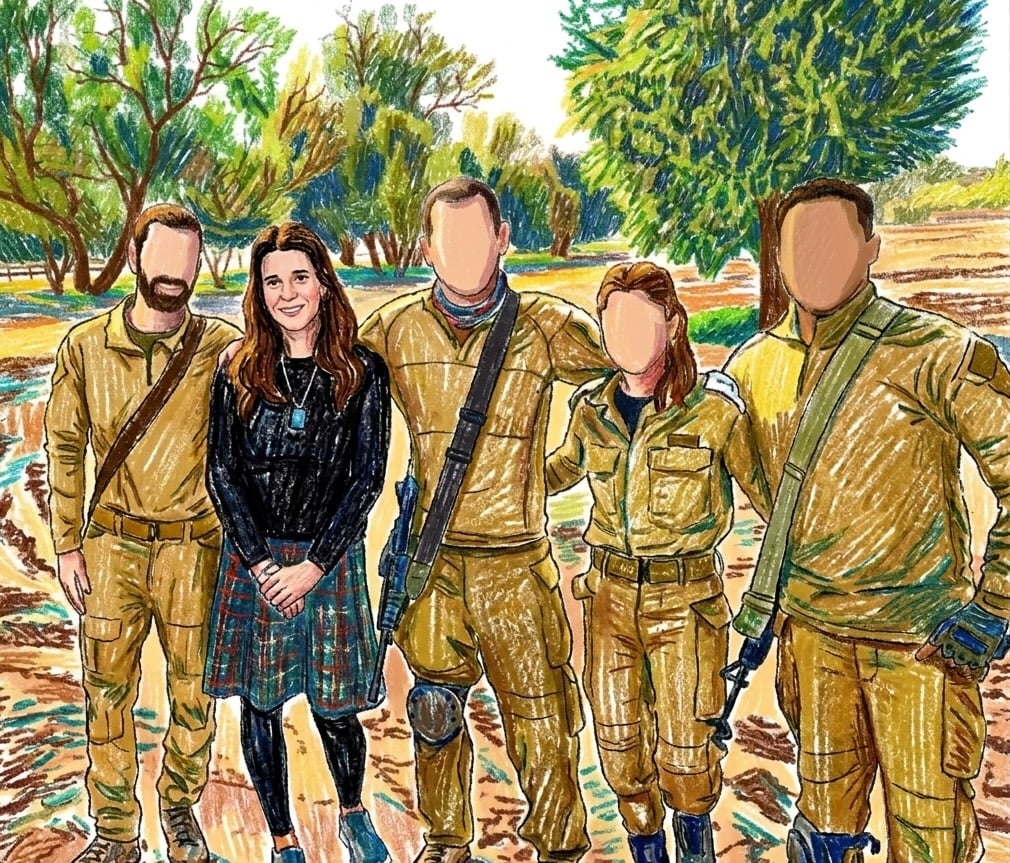
Recently, I wrote a post with the above heading and noted a follow-up coming about another Jewish woman in the Diaspora whose life (and approach to self-service) changed dramatically after October 7th. These “women of valor” so named after King Solomon’s poetic celebration (Eshet Chayil, Proverbs 31) of a woman with “value far beyond pearls,” are everywhere, of course. And if both posts do nothing more than to inspire ToI readers to search out and celebrate the many N’shot Chayil in their own communities, then I’ll consider it a job well done.
Along those lines, meet Adinah Finn, a suburban Los Angeles mom with four kids, whose life changed dramatically after that fateful Saturday in October. Finn grew up in nearby Orange County, with a mixed Israeli American parentage. Hebrew wasn’t spoken in the home, so Finn says her Jewish identity was forged through summers at a local Chabad-run Camp Gan Israel, along with two years at an orthodox day school. “The first time I felt a spark for Israel was on a Birthright trip between my freshman and sophomore year at college,” she recalls. “It inspired me to return three years later with my now-husband [Dr. Richard S. Finn, professor of clinical medicine, Hematology/Oncology at UCLA] and his father, who had never been. I met Richard at an L.A. singles event because there were so few Jewish boys in Orange County.”
Dr. Finn’s busy medical career kept him on the road, which left his wife to run the home. When their second oldest graduated high school and decided to spend a gap year at a seminary in Israel, Finn felt the tug to reciprocate. She became a “host mom” to an Israeli grad, also doing a “gap year” as a cultural ambassador in the US. This shinshin (a Hebrew acronym for shnat sherut – year of service) created what Finn calls, “my first personal connection to Israel. We had been there as a family several times,” she notes. “But this boy was the same age as my daughter, and he was going into the army right after his time with us. Through him, I had a stake in Israel. Through him, I became vested in its people.”
Run by the Jewish Agency, the Shinshinim program arrived in Los Angeles in 2018. Finn signed on in 2022, bringing the Israeli teen into her home for a full year. “Our shinshin went back to Israel just before October 7th,” she continues, “and began his military service a month later, on November 3rd. I spoke to him right after Yom Tov on that horrible day, and I said, ‘Please, just stay at home. Please stay safe.’ And he said: “No, I’m going to go help the army. And you need to do the same!”
Finn says it was those words, from a teenager thousands of miles away, that changed her life – and the many others she’s since touched. “When reports started coming in that the IDF needed supplies, my feeling was that I was going to send over as much equipment as I could, in the hopes it would trickle down to wherever my shinshin was serving,” she reflects. Connecting with fellow community member Sara Jacobs (see Women of Valor) who had spent the last year starting a nonprofit organization (Maman), Finn told Jacobs her passion was to help the IDF. “Sara was involved with helping displaced kibbutzim members, widows and orphans, and she couldn’t do everything,” Finn recalls. “So, my focus became 100 percent on procuring what the IDF needed to fight this war.”
Once the call went out for donations, Finn was stunned by the community response. “The Amazon boxes filled my entire backyard and kept going out to the street,” she smiles. “I had never done anything like this before. So, becoming a supply chain manager overnight was…crazy! Then one of my neighbors came down the street and said: ‘You can’t just put all this stuff on a plane. You need to create a manifest by weight, cost, item, etc. with a Google sheet or it will never get through!” The sheer mass of boxes meant we needed volunteers, many of whom were already unpacking and sorting, to make a recycling trip every day. We were drowning in cardboard.”
That first delivery was through a non-profit partner in Israel. But then Finn started getting requests directly from soldiers, so she opted to have donated items travel with passengers on commercial flights. “By that time, I was hosting another shinshin,” she states. “His family in Israel knew someone who wanted to help.” This “Israeli assistant” created a system where volunteers would meet the El Al flight in Tel Aviv and deliver the donations to the different units. “One shipment would be for the orthodox, another for Golani, another for the Caracal,” Finn notes. “He would tell us what was needed, and where, and then when people called wanting to donate, we could have them choose a specific group of soldiers to help. It became very personalized.”
Finn recalls going to meet Israel-bound travelers at LAX with 12 bags in hand, hoping the paperwork would not overwhelm customs. “At first you could only donate to the IDF, and then, later, you could only donate to a local town or settlement that was responsible for security in their particular area,” she describes. “Gush Etzion was an example of a town we helped a lot. But the paperwork got so complicated that, to avoid planes and customs, we just started buying all the supplies in Israel, which also helped the Israeli economy.”
The next evolution was to start organizing donor trips to Israel (with Tarzana, CA-based Rabbi Yanky Khan). “We’d bring people over from L.A. to spend money on supplies for soldiers, for impacted communities, for the border troops in the north and in Gaza,” Finn recalls proudly. “We did four of those and then reversed it, bringing impacted people from Israel over to the U.S.” That first U.S. trip was for residents from Moshav Shuva – on the Gaza envelope – which had experienced trauma from continuous rocket fire. “I remember one resident telling me that it would be great if we could do the same trip for injured soldiers,” Finn adds. “It seemed far-fetched at the time. But it lit a spark. So, I thought: ‘Why not try?’”
Why not, indeed? Finn soon teamed with a key Israeli nonprofit –The Irgun (formerly Beit HaLochem) – whose mission is geared toward helping wounded IDF soldiers. That partnership laid out the map for the next phase of her journey, along with a job offer from a nonprofit already close to her heart. “When I saw the impact of Beit HaLochem, I knew that helping wounded soldiers should be my prime focus,” she explains. “So, I got onto their board and started running trips for injured soldiers coming over to the States. At the same time, I got an offer from the Jewish Agency to take over the shinshinim program in Los Angeles. The two programs blended well because I was bringing these teen emissaries over from Israel and they loved interacting with the wounded soldiers.”
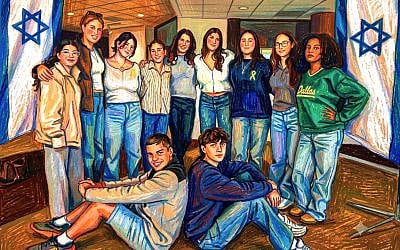
Since her first trip in the summer of 2024 (with Maman), Finn has organized seven more, ranging from 3-18 soldiers per trip. “What may surprise people is the amount of reservists in their 30’s, with families, that make up these delegations,” she intones. “Our goal was to show them a place free of conflict, where they could just exhale and breathe.”
I was fortunate to hear from the last delegation Finn brought over for Yom HaAztmaut. It was through the Jewish Agency’s “Shlichim in Uniform” program and was comprised of warriors currently serving as well as those recovering from injuries. Their stories were horrific and inspiring, filled with loss and determination, tragedy and honor, including several who have chosen to return to fight, even after recovering from near-life-ending wounds.
“We raised the funds [to bring them over] from local donors as well as subsidies from the Jewish Agency,” Finn recalls. “What made this last trip so special is we brought them all, in uniform, to L.A.-area schools. In the beginning it was about giving soldiers the space to heal. Now it’s evolved to trying to help them build careers after they leave the military. We collaborate with UCLA to have them meet professors in their fields of interests. So, once they get back home, they can enter the workforce with knowledge and preparation.”
Ido Benvenisti, Regional Director, Western US, for the Jewish Agency for Israel, recalls how Finn first opened her home and heart to the Shinshinim program. “Adinah truly embodied that term – ‘host mom’ – and by doing so, gained a huge extended family in Israel,” Benvenisti states. “She has championed our Shlichim B’madim program in L.A., bringing IDF soldiers to share their accounts from the war, and run activities about Israel to different audiences. She’s raised funds, planned the itinerary, oversaw every detail, and went above and beyond to make them feel at home.”
Finn, who calls herself simply “a connector,” has garnered pride in seeing members of her own L.A. community forge relationships with individual soldiers – bonds that continue long after they’ve boarded their El Al flight home. “Now, it’s not just, ‘oh, a bomb went off in Southern Israel,’” she explains. “It’s ‘a bomb went off near where Shalev lives in the South. I need to text Shalev and find out if he’s okay!’”
And given the many young Israelis Finn has brought to town, her own children can’t help but have been changed. “This last trip included a female soldier, [from Shlichim in Uniform],” Finn shares, “whose role is to create instructional videos. My youngest came up to me later and said that when she finished high school, she wanted to join the IDF. Seeing this female soldier made her realize that you didn’t have to only be in combat – there are many roles to serve in Israel’s military.”
For all that she’s done for Israel, Finn insists, “Israel has given back so much to me. The opportunity to do mitzvot, to help and connect so many people in need.” The timing, she says, was auspicious. “I was a stay-at-home mom for many years and was just waiting for something important enough to pull me back into the workforce. Then October 7th happened, and an Israeli boy, who I had been like a second mom to for a whole year, made me realize I could no longer just sit at home. This was my moment and I had to take it.”