Yaacov Agam: The artist who reread the 2nd commandment
Most accounts of 20th-century art begin with liberation. Painting escaped representation, sculpture escaped the pedestal, and eventually the artwork itself escaped stillness. The century was full of artists who wanted movement, participation, instability, and the active viewer. Kinetic art, Op Art, conceptual art: all, in different ways, challenged the notion that a work of art should present a single, complete image to a passive observer.
Yaacov Agam, who died on June 21, 2026, at 98, belonged unmistakably to that revolution. Yet he also stood apart from it.
His contemporaries often treated movement as a problem of perception: how the eye sees, how forms change, how vision itself can become unstable. Agam certainly shared those concerns. But movement was never merely optical for him. It was hermeneutic. His works do not simply move before the eye; they ask to be read again.
That difference is easy to miss because Agam’s biography seems, at first glance, to tell the opposite story. He was the son of a rabbi and kabbalist in Rishon LeZion, raised on the second commandment: “You shall not make for yourself a graven image, or any likeness.” For 70 years, he devoted himself to making images. The obvious interpretation is rebellion: the rabbi’s son who abandoned sacred texts for abstraction, words for color. But it is only the first reading.
Agam himself never described his work as a break with Judaism. He spoke naturally about Kabbalah, about time, multiplicity, and creation. His works carry Hebrew titles. More importantly, they embody one of the oldest habits of Jewish interpretation: the long conviction that a sacred text yields more than any single reading can hold.
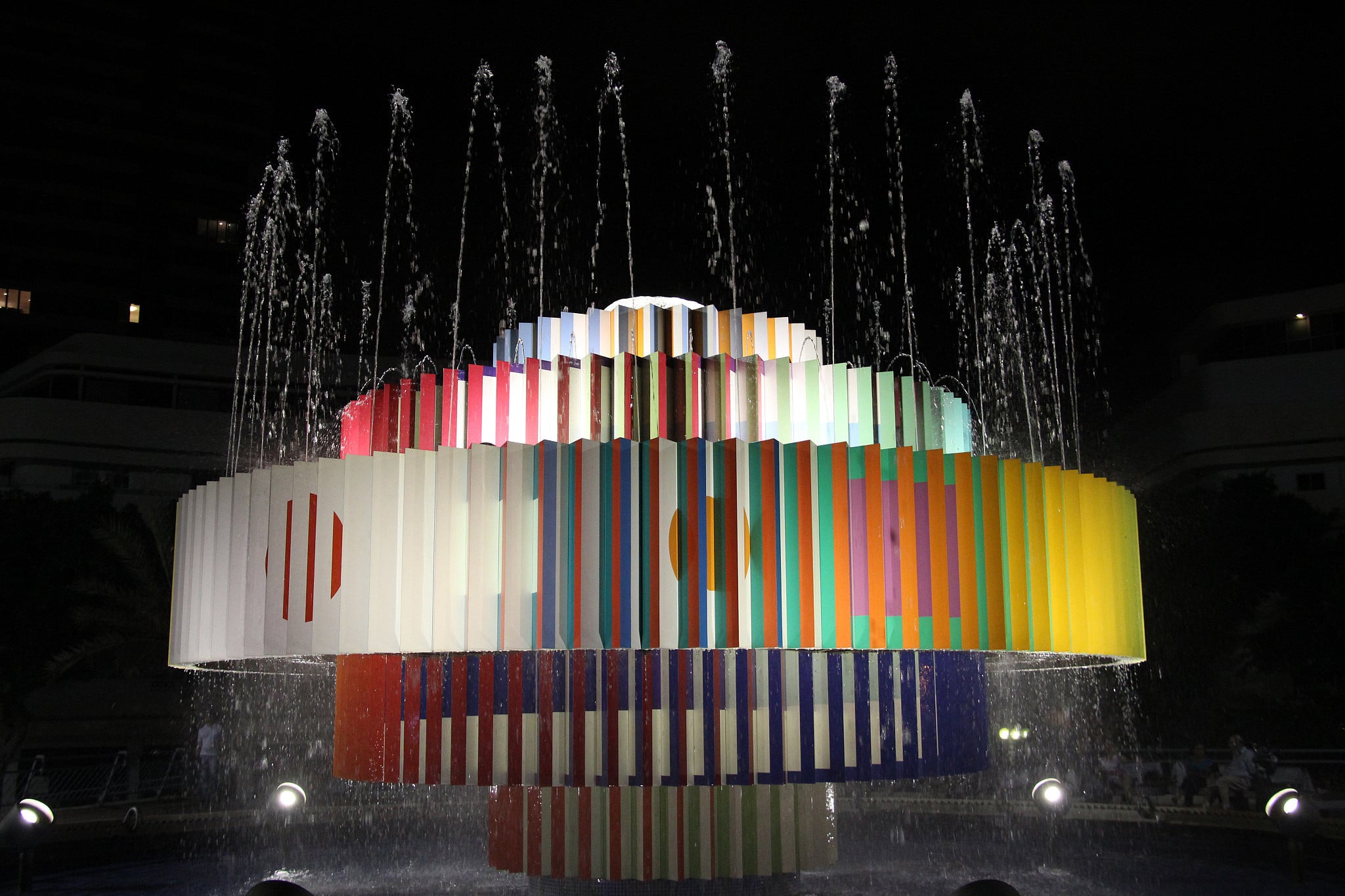
His Fire and Water Fountain, installed in Tel Aviv’s Dizengoff Square in 1986, demonstrates the principle more clearly than any manifesto could. It is tempting to call it a sculpture, but it behaves less like an object than like an event. Rows of layered elements, angled differently and painted on multiple sides, produce a different image from every position. Walk around it, or let its rings turn, and colors slide into new alignments. No viewpoint gathers the work into a final whole. Every perspective is genuine; none is complete.
This is different from the motion kinetic art is usually praised for. A Calder mobile moves through space; Op Art vibrates on the retina. The difference is not stillness against motion – his rings turn too – but that he composed what Calder leaves to the air. What shifts in Agam is not just appearance but the relation the work asks of you. The change is no longer merely physical. It becomes interpretive.
Seen this way, his lifelong dialogue with the second commandment begins to look less paradoxical. The commandment has often been understood as closing the door on images altogether. But that is not the only way it has been read. A longstanding tradition distinguishes between the image and the idol: what is forbidden is not representation itself but the claim that any finite object can contain the infinite, that one form can capture what exceeds all forms and demand worship in its place. The prohibition, on this reading, is directed not against images but against finality.
Agam did not invent that distinction. What he realized was that it could become an artistic principle. His works refuse precisely what idolatry demands: the fixed image that claims to reveal everything at once.
Perhaps nowhere is that clearer than in the Rainbow Torah, the extraordinary cover he designed in 1992 for a printed edition of the Five Books of Moses. Tilt the volume and the image changes. The very book containing the commandment against graven images carries a cover that cannot be reduced to a single appearance. The object itself performs interpretation.
It is fitting, then, that the Yaacov Agam Museum in Rishon Lezion cannot really be experienced from a single position either. Devoted entirely to his work, it must be walked through. Reliefs, polymorphs, and sculptures rearrange themselves as the visitor moves among them. The museum does not merely preserve Agam’s art; it extends its logic. It asks the viewer to do exactly what the works themselves require: keep moving.
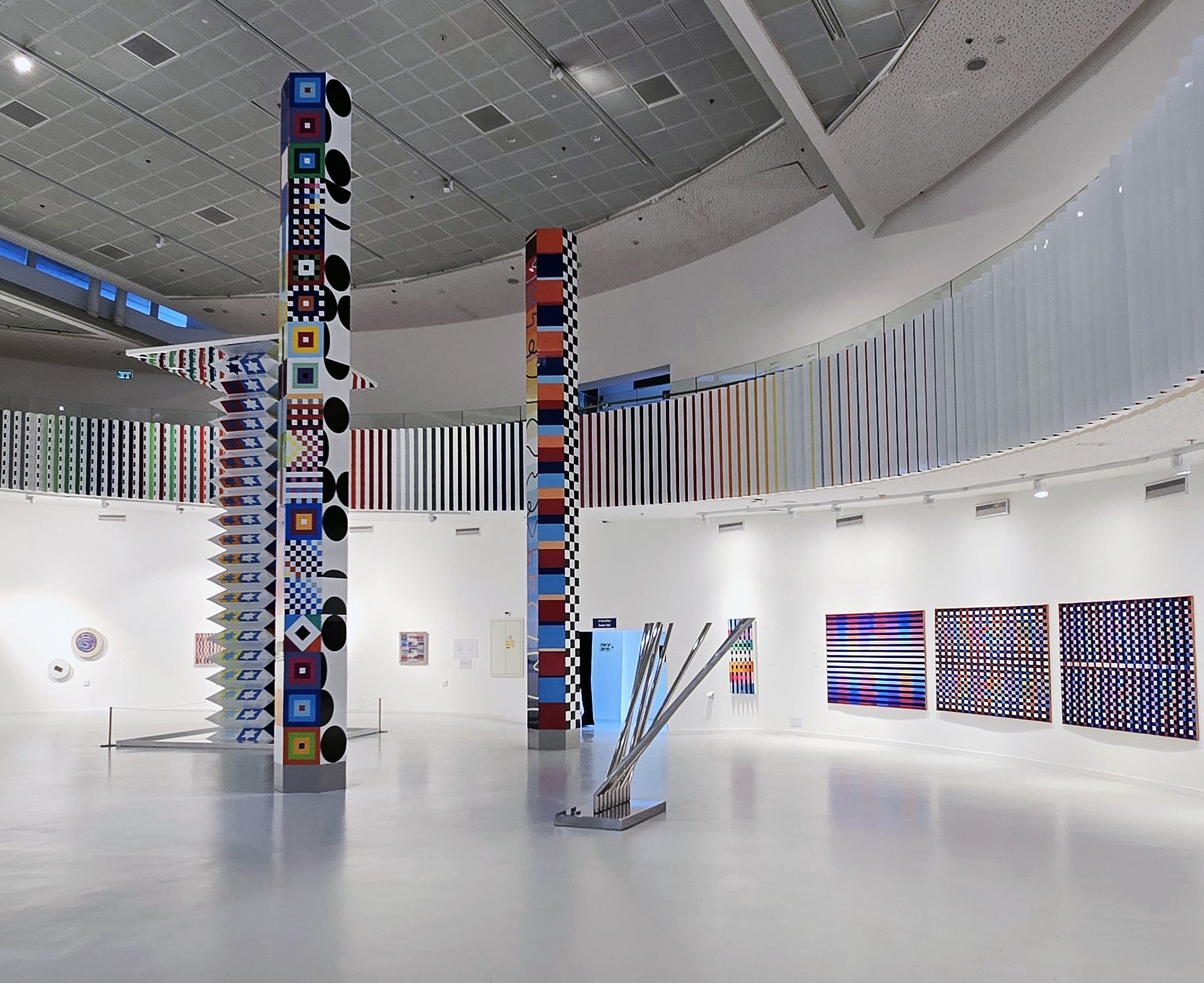
The point is not that every reading is equally valid. Quite the opposite. Jewish interpretation has always insisted that readings argue with one another, that some survive and others fail. Agam’s art achieves the same balance. His fountain never becomes a false object. Even as its rings turn and the water rises, nothing untrue appears before the eye. What changes is only the relationship between the viewer and something real that exceeds every individual perspective.
The object is held fixed. The reading is kept alive. That, perhaps, is Agam’s deepest artistic achievement.
We increasingly confuse certainty with strength. Public life rewards immediate judgments, fixed identities, and settled interpretations. At the same time, the fear of dogmatism often produces the opposite mistake, dismissing the idea of truth altogether because no reading is final. Agam accepted neither conclusion. His work proposes another possibility: that truth need not be frozen in order to remain true, and that fidelity sometimes consists not in refusing to look again, but in doing exactly that.
He did more than make kinetic art. He found a way to give one of Judaism’s oldest interpretive habits a visual form. He showed that rereading is not something we do only with sacred texts. Sometimes a painting demands it. Sometimes a sculpture demands it. And so, most of all, do the people and the texts we are most certain we have already read.