


Yelling in Public!

Letting it all Hang Out, Loud
This blog is in 2 parts: 1. Yelling in Public; 2. Blaring Your Own Horn
Yelling in Public!
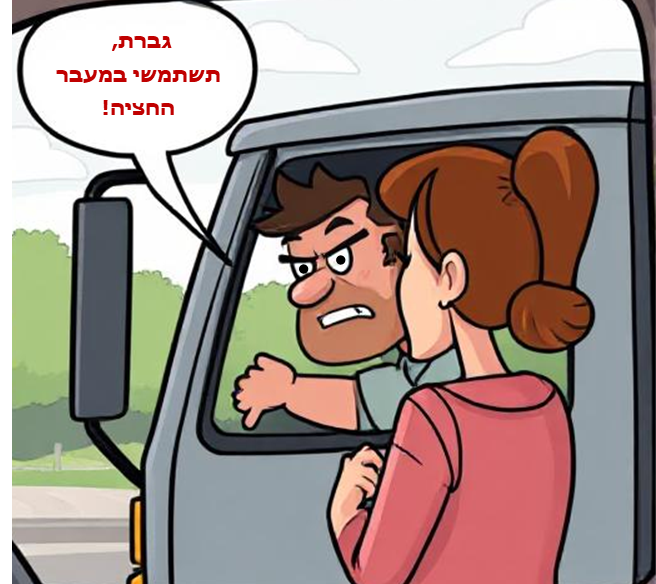
One pleasant morning a woman stands on the median strip of a busy street, 20 meters from the next intersection. A truck pulls over. Through his open window, the driver yells, “Lady, use the crosswalk!” As he drives on, the woman shakes her fist at him and yells back something I cannot catch. It is probably not, “Thank you for your concern, kind sir. Have a nice day!”
Seeing that the coast is clear, she crosses the street.
***
Israelis like to tell people what they think.
Years ago I knew an Israeli couple who had lived in the US for a long time. The husband retired, and they were headed home.
“I’m really happy to be going back to Israel,” said his wife.
“That’s great,” I said. “How come?”
“Because in Israel I don’t have to be polite,” she said. “I can say what I think.
“For instance,” she went on, “if I see a doctor and don’t like him, and I can tell him that I don’t like him and exactly why.”
Since I was her doctor at the time, I was glad we were both in the US.
***
Anyone can get impatient and upset. When Israelis do, they share their feelings with the world.
One afternoon on the bus, I heard a bang and a yell coming from the back. I guessed the driver had closed the rear door before a passenger got all the way in. The yell was followed by another yell, coming closer.
The driver pulled over and stopped the bus. He opened the Plexiglas barrier to his cab, came out, and faced the passengers. A slightly-built man with a fierce expression and tense posture, he yelled. “LO LITZ’OK!” “LO LITZ’OK!” NO YELLING!
That yell, of course, drew more yelling. “LO LITZ’OK!” yelled the passenger. They traded yells. The air filled with testosterone.

After a time the driver resumed his seat, perhaps concerned he would get too far behind schedule. The passenger must have sat down. We proceeded in silence.
Israelis often yell in public: at the post office, when a customer is unhappy with the service; on a street corner, when a passerby objects to an outdoor Friday night minyan; in grocery stores, in medical clinics. Yells are part of the aural landscape.
Watch a talk show on TV. See the guests scream over each other. Members of Knesset do the same. I am told that after trading lusty invective with each other, MK’s leave for the cafeteria together to have a cup of coffee and transact the actual business.
Public yelling looks easy but is actually hard for people who grew up in sedate places where public shouting is frowned upon. I will never be Israeli, but sometimes I like to try. One day I felt good about making some progress.
Before I could exit the rear door of a bus, the driver closed it in my face. I have seen that happen when, for instance, a pregnant woman tries to get down the stairs but sees the door slamming on her triple stroller. I did what I she did.
I banged on the door. “NAHAG!” I yelled, “YORDIM!” DRIVER—GETTING OUT!!
The door opened. I was pleased. Later, I realized that my reaction was not so much learned social behavior as a primal reflex, adrenaline-fueled, the kind that helped our remote ancestors survive an encounter with a charging mastodon.

Israeli yelling is not as fierce as it sounds. I ran into a young fellow from Moscow. “Dmitri,” I asked, “do Russians yell in public?”
“They do,” he said. “But when a Russian yells at you in the street, the best thing to do is to get away as fast as possible. After a yell, the next step could be a punch in the face.”
Israeli yelling does not result in violence. Often, it seems not to result in anything. Like a geyser, it splutters, sputters, subsides.
For instance, I once went to an urgent care center, to get urgent care. The receptionist was busy with a loud conversation. “Yes, you can see the doctor,” she said, “but you have to make an appointment! Do you understand?”
The other party apparently did not, so the receptionist said it again, louder. When I saw that this was going to go on for a while, I turned and chatted with another patient also seeking urgent care. Then I sensed a change in the receptionist’s voice.
When I turned around, her tones were softer. She was calling the person she had just been yelling at Mami and Neshama and Motek, sweetie, terms of gentle endearment, wishing her long life, good health, and pleasant holidays. Then she turned to my urgent concerns.
Israelis yell and move on. As a man who once fixed my flat said, Po ba’Aretz mamshichim, here in Israel, we proceed. I would add: Po ba’Aretz tzo’akim, v’az mamshichim. Here in Israel, we yell. Then we proceed. It’s what we do.
Well, not me personally. I lived for too long in quiet places where public yelling is not appreciated. All people there can do is swallow their wrath and plot revenge.
***
The second part of this blog will be called:
Blaring Your Your Own Horn
I do not own a car. As pedestrian or bus passenger, when I see a huge vehicle blocking both lanes, so everyone can see why nobody is going anywhere, and then the road erupts in cacophony of angry horns, it makes me want to….
Oh, right. I don’t do that. I am quiet. I am polite. I cross only in crosswalks.
Then I go home and write blogs.